Hongdae & Sinchon Arm Lift Surgery
in Seoul, Korea
Arm lift surgery is a procedure designed to remove excess skin and improve the contour of the upper arms.
Treatment may also include fat removal depending on skin laxity, fat distribution, and individual body goals.
Patients seeking
arm lift surgery in Hongdae or Sinchon should consider surgical technique, scarring, and recovery needs.
If you are concerned about loose or hanging upper-arm skin that does not improve sufficiently with weight loss or Liposuction, Arm Lift Surgery may be considered to create a firmer and smoother upper-arm contour. Also called brachioplasty, the procedure removes selected excess skin and may also include fat removal when necessary. It is particularly common after major weight loss, although wound healing and scar quality are important considerations.
Hongdae and Sinchon are convenient areas for Arm Lift Surgery consultations in Seoul, especially for international residents and travelers seeking body-contouring procedures.
What Is Arm Lift Surgery?
Arm Lift Surgery, or brachioplasty, is a surgical body-contouring procedure that removes redundant skin and selected soft tissue from the upper arms.
Depending on the patient's anatomy, treatment may involve:
- Skin excision
- Limited fat removal
- Arm Liposuction
- Extension into the armpit
- Treatment of excess tissue extending toward the lateral chest
Different incision designs are used according to the amount and location of loose tissue.
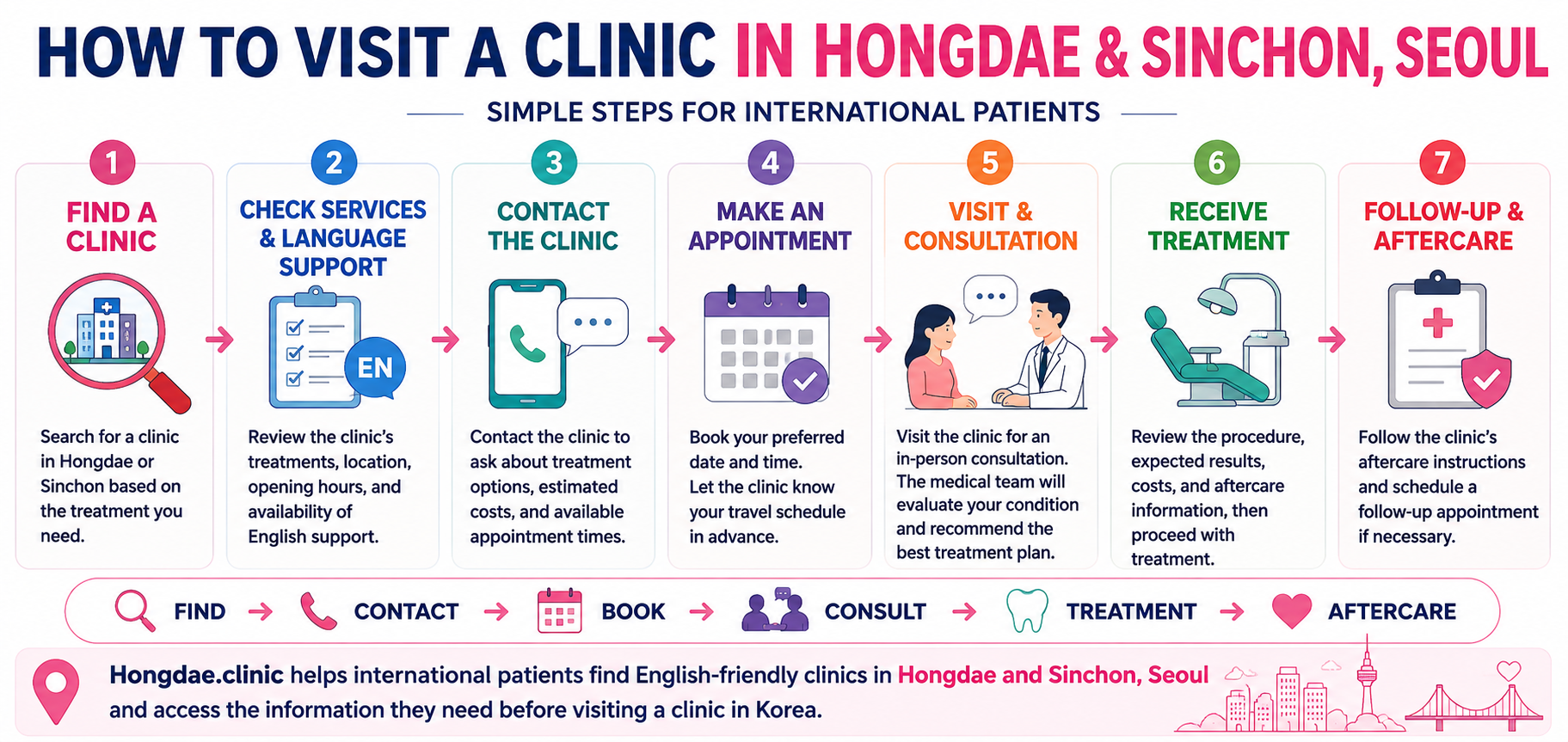
Consultation → arm and skin assessment → incision planning → excess tissue removal → contouring → closure → recovery → follow-up.
When Might You Consider an Arm Lift?
Arm Lift Surgery may be considered for:
- Significant upper-arm skin laxity
- Hanging or “bat-wing” skin
- Loose skin after major weight loss
- Age-related upper-arm sagging
- Excess skin that remains after Arm Liposuction
- Upper-arm contour asymmetry
- Skin redundancy extending toward the armpit
- Desire for improved arm contour despite accepting a longer scar
Brachioplasty is particularly useful when skin redundancy rather than fat alone is the main problem. Post-weight-loss clinical series have reported meaningful improvements in arm contour and high patient satisfaction despite the tradeoff of a visible scar.
What Can an Arm Lift Improve?
Loose Upper-Arm Skin
The main purpose of brachioplasty is to remove excessive skin that cannot be adequately corrected through Liposuction alone.
This is especially relevant after significant weight loss, when the skin may no longer contract around the reduced arm volume.
Upper-Arm Shape
By removing redundant tissue, the procedure can create a straighter and more proportionate contour from the armpit toward the elbow.
Axillary and Lateral Chest Tissue
For patients whose excess tissue extends beyond the upper arm, an extended technique may continue into the axilla or lateral chest. An L-shaped brachioplasty series described correction of excess tissue involving all three regions in post-weight-loss patients.
Arm Lift Surgery Process
A typical surgical process may include:
- Plastic surgery consultation
- Assessment of skin excess and remaining arm fat
- Evaluation of scar location and arm symmetry
- Customized incision marking
- Removal of excess skin and selected fat
- Liposuction when appropriate
- Layered closure and postoperative follow-up
The exact amount of skin removed should be planned carefully because excessive tension along the incision can contribute to wound separation and widened scars.
Arm Lift vs Arm Liposuction
These procedures address different anatomical concerns.
Arm Lift Surgery
- Removes loose skin
- Can reduce significant tissue redundancy
- Creates a longer scar
- May include Liposuction
Arm Liposuction
- Primarily removes subcutaneous fat
- Uses smaller access incisions
- Does not directly remove substantial loose skin
- Works best when skin elasticity is adequate
Patients with significant sagging may achieve inadequate correction from Liposuction alone, while patients with good skin elasticity and primarily excess fat may not need a full Arm Lift.
Can Liposuction Be Combined With an Arm Lift?
Yes.
Liposuction may be used to reduce excess fat and help shape the arm before or during skin excision.
In a registry study of 144 brachioplasty patients, 64 underwent concurrent arm Liposuction. The investigators did not find significant differences between combined Liposuction and excision alone for seroma, infection, hematoma, wound dehiscence, or lymphedema.
However, outcomes may differ in higher-risk populations. A more recent study of post-bariatric patients found that concomitant Liposuction was associated with greater wound dehiscence and longer healing in that specific cohort.
Where Is the Arm Lift Scar?
The scar depends on how much skin must be removed.
Common locations include:
- Inner upper arm
- Posteromedial arm
- Posterior arm
- Armpit for limited correction
- Extension toward the lateral chest for extensive laxity
The incision may extend from the axilla toward the elbow when substantial skin excess is present.
A recent 90-patient study comparing medial, posterior, and posteromedial approaches found differences in scar visibility, functional outcomes, and postoperative healing, illustrating why scar placement should be individualized.
Limited-Scar vs Full Arm Lift
A limited-incision Arm Lift may be appropriate when loose skin is mainly concentrated near the armpit.
A full brachioplasty is more appropriate when redundancy extends along much of the upper arm.
Choosing a shorter scar solely to avoid visibility may leave residual loose tissue when the deformity is extensive. The appropriate balance should be between adequate skin removal and acceptable scar length.
Can the Scar Widen or Become Raised?
Yes.
Possible scar concerns include:
- Widening
- Hypertrophic scarring
- Pigmentation
- Asymmetrical scars
- Scar migration
- Need for scar revision
In a 96-patient multipractice cohort, hypertrophic scarring occurred in 24% of patients and was one of the most common reasons for revision surgery.
Another 31-patient series reported a 16% revision rate, with most revisions involving relatively minor scar or contour correction.
Wound Dehiscence After Arm Lift
Wound dehiscence means partial separation of the surgical incision.
It can occur because of:
- Tension along the incision
- Reduced tissue blood supply
- Significant previous weight loss
- Smoking
- Larger combined operations
- Individual healing characteristics
A recent study of 31 post-bariatric brachioplasty patients reported wound dehiscence in 48.4%, although most cases were minor. Combined procedures were also associated with longer healing in that particular high-risk population.
This rate should not be assumed for all patients because complication rates vary greatly according to patient characteristics and surgical technique.
Seroma After Arm Lift
A seroma is a collection of fluid beneath the surgical tissues.
In a 144-patient study, seroma occurred in 19.1% of patients undergoing concurrent arm Liposuction and 23.1% undergoing excisional brachioplasty alone, without a statistically significant difference between groups.
Small seromas may resolve with monitoring, while larger collections may require aspiration or other treatment.
Can an Arm Lift Affect Lymphatic Drainage?
Lymphatic complications such as lymphedema or lymphocele are possible but are not inevitable.
A prospective study of 12 women after major weight loss evaluated lymphatic drainage before and after brachioplasty using indocyanine green lymphography. All patients maintained normal linear lymphatic patterns during the 12-month follow-up.
In the larger 144-patient registry study, lymphedema occurred in 3.2% of patients receiving Liposuction plus brachioplasty and 1.3% of those receiving excision alone.
Numbness and Nerve Injury
Temporary numbness around the upper arm can occur after brachioplasty.
A particularly important structure is the medial antebrachial cutaneous nerve, which provides sensation to part of the medial forearm.
A long-term study of 40 bilateral brachioplasties reported injury to this nerve in two patients. Cadaveric dissection in the same study demonstrated that the nerve can lie within the operative plane used during standard brachioplasty.
Rare nerve injuries can cause persistent numbness, tingling, or neuropathic pain.
Can Arm Lift Surgery Look Natural?
Yes.
Natural-looking results generally depend on:
- Removing enough loose skin without excessive tension
- Maintaining smooth arm circumference
- Avoiding over-resection
- Appropriate Liposuction when needed
- Balanced left-right contour
- Careful scar positioning
A post-weight-loss clinical series reported average patient satisfaction of 4.3 out of 5 for overall outcome and contour improvement, although scar appearance received a lower average score of 3.9 out of 5.
The main aesthetic tradeoff is therefore often improved contour in exchange for a visible scar.
When Do Results Appear?
The reduction in loose skin is immediately visible, but early appearance is affected by:
- Swelling
- Bruising
- Incision tightness
- Temporary asymmetry
- Scar redness
The arms gradually become more natural as swelling decreases and scars mature.
Scar maturation takes considerably longer than the initial recovery period, so early red or firm scars should not be considered the final appearance.
What Is Recovery Like?
Temporary postoperative effects may include:
- Upper-arm swelling
- Bruising
- Tightness
- Incision discomfort
- Temporary numbness
- Limited comfortable arm movement
- Temporary asymmetry
- Scar redness
Heavy lifting and activities that place excessive tension on the incision may be restricted during early healing according to the surgeon's protocol.
Post-weight-loss patients can experience delayed healing more frequently, particularly when several body-contouring procedures are combined.
Possible Risks and Complications
Potential complications include:
- Wound dehiscence
- Delayed healing
- Hypertrophic or widened scars
- Seroma
- Hematoma
- Infection
- Temporary or persistent numbness
- Nerve injury
- Lymphedema or lymphocele
- Asymmetry
- Residual loose skin
- Need for revision surgery
In a large prospective multicenter database of 2,294 brachioplasty patients, major complications occurred in 3.4%. Infection occurred in 1.7% and hematoma in 1.1%. Combined procedures, male sex, and BMI of 30 kg/m² or greater were identified as independent risk factors for major complications.
Does Combining Other Surgeries Increase Risk?
It can.
In the 2,294-patient multicenter study, brachioplasty performed alone had a 1.3% major-complication rate, compared with 4.4% when it was combined with other procedures.
However, risk depends on the specific combination, procedure length, health status, and patient population. Another prospective registry focusing on massive-weight-loss patients found that combined procedures did not necessarily increase arm-specific complications in the same way.
This is why combined body-contouring surgery should be planned individually.
Arm Lift After Major Weight Loss
Brachioplasty is particularly common after bariatric surgery or substantial nonsurgical weight loss.
These patients may have:
- Significant skin redundancy
- Thin or altered skin quality
- Long areas requiring excision
- Nutritional considerations
- Multiple body regions requiring contouring
Clinical studies show that post-weight-loss brachioplasty can produce high satisfaction but may also have relatively high rates of minor wound problems, poor scarring, and revision.
Revision Arm Lift Surgery
Revision may be considered for:
- Widened scars
- Hypertrophic scars
- Residual loose skin
- Contour irregularity
- Asymmetry
- Recurrent sagging
In a 96-patient cohort, the revision rate was 22.9%, with residual contour deformity and hypertrophic scarring representing the most common reasons for secondary surgery.
A separate long-term 40-patient study reported a 12.5% revision rate.
Arm Lift Surgery for International Patients
When contacting a plastic surgery clinic, consider asking:
- Is English consultation available?
- Do I need an Arm Lift or Arm Liposuction?
- How long will my scar be?
- Where will the scar be positioned?
- Will Liposuction be performed at the same time?
- What is my risk of wound separation or poor scarring?
- How will sensory nerves and lymphatic structures be protected?
- When can I comfortably raise and use my arms?
- How long should I stay in Korea?
- Is postoperative follow-up included?
If you have previously undergone Arm Liposuction, bariatric surgery, breast surgery, lymph-node surgery, or previous brachioplasty, tell the surgeon because prior treatment can influence anatomy and surgical planning.
Choosing an Arm Lift Clinic in Hongdae or Sinchon
Consider:
- Qualified plastic surgeon
- Experience with Brachioplasty
- Detailed skin and fat assessment
- Customized scar-placement planning
- Careful nerve anatomy management
- Assessment of lymphatic and wound-healing risks
- Experience with post-weight-loss patients
- Clear revision and scar-management policy
- English communication
- Transparent surgery costs
Clinical studies show that Arm Lift outcomes depend heavily on patient selection, incision design, wound tension, scar management, and whether other procedures are performed simultaneously.
Hongdae & Sinchon Medical Care
Hongdae is convenient for patients around:
Hongik University · Yeonnam-dong · Hapjeong · Sangsu · Mapo
Sinchon is convenient for patients around:
Yonsei University · Ewha Womans University · Seodaemun · Mapo
Common searches include:
- Arm Lift Surgery Hongdae
- Brachioplasty Hongdae
- Upper Arm Skin Removal Hongdae
- Arm Lift Surgery Sinchon
- Brachioplasty Sinchon
- English speaking plastic surgery clinic Sinchon
Frequently Asked Questions
What is Arm Lift Surgery?
Arm Lift Surgery, or brachioplasty, removes selected excess upper-arm skin and soft tissue to improve sagging and arm contour. It may also be combined with Liposuction when appropriate.
Is an Arm Lift the same as Arm Liposuction?
No. Arm Liposuction primarily removes fat, while an Arm Lift directly removes loose skin and therefore requires a longer incision.
Does an Arm Lift leave a long scar?
It can. Significant skin redundancy may require an incision extending from the armpit toward the elbow, although shorter approaches can be used for limited laxity. Scar position depends on the surgical technique and amount of tissue requiring removal.
Can an Arm Lift cause numbness?
Yes. Temporary sensory changes are possible, and injury to the medial antebrachial cutaneous nerve has been documented after brachioplasty.
Can foreigners get Arm Lift Surgery in Seoul?
Yes. International patients can contact plastic surgery clinics in Seoul regarding skin and fat assessment, scar planning, Liposuction combination, recovery, postoperative monitoring, and English-language support.