Hongdae & Sinchon Breast Lift
in Seoul, Korea
Breast lift is a surgical procedure designed to raise and reshape sagging breasts for a firmer, more balanced appearance.
Treatment may involve removing excess skin and repositioning breast tissue and the nipple based on individual anatomy.
Patients seeking
breast lift in Hongdae or Sinchon should consider surgical technique, scarring, and recovery needs.
If you are concerned about sagging breasts, downward-pointing nipples, loose breast skin, or loss of breast shape after pregnancy, weight changes, or aging, a breast lift may be considered. Also called mastopexy, the procedure reshapes and elevates breast tissue while repositioning the nipple-areola complex when necessary.
Hongdae and Sinchon are convenient areas for breast lift consultations in Seoul, especially for international residents, students, and travelers.
What Is a Breast Lift?
Breast Lift Surgery, or mastopexy, is designed to improve breast position and shape by removing selected excess skin and reshaping the breast tissue.
The procedure can reposition a low nipple-areola complex and tighten the surrounding skin envelope. Mastopexy techniques include periareolar, vertical, and Wise-pattern approaches, with the choice depending on breast anatomy and the amount of lifting required.
Consultation → breast assessment → surgical planning → breast reshaping and lifting → recovery → follow-up.
When Might You Consider a Breast Lift?
A breast lift may be considered for:
- Sagging or drooping breasts
- Downward-pointing nipples
- Low nipple position
- Loose breast skin
- Loss of shape after pregnancy
- Changes following significant weight loss
- Breast asymmetry
- Enlarged or stretched areolas
- Desire for a firmer and more elevated breast contour
Mastopexy primarily addresses the skin envelope, breast position, and breast shape rather than simply increasing breast volume.
What Can a Breast Lift Change?
Breast Position
A breast lift can elevate sagging breast tissue and improve the relationship between the breast and chest wall.
Nipple Position
The nipple-areola complex can be repositioned to a higher location while maintaining its blood supply through a tissue pedicle.
Breast Shape
Excess skin is removed and the remaining tissue is reshaped to create a more compact breast contour.
The amount of achievable change depends on breast volume, skin quality, nipple position, tissue distribution, and the degree of ptosis.
Breast Lift Surgery Process
A typical surgical process may include:
- Plastic surgery consultation
- Breast and chest measurements
- Assessment of breast ptosis and nipple position
- Selection of incision pattern
- Removal of selected excess skin
- Breast reshaping and nipple repositioning
- Postoperative follow-up
Different combinations of skin patterns and tissue pedicles can be used, so the operation should be customized rather than based on one standard design.
Common Breast Lift Incision Patterns
Periareolar Lift
The incision is positioned around the border of the areola.
This approach is generally considered for more limited lifting and produces a scar concentrated around the areola.
Vertical or Lollipop Lift
The incision runs around the areola and vertically down toward the breast fold.
Vertical mastopexy allows broader reshaping while avoiding the full horizontal scar used in an anchor pattern.
Wise-Pattern or Anchor Lift
This technique typically includes scars around the areola, vertically downward, and along the inframammary fold.
It may be used when more substantial skin removal and reshaping are required.
Breast Lift vs Breast Augmentation
Breast lift surgery primarily raises and reshapes the breasts, while breast augmentation adds volume using implants.
A lift alone does not create the same increase in upper-breast volume that an implant can provide. Recent quantitative review data found that implants provide substantially greater increases in breast and upper-pole projection than tissue reshaping alone.
Patients who want both lifting and increased volume may consider augmentation mastopexy.
Breast Lift With Implants
A breast lift can sometimes be combined with breast augmentation during the same operation.
This may be considered when a patient has both:
- Breast sagging
- Loss of breast volume
- Reduced upper-pole fullness
- Desire for increased breast size
A systematic review of 4,856 simultaneous augmentation-mastopexy cases reported a pooled complication rate of 13.1% and reoperation rate of 10.7%, although results varied substantially between studies and techniques.
Careful patient selection and surgical planning are particularly important when lifting and augmentation are performed together.
Breast Lift vs Breast Reduction
Breast lift surgery focuses primarily on breast position and shape, while breast reduction removes a larger amount of breast tissue to decrease breast volume and weight.
Both procedures may:
- Remove excess skin
- Reposition the nipples
- Reduce areola size
- Reshape the breasts
Patients with large and heavy breasts who also want significant volume reduction may be better suited to reduction mammaplasty, while those satisfied with their general breast volume may consider mastopexy alone.
Can a Breast Lift Reduce Areola Size?
Yes.
If the areolas have become stretched or enlarged, their diameter can often be reduced during breast lift surgery.
The new areola size should be planned according to the new breast proportions and degree of skin tension, rather than attempting to make the areola as small as possible.
Can a Breast Lift Correct Asymmetry?
Yes, selected breast asymmetry can be improved.
The surgeon may adjust:
- Breast shape
- Nipple height
- Areola diameter
- Skin removal
- Tissue distribution
However, perfect symmetry cannot be guaranteed, particularly when there are pre-existing differences in breast volume, chest-wall shape, or nipple position.
Does a Breast Lift Add Upper-Pole Fullness?
A breast lift can improve overall breast shape, but it does not add new breast volume.
A recent review comparing objective breast measurements found that vertical mammaplasty techniques can improve projection, but an implant produces a larger increase in upper-pole fullness when substantial volume enhancement is desired.
For this reason, patients seeking both lifting and significant upper-breast fullness may discuss augmentation mastopexy.
Can Breasts Sag Again After a Lift?
Yes.
Breast lift surgery reshapes existing tissues, but the breasts continue to respond to:
- Aging
- Gravity
- Pregnancy
- Weight fluctuations
- Skin elasticity
- Breast volume
Recurrent ptosis is a recognized reason for revision following mastopexy, particularly when breast lifting is combined with implants.
Maintaining a relatively stable weight can help preserve the postoperative contour, but permanent prevention of future sagging cannot be guaranteed.
Does Breast Lift Surgery Leave Scars?
Yes.
All surgical breast lifts produce permanent scars, although their location depends on the technique.
Possible scars include:
- Around the areola
- Around the areola plus a vertical scar
- Around the areola, vertically downward, and along the breast fold
Poor or widened scarring is a recognized complication of mastopexy and augmentation-mastopexy.
Scars generally mature over time, but individual scar quality varies.
When Do Results Appear?
Breast elevation is visible immediately after surgery, although the early shape may be affected by:
- Swelling
- Tissue tightness
- High initial breast position
- Temporary asymmetry
- Incision healing
The breasts gradually settle as postoperative swelling decreases and tissues adapt.
Long-term results should be evaluated after adequate healing because breast shape and tissue position continue to change after surgery.
What Is Recovery Like?
Temporary postoperative symptoms may include:
- Swelling
- Bruising
- Breast soreness
- Tightness
- Temporary numbness
- Changes in nipple sensation
- Incision redness
- Temporary asymmetry
Patients may be advised to wear a supportive postoperative bra and temporarily avoid heavy lifting or strenuous exercise.
Recovery depends on the degree of lifting, incision pattern, additional procedures, and individual healing.
Possible Risks and Complications
Potential complications may include:
- Bleeding or hematoma
- Infection
- Seroma
- Delayed wound healing
- Wound separation
- Visible or widened scars
- Breast asymmetry
- Changes in nipple sensation
- Recurrent breast sagging
- Changes in nipple or areola position
- Partial compromise of nipple or skin blood supply
- Need for revision surgery
Clinical studies of cosmetic breast procedures identify hematoma, infection, poor scarring, recurrent ptosis, and reoperation among important possible complications.
Breast Lift After Previous Breast Implants
A breast lift may be considered for patients whose breasts have sagged after previous augmentation.
However, secondary mastopexy can be more complex because previous implants and surgery may cause:
- Scar tissue
- Tissue thinning
- Changes in implant pocket
- Reduced skin elasticity
- Altered breast blood supply
Published surgical literature emphasizes careful planning because previously augmented breasts can have greater risks of tissue or nipple blood-supply complications during secondary lifting.
Can a Breast Lift Look Natural?
Yes. Natural-looking mastopexy depends on balancing:
- Breast height
- Breast projection
- Nipple position
- Areola size
- Breast width
- Existing volume
- Overall body proportions
The goal should generally be to create a proportionate and elevated breast shape, rather than placing the breasts or nipples as high as technically possible.
Recent meta-analysis data indicate generally favorable safety and patient-satisfaction outcomes after appropriately planned mastopexy, while emphasizing realistic preoperative expectations.
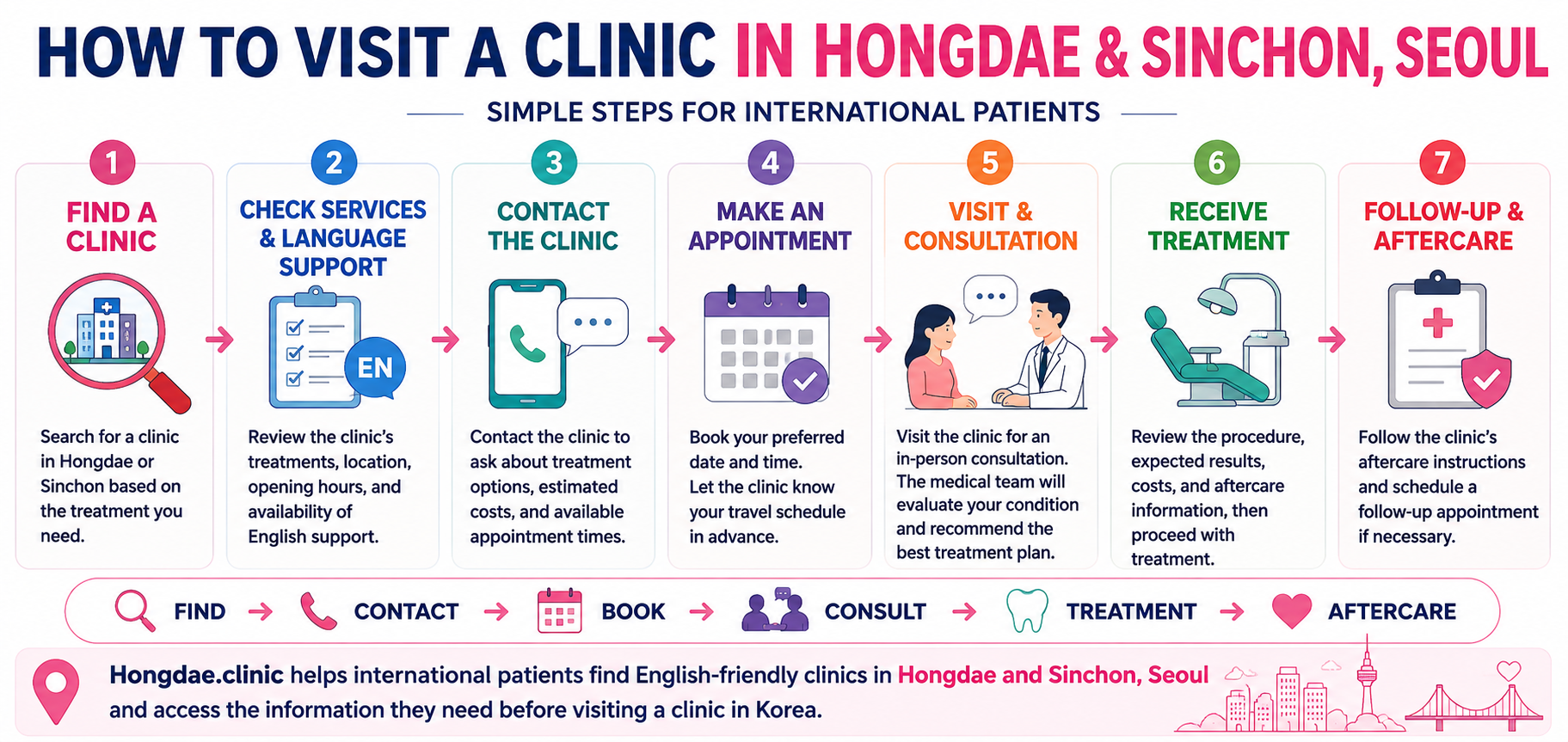
Breast Lift for International Patients
When contacting a plastic surgery clinic, consider asking:
- Is English consultation available?
- What degree of breast sagging do I have?
- Which incision pattern is recommended?
- Where will my nipples be repositioned?
- Will my areolas also be reduced?
- Do I need implants for additional volume?
- Where will the scars be located?
- What downtime should I expect?
- How long should I stay in Korea?
- Is postoperative follow-up included?
If you have previously undergone breast augmentation, breast reduction, mastopexy, or other breast surgery, tell the surgeon because previous scars and alterations in blood supply can affect surgical planning.
Choosing a Breast Lift Clinic in Hongdae or Sinchon
Consider:
- Qualified plastic surgeon
- Experience with mastopexy
- Detailed breast and nipple assessment
- Multiple incision-pattern options
- Customized breast reshaping
- Attention to nipple blood supply
- Experience with augmentation-mastopexy when needed
- Clear discussion of scars and recurrence
- English communication
- Transparent surgery costs
Because breast size, ptosis, skin quality, and nipple position vary between patients, mastopexy should be individually designed rather than performed with one standardized technique.
Hongdae & Sinchon Medical Care
Hongdae is convenient for patients around:
Hongik University · Yeonnam-dong · Hapjeong · Sangsu · Mapo
Sinchon is convenient for patients around:
Yonsei University · Ewha Womans University · Seodaemun · Mapo
Common searches include:
- Breast Lift Hongdae
- Mastopexy Hongdae
- Sagging Breast Surgery Hongdae
- Breast Lift Sinchon
- Breast Lift with Implants Sinchon
- English speaking plastic surgery clinic Sinchon
Frequently Asked Questions
What is Breast Lift Surgery?
A breast lift, or mastopexy, removes selected excess skin and reshapes breast tissue to create a higher and more compact breast contour.
Does a Breast Lift make the breasts bigger?
Not by itself. A breast lift primarily changes shape and position rather than adding volume. An implant may be combined with mastopexy when additional fullness or size is desired.
Will a Breast Lift leave scars?
Yes. Scar patterns vary from around the areola to vertical or anchor-shaped scars, depending on the degree of correction required.
Can breasts sag again after a lift?
Yes. Aging, pregnancy, weight changes, tissue characteristics, and gravity can contribute to recurrent sagging. Recurrent ptosis is a recognized reason for revision after mastopexy.
Can foreigners get Breast Lift Surgery in Seoul?
Yes. International patients can contact plastic surgery clinics in Seoul regarding consultation, surgical planning, recovery, postoperative follow-up, and English-language support.