Hongdae & Sinchon Brow Bone Reduction
in Seoul, Korea
Brow bone reduction is a surgical procedure designed to reduce prominent brow bones and create a smoother, more balanced forehead contour. Treatment involves reshaping the underlying bone based on individual facial structure and aesthetic goals.
Patients seeking
brow bone reduction in Hongdae or Sinchon should consider surgical technique, facial proportions, and recovery needs.
If you are concerned about prominent brow bones, a heavy supraorbital ridge, frontal bossing, or a strong upper-face profile, Brow Bone Reduction may be considered to create a smoother forehead and brow contour. Depending on the underlying anatomy, treatment may involve bone burring alone or reconstruction and setback of the anterior wall of the frontal sinus.
Hongdae and Sinchon are convenient areas for Brow Bone Reduction consultations in Seoul, especially for international residents, students, and travelers seeking facial bone contouring procedures.
What Is Brow Bone Reduction?
Brow Bone Reduction is a facial bone contouring procedure that decreases excessive projection of the bone above the eyes, particularly around the supraorbital ridges and glabella.
The operation may range from relatively limited bone shaving to a more extensive frontal sinus anterior-table osteotomy and setback. The appropriate technique depends heavily on the thickness of the frontal bone and the size and position of the frontal sinus.
Consultation → CT assessment → forehead and frontal sinus planning → bone reduction or setback → contour smoothing → fixation when required → recovery → follow-up.
When Might You Consider Brow Bone Reduction?
Brow Bone Reduction may be considered for:
- Prominent brow ridges
- Strong frontal bossing
- Heavy-looking upper orbital area
- Excessive projection between the eyebrows
- Desire for a smoother forehead profile
- Asymmetrical brow bone projection
- Upper-face feminization
- Brow bone concerns combined with forehead or hairline surgery
Modern clinical studies show that frontal bone contouring can produce measurable reductions in forehead projection and bossing when appropriately planned.
What Part of the Bone Is Reduced?
Supraorbital Ridges
The supraorbital ridges are the bony prominences above the eye sockets.
These areas may be selectively contoured to reduce a heavy brow appearance while maintaining appropriate protection and shape around the orbit.
Glabella
The glabella is the central region between the eyebrows.
When this area projects strongly, reduction may create a smoother transition between the forehead and nasal bridge.
Frontal Bone
More extensive frontal bossing may involve the bone overlying the frontal sinus, where simple shaving may not provide enough reduction.
Brow Bone Reduction Surgery Process
A typical surgical process may include:
- Plastic or craniofacial surgery consultation
- CT evaluation of the forehead and frontal sinus
- Assessment of brow ridge and orbital projection
- Customized bone-reduction planning
- Burring or frontal sinus anterior-table setback
- Bone fixation and contour smoothing when required
- Postoperative follow-up
Preoperative imaging is particularly important because frontal sinus anatomy varies substantially between individuals. A clinical series involving 23 patients emphasized precise mapping of the frontal sinus boundary before forehead contouring.
Bone Shaving vs Frontal Sinus Setback
The two approaches are not interchangeable.
Bone Shaving or Burring
When the frontal bone is sufficiently thick and the sinus is shallow or absent, selected areas may be reduced with surgical burring.
This approach avoids removing the frontal sinus wall but is limited by the amount of bone safely available for reduction.
Frontal Sinus Setback
When prominent brow projection is created by a thin anterior wall covering a deeper frontal sinus, greater reduction may require removal of the anterior sinus table, reshaping it, and repositioning it farther back.
The reconstructed bone may then be stabilized with plates, screws, mesh, or another fixation strategy depending on the technique.
Why Is CT Imaging Important?
CT imaging helps determine:
- Frontal sinus size
- Frontal sinus depth
- Anterior-table thickness
- Brow ridge projection
- Left-right asymmetry
- Safe bone-reduction boundaries
An anatomical CT study of 50 patients demonstrated substantial variation in frontal sinus dimensions and anterior-wall thickness, supporting individualized imaging before frontal setback procedures.
Can 3D Surgical Planning Be Used?
Yes.
Virtual surgical planning can help surgeons determine the intended forehead contour and understand the relationship between bone reduction and the frontal sinus.
In a comparative clinical study, virtual planning for frontal sinus setback was associated with greater operative accuracy and fewer unintended intracranial entries compared with conventional planning in the studied patients.
Brow Bone Reduction vs Forehead Reduction
These procedures are different.
Brow Bone Reduction
- Reduces skeletal brow prominence
- Changes supraorbital projection
- May involve the frontal sinus
Forehead Reduction or Hairline Lowering
- Shortens the visible forehead
- Advances the hairline
- Primarily changes forehead height rather than brow-bone projection
The procedures may sometimes be combined, but one does not automatically replace the other.
Brow Bone Reduction vs Brow Lift
A Brow Lift repositions soft tissue and eyebrow position, while Brow Bone Reduction changes the underlying bone.
Patients may have:
- Prominent brow bone without brow drooping
- Brow ptosis without excessive bone projection
- Both concerns together
Some forehead-contouring procedures have combined brow lifting and frontal bone reduction when both skeletal prominence and eyebrow position required correction.
Brow Bone Reduction vs Orbital Contouring
Brow Bone Reduction focuses primarily on frontal and supraorbital projection.
Orbital contouring may additionally reshape portions of the bone around the eye socket to alter orbital shape and transition into the forehead.
The two procedures are frequently discussed together in upper-face contouring because the brow ridge and orbital rims form a continuous skeletal region.
Can Brow Bone Reduction Change the Facial Profile?
Yes.
Reducing frontal bossing can soften the transition between the forehead, brow ridge, and nose.
A quantitative CT study of 22 patients who underwent frontal sinus setback, forehead contouring, and suprabrow contouring demonstrated significant reductions in forehead volume and measured bossing after surgery.
The amount of visible change depends on the original bone shape and the reduction that can be performed safely.
Can Brow Bone Reduction Correct Asymmetry?
Selected skeletal asymmetry may be improved.
Planning can account for differences in:
- Brow-ridge projection
- Frontal sinus anatomy
- Orbital rim shape
- Forehead curvature
- Eyebrow position
However, perfect symmetry cannot be guaranteed, because the frontal sinuses and facial bones are naturally asymmetric in many people.
Does Brow Bone Reduction Leave a Scar?
Yes, although scar location depends on the approach.
Incisions may be placed:
- Within the scalp
- Along the hairline
- Through a pretrichial incision
The chosen approach may also depend on whether the patient wants hairline advancement or brow lifting at the same time.
Scar visibility varies according to hair density, skin characteristics, wound tension, and individual healing.
Can Brow Bone Reduction Cause Numbness?
Yes.
Temporary altered sensation may occur around the forehead or scalp because sensory nerves travel through the surgical region.
Careful treatment around the supraorbital area is important because the supraorbital neurovascular structures exit near the brow ridge.
Persistent sensory changes are possible after any extensive forehead operation, although severity varies between patients.
What Happens to the Frontal Sinus?
Not every Brow Bone Reduction enters the frontal sinus.
When frontal sinus setback is required, the anterior wall may be temporarily removed, reshaped, repositioned, and secured while maintaining appropriate management of the sinus.
A retrospective study with follow-up extending as long as eight years did not detect worse long-term sinus or headache scores in patients whose frontal sinus mucosa had been violated compared with patients whose sinus was preserved.
However, sinus-related complications remain possible.
Possible Frontal Sinus Complications
Rare complications can include:
- Frontal sinusitis
- Mucocele-related problems
- Infection
- Bone infection
- Sinus drainage problems
- Forehead contour deformity
A published clinical case described frontal osteomyelitis, sinusitis, and forehead deformity after type III frontal bone contouring, demonstrating that significant sinus complications, although uncommon, can occur.
A separate case has also documented a delayed sinocutaneous fistula after forehead contouring.
Bone Fixation After Frontal Sinus Setback
When the anterior frontal sinus wall is repositioned, stable fixation may be required.
A retrospective study of 483 frontal bone cranioplasty patients found no clinical signs of bone-flap mobility when conservative fixation strategies were used in the studied population.
Another 43-patient cohort using titanium mesh or burring reported no infection, hardware extrusion, mucocele formation, or forehead revision during the available follow-up.
The fixation method should be selected according to the surgical reconstruction.
Can Brow Bone Reduction Create an Uneven Forehead?
Yes.
Potential contour problems include:
- Visible irregularity
- Asymmetrical bone reduction
- Residual bossing
- Excessive flattening
- Palpable edges
- Forehead depression
Accurate assessment of the frontal sinus boundary can help reduce the possibility of postoperative surface irregularity.
The goal should be a smooth transition rather than aggressive bone removal.
Can Too Much Brow Bone Be Removed?
Yes.
Excessive reduction can potentially create:
- Unnatural forehead flattening
- Excessive orbital exposure
- Contour depressions
- Structural reconstruction problems
- Difficulty with revision surgery
The safe amount of reduction depends partly on frontal sinus depth and anterior-table thickness, which can differ considerably between patients.
When Do Results Appear?
The skeletal contour changes during surgery, but early appearance can be affected by:
- Forehead swelling
- Bruising
- Scalp tightness
- Temporary asymmetry
- Incision redness
As swelling decreases, the new relationship between the forehead, brow ridge, and orbital region becomes easier to evaluate.
Bone and soft tissues continue to heal beyond the early postoperative period.
What Is Recovery Like?
Temporary postoperative symptoms may include:
- Forehead swelling
- Bruising
- Scalp tightness
- Tenderness
- Temporary numbness
- Temporary asymmetry
- Incision discomfort
Recovery depends strongly on whether treatment involves limited burring or full frontal sinus reconstruction, as well as whether hairline advancement, brow lifting, rhinoplasty, or other facial procedures are performed simultaneously.
Possible Risks and Complications
Potential complications may include:
- Bleeding or hematoma
- Infection
- Temporary or persistent numbness
- Visible scarring
- Hair loss around the incision
- Facial asymmetry
- Forehead contour irregularities
- Hardware-related problems
- Frontal sinus complications
- Bone-healing problems
- Under-correction or overcorrection
- Need for revision surgery
Because frontal sinus reconstruction is more extensive than simple bone burring, patients should understand exactly which technique is planned before surgery.
Revision Brow Bone Reduction
Revision surgery may be considered for:
- Residual brow bossing
- Asymmetry
- Insufficient reduction
- Excessive reduction
- Forehead irregularity
- Hardware concerns
- Previous frontal sinus complications
Revision surgery can be more difficult because previous treatment may alter bone thickness, frontal sinus anatomy, fixation hardware, scar tissue, and scalp tissues.
A recent clinical series examining upper-face revision cases found that insufficient brow-bone reduction and inadequate anterior frontal sinus setback were important reasons patients sought secondary treatment.
Can Brow Bone Reduction Look Natural?
Yes.
Natural-looking results generally depend on balancing:
- Brow-ridge projection
- Forehead curvature
- Orbital contour
- Nasal-root transition
- Hairline
- Eyebrow position
- Overall facial proportions
The goal should be a smooth, anatomically appropriate forehead contour, rather than removing as much bone as possible.
Quantitative postoperative imaging has demonstrated that carefully planned forehead contouring can produce measurable skeletal changes while improving patient-reported satisfaction.
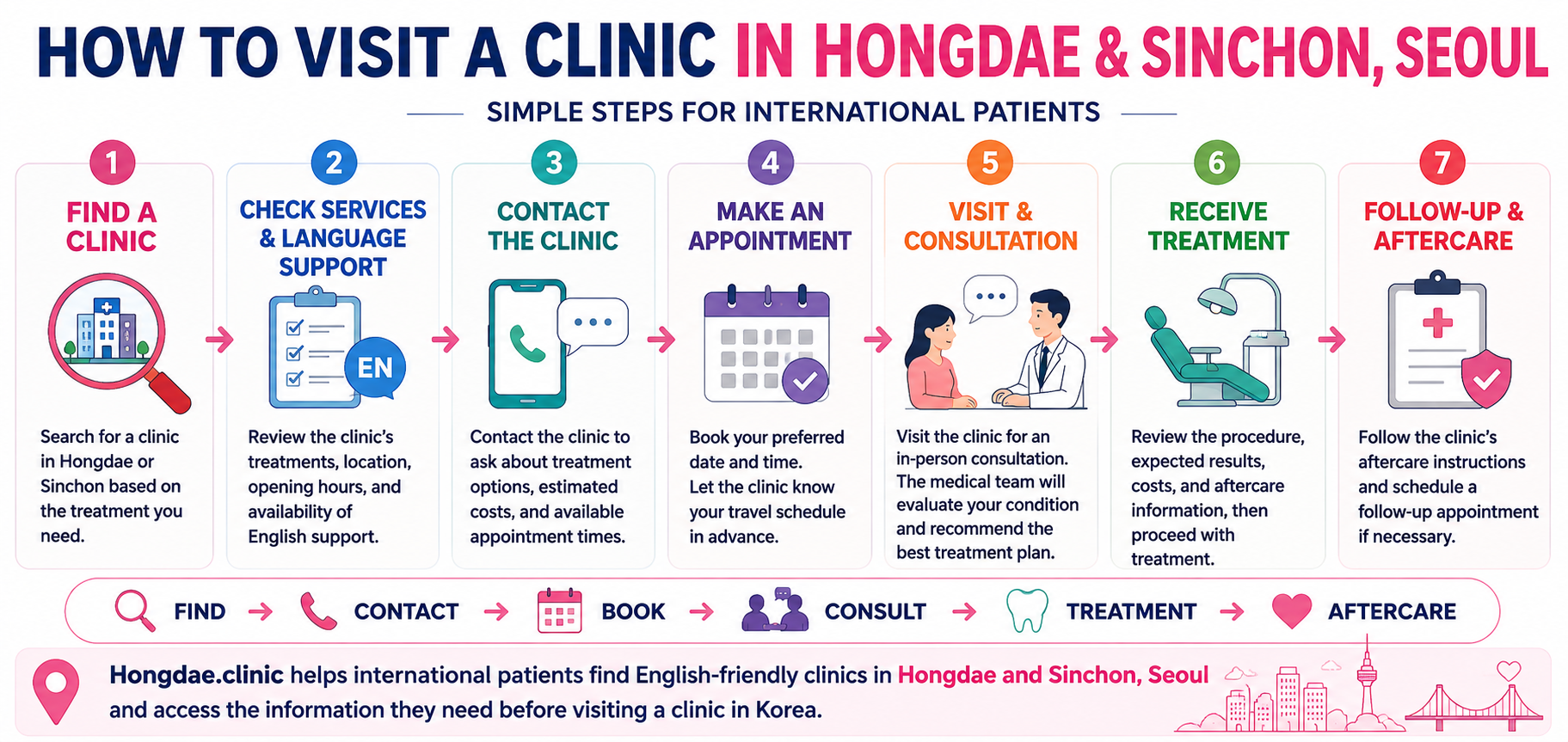
Brow Bone Reduction for International Patients
When contacting a plastic surgery clinic, consider asking:
- Is English consultation available?
- Is CT imaging included before surgery?
- Can my brow bone be reduced with burring alone?
- Does my frontal sinus require anterior-table setback?
- How much reduction is considered safe?
- Will orbital contouring also be performed?
- Where will the incision be located?
- What is the risk of forehead numbness or sinus complications?
- How long should I stay in Korea?
- Is postoperative follow-up included?
If you have previously undergone Forehead Lift, Brow Lift, hairline surgery, rhinoplasty, frontal bone surgery, or facial feminization surgery, tell the surgeon because previous treatment can affect surgical planning.
Choosing a Brow Bone Reduction Clinic in Hongdae or Sinchon
Consider:
- Qualified plastic, craniofacial, or maxillofacial surgeon
- Experience with frontal bone contouring
- Preoperative CT assessment
- Detailed frontal sinus evaluation
- Experience with anterior-table setback when necessary
- Customized orbital and brow contour planning
- Careful nerve and scalp management
- Experience with revision forehead surgery
- English communication
- Transparent surgery costs
Clinical research supports anatomy-based treatment selection, because patients with different frontal sinus depths and bone thicknesses may require fundamentally different techniques.
Hongdae & Sinchon Medical Care
Hongdae is convenient for patients around:
Hongik University · Yeonnam-dong · Hapjeong · Sangsu · Mapo
Sinchon is convenient for patients around:
Yonsei University · Ewha Womans University · Seodaemun · Mapo
Common searches include:
- Brow Bone Reduction Hongdae
- Forehead Bone Contouring Hongdae
- Frontal Bossing Reduction Hongdae
- Brow Bone Reduction Sinchon
- Forehead Contouring Sinchon
- English speaking facial contouring clinic Sinchon
Frequently Asked Questions
What is Brow Bone Reduction?
Brow Bone Reduction surgically decreases excessive supraorbital and frontal bone projection using bone contouring or, when necessary, frontal sinus anterior-table setback.
Can the brow bone simply be shaved down?
Sometimes. Patients with adequate bone thickness and suitable frontal sinus anatomy may be treated with burring, while more prominent bossing over a deeper frontal sinus may require osteotomy and setback.
Why is CT imaging important?
The size, depth, and anterior-wall thickness of the frontal sinus vary between patients, so imaging helps determine the safe surgical technique and reduction limits.
Can Brow Bone Reduction cause sinus problems?
Yes, particularly when surgery involves the frontal sinus. Significant complications such as sinusitis and osteomyelitis have been reported, although long-term cohort data also show favorable sinonasal outcomes in many patients.
Can foreigners get Brow Bone Reduction in Seoul?
Yes. International patients can contact plastic surgery or craniofacial clinics in Seoul regarding CT assessment, technique selection, surgical planning, recovery, postoperative monitoring, and English-language support.