Hongdae & Sinchon Chin Augmentation
in Seoul, Korea
Chin augmentation is a procedure designed to improve chin projection, shape, and overall facial balance.
Treatment may involve implants, fillers, or other techniques depending on individual anatomy and aesthetic goals.
Patients seeking
chin augmentation in Hongdae or Sinchon should consider treatment method, expected results, and recovery needs.
If you are concerned about a small, recessed, or under-projected chin, weak jawline definition, or facial imbalance between the nose, lips, and lower face, Chin Augmentation may be considered. Treatment can involve a chin implant, sliding genioplasty, or injectable filler, depending on the degree of correction, skeletal anatomy, soft-tissue thickness, and desired durability.
Hongdae and Sinchon are convenient areas for chin augmentation consultations in Seoul, especially for international residents, students, and travelers seeking facial contouring procedures.
What Is Chin Augmentation?
Chin Augmentation is a procedure designed to increase chin projection or modify chin shape to improve lower-face proportions.
The two main surgical approaches are alloplastic chin implants and osseous sliding genioplasty. Non-surgical augmentation with injectable fillers is another option for selected patients who want temporary or more limited correction.
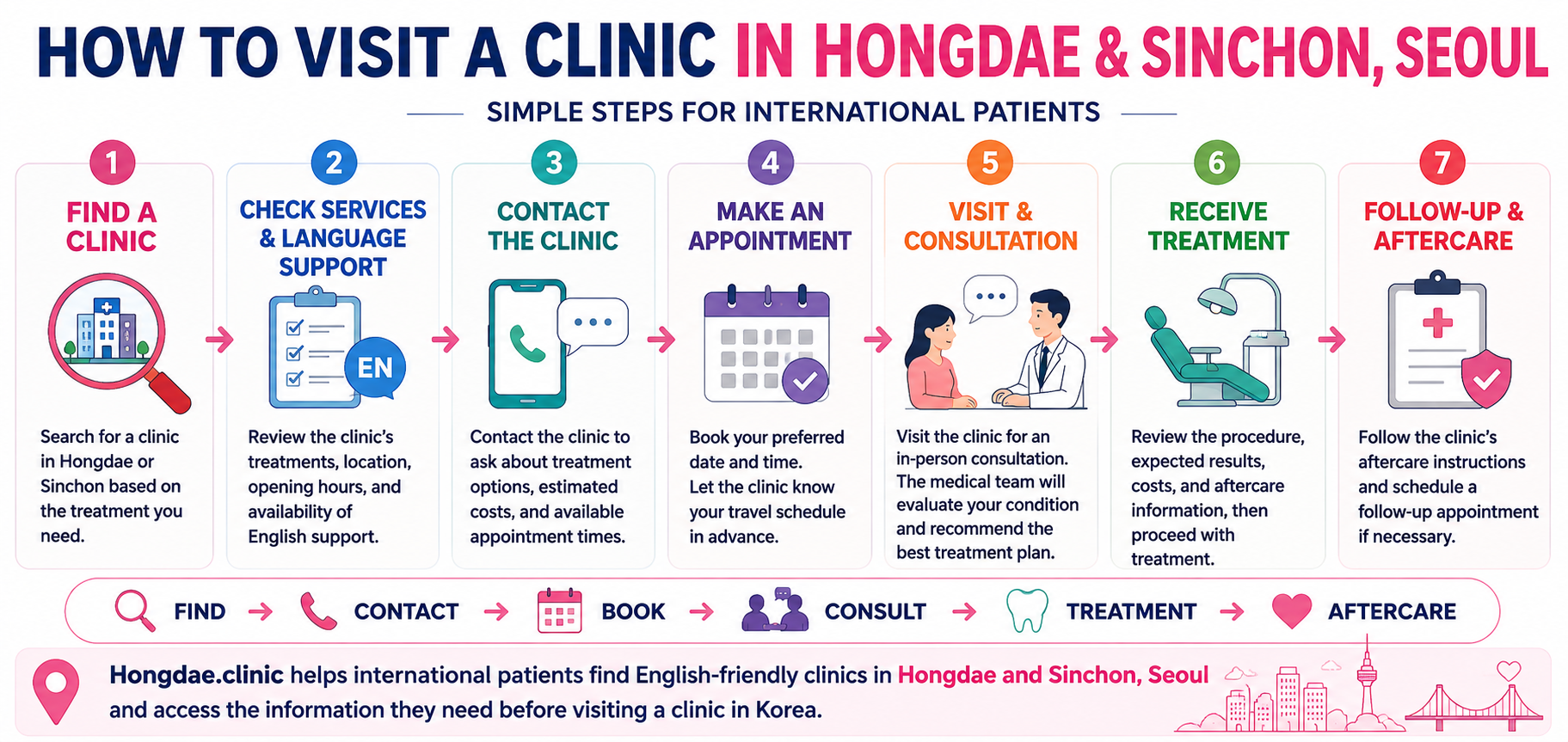
Consultation → facial profile assessment → treatment selection → chin augmentation → recovery → follow-up.
When Might You Consider Chin Augmentation?
Chin Augmentation may be considered for:
- Recessed or retruded chin
- Small-looking chin
- Weak facial profile
- Reduced jawline definition
- Chin asymmetry
- Desire for greater lower-face projection
- Facial imbalance between the nose and chin
- Chin correction combined with rhinoplasty or jaw surgery
The treatment plan should consider chin projection, vertical chin height, facial width, dental bite, jaw position, and surrounding soft tissues rather than evaluating the chin in isolation.
Common Chin Augmentation Options
Chin Implant
A chin implant is placed over the front of the mandible to increase projection and modify the lower-face contour.
Different alloplastic implant materials have been used, including silicone and porous materials. A systematic review found that complication profiles vary according to implant material and surgical technique.
Sliding Genioplasty
Sliding genioplasty involves cutting and repositioning part of the patient's own chin bone.
The bone segment can be advanced or otherwise repositioned, making the technique useful when more substantial or three-dimensional skeletal correction is required.
Chin Filler
Injectable filler can temporarily increase projection or improve selected contour concerns without bone surgery or an implant.
Systematic-review evidence indicates that fillers can provide rapid improvement and high short-term satisfaction, although results are less durable than surgical augmentation and rare vascular complications are possible.
Chin Augmentation Surgery Process
A typical treatment process may include:
- Plastic surgery or maxillofacial consultation
- Facial profile and symmetry assessment
- Evaluation of jaw position and bite
- Selection of implant or genioplasty
- Customized surgical planning
- Implant placement or bone repositioning
- Postoperative follow-up
Appropriate assessment is particularly important because a recessed chin can result from isolated chin deficiency or a broader jaw-position problem, which may require different treatment.
Chin Implant vs Sliding Genioplasty
Both procedures can increase chin projection, but they work differently.
Chin implants add material over the existing bone, while sliding genioplasty repositions the patient's own chin bone.
A recent systematic review found that both approaches can provide durable aesthetic improvement, but their indications and complication profiles differ.
Sliding genioplasty may provide greater flexibility for patients who need:
- Significant advancement
- Vertical chin adjustment
- Chin asymmetry correction
- More complex three-dimensional reshaping
Implants may be considered for selected patients needing relatively straightforward projection enhancement.
Which Option Is Better?
There is no single best procedure for every patient.
A comparative clinical study of 80 patients found higher satisfaction and fewer selected early complications with osseous genioplasty than implant augmentation, although this represents one study population and does not mean genioplasty is universally preferable.
A broader systematic review similarly found that both implants and osteotomy techniques have recognized benefits and complications.
Selection should depend on anatomy, desired correction, surgical tolerance, and surgeon assessment.
Chin Augmentation vs Jaw Surgery
These procedures are not the same.
Chin Augmentation changes the chin itself, while orthognathic jaw surgery repositions the upper jaw, lower jaw, or both to correct skeletal and bite abnormalities.
A patient with a small-looking chin may actually have:
- Isolated chin deficiency
- Retruded lower jaw
- Dental malocclusion
- Combination of chin and jaw abnormalities
When significant bite or jaw-position problems are present, chin augmentation alone may not address the underlying skeletal issue.
Chin Augmentation and Rhinoplasty
The nose and chin strongly influence the appearance of the facial profile.
Chin augmentation may therefore be considered together with rhinoplasty when improving chin projection helps create better balance between the upper and lower facial profile.
However, treatment should be individualized rather than automatically combining procedures.
Can Chin Augmentation Improve the Jawline?
Yes, particularly when a recessed chin contributes to a poorly defined lower-face profile.
Increasing chin projection can improve the transition between the chin, jawline, and neck, although it does not directly reduce jaw width or remove neck fat.
Patient-reported studies after osseous genioplasty have demonstrated substantial improvements in satisfaction with chin prominence, chin shape, lower face, and jawline appearance.
Can Chin Augmentation Correct Asymmetry?
Selected chin asymmetry can be improved.
Sliding genioplasty is particularly versatile because the bony chin segment can be moved in multiple directions to address projection, vertical height, and asymmetry.
However, perfect symmetry cannot always be guaranteed because differences may also come from:
- Jaw asymmetry
- Dental midline
- Facial soft tissues
- Muscle anatomy
- Previous surgery
Does a Chin Implant Leave a Scar?
Chin implants may be placed through either an intraoral incision or an external incision beneath the chin, depending on the surgical approach.
An intraoral approach avoids an external skin scar but requires careful treatment of the mentalis muscle and surrounding structures.
An external approach creates a small scar beneath the chin but may provide different surgical access.
The preferred approach depends on implant type, fixation method, anatomy, and surgeon technique.
Can a Chin Implant Move?
Yes.
Possible implant-related problems include:
- Implant displacement
- Malposition
- Infection
- Extrusion
- Asymmetry
- Bone remodeling or resorption
- Need for revision surgery
A systematic review of alloplastic chin augmentation identified implant-related complications across different materials and surgical approaches.
Implant pocket design and stabilization are therefore important parts of surgical planning.
Bone Resorption Under Chin Implants
Long-term pressure from an implant can sometimes lead to remodeling or resorption of the underlying mandibular bone.
Bone resorption has been described as a recognized complication of chin implant augmentation, although severity varies considerably between patients and implant designs.
This is one reason long-term follow-up may be appropriate after implant-based augmentation.
Sliding Genioplasty and Numbness
Sliding genioplasty involves surgery near the mental nerves, which provide sensation to the lower lip and chin.
Temporary sensory changes are therefore a recognized complication. A systematic review of chin augmentation techniques reported a higher proportion of transient mental nerve-related symptoms after osteotomy than implant procedures in the included studies.
Most temporary sensory disturbances improve, but persistent changes can occur.
When Do Results Appear?
Chin projection changes are visible immediately after surgical augmentation, but swelling can temporarily alter the early contour.
After implant surgery, the surrounding tissues gradually adapt to the implant.
After sliding genioplasty, bone and soft tissues require additional time to heal and settle around the new skeletal position.
Final results should therefore be evaluated after sufficient recovery rather than immediately after surgery.
What Is Recovery Like?
Temporary postoperative symptoms may include:
- Chin swelling
- Bruising
- Tightness
- Tenderness
- Temporary numbness
- Lower-lip stiffness
- Mild asymmetry
- Difficulty with chewing after genioplasty
Recovery varies according to whether treatment involves an implant, bone osteotomy, filler, or combined facial procedures. Surgical techniques generally provide longer-lasting structural change but require more recovery than injectable augmentation.
Possible Risks and Complications
Potential complications may include:
- Bleeding
- Infection
- Chin asymmetry
- Temporary or persistent numbness
- Implant displacement
- Implant extrusion
- Bone resorption around an implant
- Hardware problems after genioplasty
- Unsatisfactory chin projection
- Need for revision surgery
Systematic reviews confirm that both implant-based augmentation and osseous genioplasty have meaningful but different complication profiles.
Chin Implant Revision
Revision surgery may be considered for:
- Implant malposition
- Excessive projection
- Insufficient projection
- Infection
- Implant asymmetry
- Bone changes beneath the implant
- Desire to replace the implant with genioplasty
Revision can be more complex because previous surgery may create scar tissue, implant pockets, or changes in the underlying bone. Recent literature continues to describe reconstructive approaches for complications related to silicone chin implants.
Can Chin Augmentation Look Natural?
Yes.
Natural-looking results generally depend on balancing:
- Chin projection
- Chin width
- Vertical height
- Lower-face length
- Jawline contour
- Lip position
- Nose-chin relationship
The goal should be to improve facial proportions rather than simply maximizing chin projection.
Studies evaluating chin surgery have reported meaningful improvements in patient satisfaction with chin shape, prominence, profile, and overall lower-face appearance.
Chin Augmentation for International Patients
When contacting a plastic surgery clinic, consider asking:
- Is English consultation available?
- Is my concern the chin or the entire lower jaw?
- Is a chin implant or sliding genioplasty recommended?
- How much projection is appropriate?
- Can asymmetry also be corrected?
- Where will the incision be located?
- What is the risk of numbness?
- How long should I stay in Korea?
- Is postoperative follow-up included?
If you have previously undergone jaw surgery, chin filler, facial contouring, rhinoplasty, or chin implant surgery, tell the surgeon because previous treatment may influence the surgical plan.
Choosing a Chin Augmentation Clinic in Hongdae or Sinchon
Consider:
- Qualified plastic or maxillofacial surgeon
- Detailed facial profile assessment
- Evaluation of jaw position and bite
- Both implant and genioplasty options
- Customized chin projection planning
- Experience with facial asymmetry
- Clear explanation of implant and nerve-related risks
- Revision treatment experience
- English communication
- Transparent surgery costs
Current systematic reviews support choosing the procedure according to individual skeletal anatomy, desired degree of correction, durability expectations, and complication profile, rather than assuming one chin augmentation technique is universally superior.
Hongdae & Sinchon Medical Care
Hongdae is convenient for patients around:
Hongik University · Yeonnam-dong · Hapjeong · Sangsu · Mapo
Sinchon is convenient for patients around:
Yonsei University · Ewha Womans University · Seodaemun · Mapo
Common searches include:
- Chin Augmentation Hongdae
- Chin Implant Hongdae
- Sliding Genioplasty Hongdae
- Chin Augmentation Sinchon
- Chin Surgery Sinchon
- English speaking facial contouring clinic Sinchon
Frequently Asked Questions
What is Chin Augmentation?
Chin Augmentation increases or reshapes chin projection using techniques such as a chin implant, sliding genioplasty, or injectable filler.
Is a chin implant better than sliding genioplasty?
Not necessarily. Implants may suit selected straightforward projection concerns, while sliding genioplasty provides greater flexibility for skeletal movement and three-dimensional correction. Treatment should be selected according to individual anatomy.
Can Chin Augmentation improve a weak jawline?
Yes. Increasing chin projection can improve lower-face balance and the visual definition of the jawline, particularly when chin deficiency contributes to the profile concern.
Can Chin Augmentation cause numbness?
Yes. Temporary numbness can occur after both implant surgery and genioplasty, particularly because the mental nerves are located near the surgical area. Persistent sensory changes are less common but possible.
Can foreigners get Chin Augmentation in Seoul?
Yes. International patients can contact plastic surgery or maxillofacial clinics in Seoul regarding facial assessment, implant or genioplasty options, recovery, postoperative monitoring, and English-language support.