Hongdae & Sinchon Closed Rhinoplasty
in Seoul, Korea
Closed rhinoplasty is a nose surgery performed through incisions inside the nostrils, leaving no visible external scar.
The procedure may refine the bridge, tip, or overall nasal shape depending on individual anatomy and goals.
Patients seeking
closed rhinoplasty in Hongdae or Sinchon should consider surgical suitability, expected results, and recovery needs.
If you are considering nose reshaping with incisions placed primarily inside the nostrils, closed rhinoplasty may be an option depending on your nasal anatomy and surgical goals. Closed rhinoplasty can provide both aesthetic and functional improvements in appropriately selected patients.
Hongdae and Sinchon are convenient areas for plastic surgery consultations in Seoul, especially for international residents, students, and travelers.
What Is Closed Rhinoplasty?
Closed rhinoplasty, also called endonasal rhinoplasty, is performed through incisions inside the nostrils without the external columellar incision typically used in open rhinoplasty.
Through these internal incisions, the surgeon can modify the nasal bridge, cartilage, tip, septum, and other structures depending on the individual surgical plan.
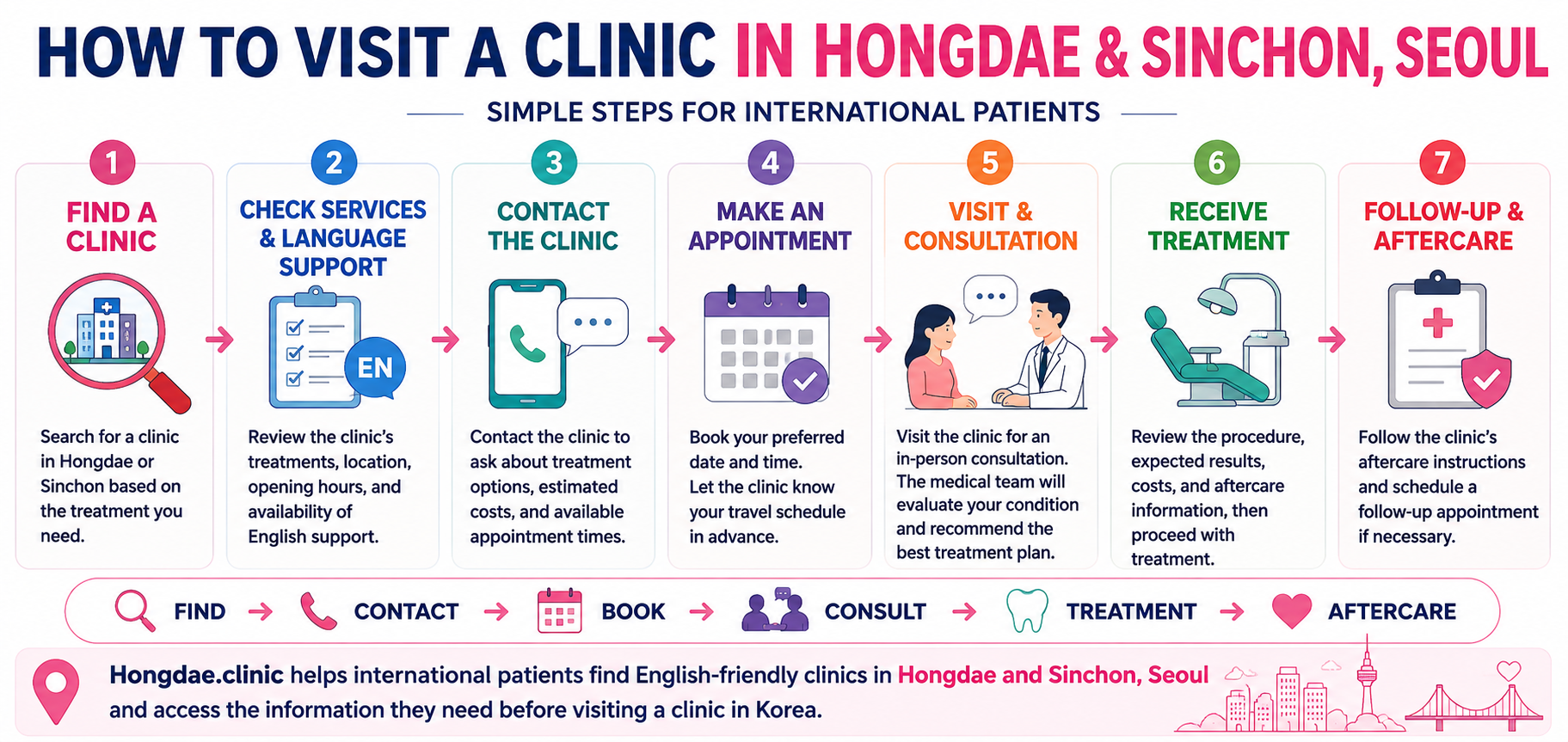
Consultation → facial analysis → surgical planning → closed rhinoplasty → recovery → follow-up.
When Might You Consider Closed Rhinoplasty?
Closed rhinoplasty may be considered for concerns such as:
- Dorsal hump
- Nasal bridge shape
- Mild nasal asymmetry
- Selected tip concerns
- Wide or disproportionate nose
- Functional nasal concerns
- Patients who prefer to avoid an external columellar incision
Whether the closed approach is appropriate depends on nasal anatomy, complexity, previous surgery, and the changes required.
Common Closed Rhinoplasty Goals
Bridge Refinement
The nasal bridge may be reduced, reshaped, or augmented to improve balance with the rest of the face.
Tip Modification
Selected tip concerns can be treated through an endonasal approach using cartilage reshaping, suturing, or grafting techniques.
Overall Nasal Balance
Closed rhinoplasty may also address selected asymmetries and structural concerns while maintaining natural facial proportions.
Closed Rhinoplasty Treatment Process
A typical surgical process may include:
- Plastic surgery consultation
- Detailed facial and nasal assessment
- Photography and surgical planning
- Internal nasal incisions
- Cartilage and bone modification
- Closure and nasal support
- Postoperative follow-up
A prospective study of 189 closed rhinoseptoplasty patients reported significant improvements in both aesthetic satisfaction and nasal-obstruction scores after surgery.
Closed Rhinoplasty vs Open Rhinoplasty
The main difference is surgical access.
Closed rhinoplasty uses internal incisions, while open rhinoplasty adds an incision across the columella to provide wider exposure of the nasal framework.
Research comparing the two approaches has not established one technique as universally superior. The appropriate approach depends largely on the complexity of the nose and the surgeon's planned technique.
What Are the Potential Advantages of Closed Rhinoplasty?
Possible advantages may include:
- No external columellar incision
- No visible columellar scar from the surgical approach
- Less disruption of some nasal soft tissues
- Potentially reduced early sensory changes in selected areas
- Effective correction for appropriately selected cases
A randomized study found temporary sensory reduction around the nasal tip after open rhinoplasty, while significant postoperative sensory loss was not detected in the closed group.
Is Closed Rhinoplasty Suitable for Every Nose?
No.
Complex deformities, major tip reconstruction, severe asymmetry, extensive grafting, or some revision cases may require the greater surgical exposure provided by an open approach.
A recent prospective comparison found that both approaches were effective, but open rhinoplasty performed better in some complex nasal deformities, emphasizing the importance of selecting the approach according to anatomy rather than preference alone.
When Do Results Appear?
The new nasal shape becomes visible after surgery, but swelling can temporarily hide the final result.
Early changes become clearer as swelling gradually decreases, while subtle changes—particularly around the nasal tip—can continue during longer-term healing.
Final results should therefore be evaluated after sufficient postoperative recovery.
What Is Recovery Like?
Temporary postoperative symptoms may include:
- Swelling
- Bruising
- Nasal congestion
- Tenderness
- Temporary numbness
- Mild asymmetry during early healing
Recovery varies according to the amount of bone, cartilage, septal, and tip work performed.
Possible Risks and Complications
Like any rhinoplasty procedure, closed rhinoplasty can involve risks such as:
- Bleeding
- Infection
- Nasal obstruction
- Persistent asymmetry
- Unsatisfactory shape
- Scarring inside the nose
- Changes in sensation
- Need for revision surgery
Studies of closed rhinoplasty show that good outcomes are achievable, but complications and revision procedures can still occur.
Closed Rhinoplasty for International Patients
When contacting a plastic surgery clinic, consider asking:
- Is English consultation available?
- Am I suitable for closed rhinoplasty?
- Why is the closed approach recommended for my nose?
- Will cartilage grafting be required?
- Will my septum or breathing function be treated?
- What recovery time should I expect?
- Is postoperative follow-up included?
If you are visiting Korea temporarily, discuss how long you should remain in Seoul for splint removal, wound checks, and early postoperative follow-up.
Choosing a Closed Rhinoplasty Clinic in Hongdae or Sinchon
Consider:
- Qualified plastic surgeon
- Detailed facial and nasal analysis
- Experience with closed rhinoplasty
- Ability to perform both open and closed techniques
- Functional breathing assessment
- Customized surgical planning
- Realistic discussion of expected results
- English communication
- Transparent surgery costs
The best approach should be selected according to the specific nasal anatomy and required surgical correction, rather than assuming closed or open rhinoplasty is always better.
Hongdae & Sinchon Medical Care
Hongdae is convenient for patients around:
Hongik University · Yeonnam-dong · Hapjeong · Sangsu · Mapo
Sinchon is convenient for patients around:
Yonsei University · Ewha Womans University · Seodaemun · Mapo
Common searches include:
- Closed Rhinoplasty Hongdae
- Nose Surgery Hongdae
- Endonasal Rhinoplasty Hongdae
- Closed Rhinoplasty Sinchon
- Rhinoplasty Sinchon
- English speaking plastic surgery clinic Sinchon
Frequently Asked Questions
What is closed rhinoplasty?
Closed rhinoplasty is a surgical approach where nasal incisions are made inside the nostrils, allowing the surgeon to reshape selected nasal structures without a routine external columellar incision.
Can foreigners get closed rhinoplasty in Seoul?
Yes. International patients can contact plastic surgery clinics in Seoul regarding consultation, surgical planning, recovery, and English-language support.
Is closed rhinoplasty better than open rhinoplasty?
Not necessarily. Research has not established one approach as universally superior. The better technique depends on nasal anatomy, surgical complexity, and the goals of the procedure.
Does closed rhinoplasty leave a visible scar?
The standard closed approach places surgical incisions inside the nostrils, so it avoids the external columellar scar associated with the open approach.
Can closed rhinoplasty correct breathing problems?
In selected patients, closed rhinoseptoplasty can address both
nasal appearance and functional obstruction. A prospective study reported improvements in both aesthetic and nasal-obstruction outcomes following closed rhinoseptoplasty.