Hongdae & Sinchon Deviated Nose Surgery
in Seoul, Korea
Deviated nose surgery is a procedure designed to correct a crooked or asymmetrical nose and improve overall nasal balance.
Treatment may involve reshaping bone and cartilage to address both cosmetic concerns and breathing difficulties.
Patients seeking
deviated nose surgery in Hongdae or Sinchon should consider nasal structure, surgical approach, and recovery needs.
If you are concerned about a crooked nose, nasal asymmetry, or difficulty breathing through one or both sides of the nose, deviated nose surgery may be considered. Treatment can involve septoplasty, rhinoplasty, or septorhinoplasty depending on whether the problem affects the internal septum, external nasal shape, or both.
Hongdae and Sinchon are convenient areas for plastic surgery and nasal consultations in Seoul, especially for international residents, students, and travelers.
What Is Deviated Nose Surgery?
Deviated nose surgery refers to surgical correction of a nose that appears crooked, has a deviated internal septum, or has both aesthetic and functional problems.
A deviated external nose is not exactly the same as a deviated nasal septum, so treatment should begin with a detailed assessment of both external appearance and internal nasal structure.
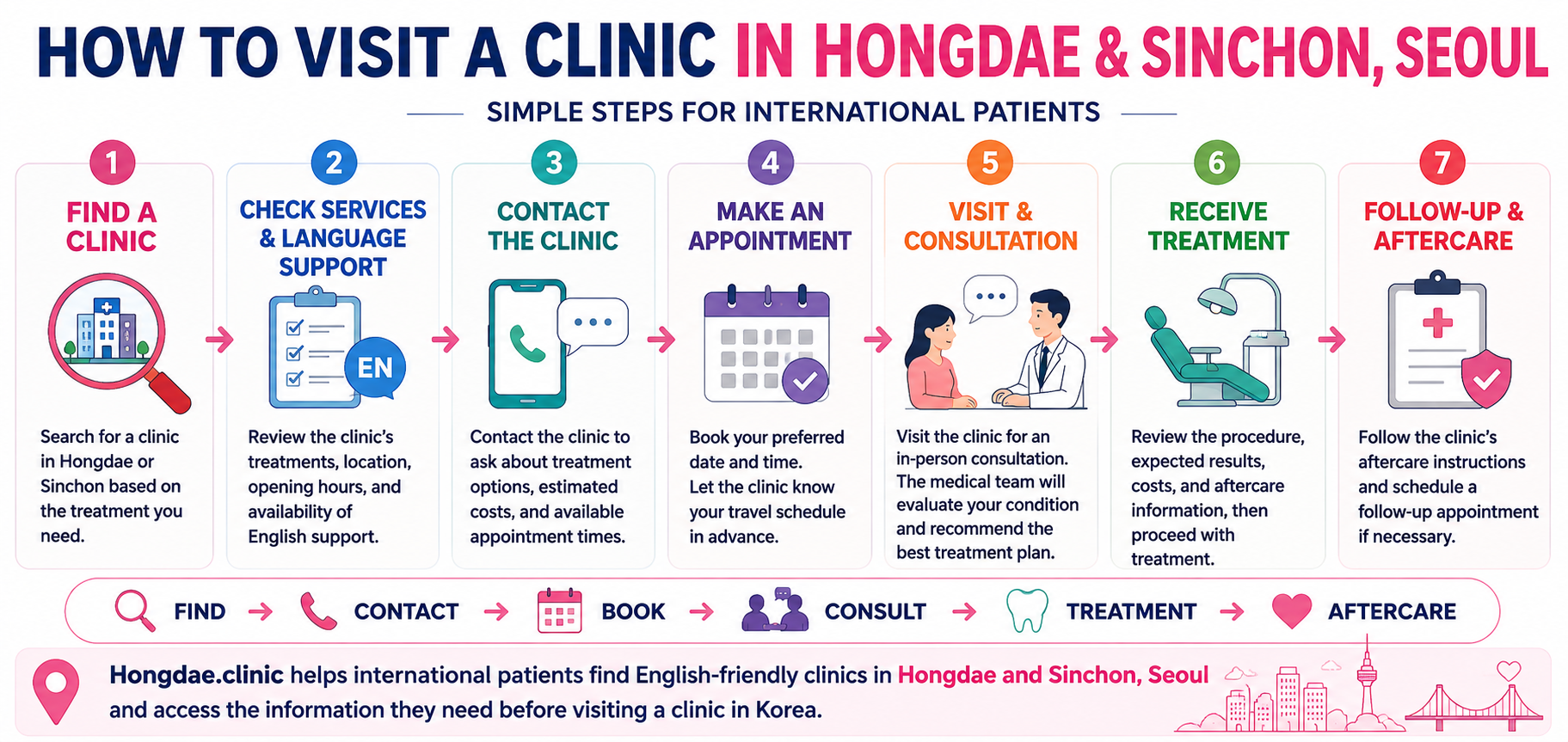
Consultation → nasal assessment → surgical planning → correction → recovery → follow-up.
When Might You Consider Deviated Nose Surgery?
Surgery may be considered for:
- Crooked or visibly deviated nose
- Nasal asymmetry
- Deviated nasal septum
- Difficulty breathing through the nose
- Chronic nasal obstruction
- Post-traumatic nasal deformity
- Uneven nasal bridge
- Functional and cosmetic concerns together
Septoplasty is commonly considered when septal deviation contributes to persistent nasal obstruction or other related symptoms.
Common Causes of a Deviated Nose
Congenital Nasal Asymmetry
Some patients naturally develop a curved or asymmetric nasal structure.
Previous Trauma
Sports injuries, falls, accidents, or previous fractures can alter the position of the nasal bones, cartilage, or septum.
Previous Rhinoplasty
Scar tissue, structural weakness, or incomplete correction after previous nose surgery can also contribute to deviation.
External nasal deviation may also occur together with broader facial asymmetry, which should be considered during surgical planning.
Deviated Nose Surgery Process
A typical surgical process may include:
- Plastic surgery or ENT consultation
- External nasal examination
- Internal septal assessment
- Photography and surgical planning
- Septoplasty, rhinoplasty, or combined surgery
- Cartilage or bone correction
- Postoperative recovery and follow-up
Nasal endoscopy or CT imaging may be used selectively when additional evaluation of internal obstruction is needed.
Septoplasty vs Rhinoplasty
Septoplasty primarily corrects a deviated internal nasal septum to improve airflow.
Rhinoplasty changes the external shape and structural appearance of the nose.
When a patient has both external nasal deviation and internal breathing problems, a combined septorhinoplasty may be considered.
Correction of an externally deviated nose is more complex than simply straightening the septum because nasal bones, cartilage, and facial asymmetry may also influence the visible result.
Can Deviated Nose Surgery Improve Breathing?
Yes, when nasal obstruction is caused by structural deviation.
Recent randomized evidence indicates that septoplasty can provide greater improvement in nasal-obstruction symptoms and quality of life than non-surgical management in appropriately selected adults with a deviated septum.
However, breathing problems can also involve the turbinates, nasal valves, allergies, polyps, or other conditions, so these should be evaluated before surgery.
Septoplasty and Turbinate Reduction
Some patients with a deviated septum also have an enlarged inferior turbinate, which can contribute to nasal obstruction.
A systematic review found that adding unilateral turbinate reduction to septoplasty improved subjective obstruction scores in selected adults, but it also increased adverse events.
For this reason, turbinate surgery should be recommended according to individual anatomy rather than routinely performed for every patient.
Severe Septal Deviation
Severe or complex septal deformities may require more extensive reconstruction.
In selected cases, techniques such as extracorporeal septoplasty may be used to reconstruct a severely deviated septum. A recent systematic review reported improvements in obstruction and aesthetic outcomes, although the overall evidence remains limited by mainly retrospective studies.
Open vs Closed Approach
Deviated nose correction may be performed using either an open or closed rhinoplasty approach.
An open approach may provide wider visualization when the surgeon needs to correct:
- Significant asymmetry
- Complex tip deviation
- Severe cartilage distortion
- Structural weakness
- Extensive grafting requirements
A closed approach may be suitable for selected cases requiring less extensive structural correction.
The surgical approach should be chosen according to the specific deformity rather than cosmetic preference alone.
When Do Results Appear?
The nose may appear straighter soon after surgery, but swelling can temporarily affect symmetry and contour.
Breathing improvement may also continue as internal swelling decreases.
Published evidence shows meaningful improvement in nasal-obstruction symptoms after septoplasty, particularly over several months of follow-up.
What Is Recovery Like?
Temporary postoperative symptoms may include:
- Swelling
- Bruising
- Nasal congestion
- Tenderness
- Mild bleeding
- Temporary numbness
- Uneven appearance during early healing
Internal splints or packing may also be used depending on the procedure. Postoperative monitoring should include assessment for bleeding, septal hematoma, infection, and healing problems.
Possible Risks and Complications
Potential complications may include:
- Bleeding
- Infection
- Persistent nasal obstruction
- Residual nasal deviation
- Nasal asymmetry
- Septal perforation
- Internal scarring
- Unsatisfactory cosmetic results
- Need for revision surgery
AAO-HNS guidance specifically lists possible complications of septoplasty including septal perforation, persistent breathing difficulty, bleeding, crusting, scarring, and rare changes in appearance.
Can a Deviated Nose Become Perfectly Straight?
Complete symmetry cannot always be guaranteed.
A deviated nose may be influenced by:
- Facial asymmetry
- Uneven nasal bones
- Cartilage memory
- Scar tissue
- Previous trauma
- Skin and soft-tissue differences
Research emphasizes that facial asymmetry is common among patients undergoing correction of a deviated nose and can influence how straight the nose appears after surgery.
The goal is generally to achieve meaningful improvement in alignment, facial balance, and function rather than absolute mathematical symmetry.
Deviated Nose Surgery for International Patients
When contacting a clinic, consider asking:
- Is English consultation available?
- Is my deviation external, internal, or both?
- Do I need septoplasty with rhinoplasty?
- Will cartilage grafting be required?
- Are my nasal valves or turbinates involved?
- Can breathing problems be corrected simultaneously?
- How long should I stay in Korea?
- Is postoperative follow-up included?
If you are visiting Korea temporarily, discuss the timing of splint removal, internal nasal checks, and postoperative follow-up before departure.
Choosing a Deviated Nose Surgery Clinic in Hongdae or Sinchon
Consider:
- Qualified plastic surgeon or ENT specialist
- Detailed external and internal nasal assessment
- Experience with deviated nose correction
- Septoplasty and rhinoplasty expertise
- Functional breathing evaluation
- Cartilage grafting experience
- Realistic discussion of symmetry
- English communication
- Transparent surgery costs
Successful treatment requires identifying whether the main problem is the septum, external nasal framework, nasal valves, turbinates, facial asymmetry, or a combination of these factors.
Hongdae & Sinchon Medical Care
Hongdae is convenient for patients around:
Hongik University · Yeonnam-dong · Hapjeong · Sangsu · Mapo
Sinchon is convenient for patients around:
Yonsei University · Ewha Womans University · Seodaemun · Mapo
Common searches include:
- Deviated Nose Surgery Hongdae
- Crooked Nose Surgery Hongdae
- Septorhinoplasty Hongdae
- Deviated Nose Surgery Sinchon
- Septoplasty Sinchon
- English speaking plastic surgery clinic Sinchon
Frequently Asked Questions
What is deviated nose surgery?
It refers to surgery used to correct external nasal crookedness, internal septal deviation, or both, using techniques such as septoplasty, rhinoplasty, or septorhinoplasty.
Can foreigners get deviated nose surgery in Seoul?
Yes. International patients can contact plastic surgery or ENT clinics in Seoul regarding consultation, functional assessment, surgical planning, and English-language support.
Can deviated nose surgery improve breathing?
Yes, when structural problems such as a deviated septum contribute to nasal obstruction. Recent randomized evidence supports symptom improvement after septoplasty in appropriately selected adults.
Is septoplasty the same as deviated nose rhinoplasty?
No. Septoplasty primarily corrects the internal septum, while rhinoplasty addresses external nasal shape and structure. Some patients require both.
Can a crooked nose become completely straight?
Substantial improvement may be possible, but perfect symmetry cannot be guaranteed because
facial asymmetry, cartilage, bone structure, scar tissue, and healing patterns can influence the final result.