Hongdae & Sinchon Dimple Surgery
in Seoul, Korea
Dimple surgery is a cosmetic procedure designed to create natural-looking dimples on the cheeks through a small incision inside the mouth. Treatment is customized based on facial structure, desired dimple position, and individual aesthetic goals.
Patients seeking
dimple surgery in Hongdae or Sinchon should consider surgical technique, expected results, and recovery needs.
If you would like to create a small cheek indentation that becomes noticeable when smiling, Dimple Surgery may be considered. Also called dimpleplasty, the procedure creates an attachment between the inner cheek tissues and the skin so that facial movement produces a dimple-like depression. Clinical series show that the procedure can provide predictable cosmetic results, although undercorrection, disappearance, overcorrection, infection, and the need for revision can occur.
Hongdae and Sinchon are convenient areas for Dimple Surgery consultations in Seoul, especially for international residents, students, and travelers seeking relatively localized facial cosmetic procedures.
What Is Dimple Surgery?
Dimple Surgery, or dimpleplasty, is a cosmetic procedure designed to create an artificial facial dimple, most commonly on the cheek.
Natural cheek dimples are associated with variations in the relationship between facial muscles and the skin. Anatomical research has suggested that a bifid or double zygomaticus major muscle can create a dermal tether that produces a visible indentation during smiling.
Surgical techniques attempt to reproduce this effect by creating a controlled connection between the buccal mucosa, cheek muscle or soft tissue, and overlying skin.
Consultation → dimple location planning → intraoral access → tissue fixation → healing → dynamic dimple formation → follow-up.
When Might You Consider Dimple Surgery?
Dimple Surgery may be considered if you:
- Naturally do not have cheek dimples
- Want one dimple on a single cheek
- Prefer symmetrical bilateral dimples
- Want dimples that become more noticeable when smiling
- Prefer a procedure performed through the inside of the mouth
- Want a subtle change to facial expression rather than major facial contouring
The position should be customized rather than determined from one standard facial landmark. A study evaluating 336 naturally occurring dimples found that more than half were not located at the traditional Khoo Boo Chai reference point, supporting individualized planning according to facial shape and desired appearance.
How Is a Dimple Created?
Several techniques have been described.
Suture Dimpleplasty
A suture-based technique creates a controlled internal connection that pulls the cheek skin inward during facial movement.
In a small clinical series of 23 patients, a closed suturing technique produced generally satisfactory results, although temporary swelling, hematoma, and infection were reported.
Open Intraoral Technique
Other techniques use a small incision inside the mouth to directly access the cheek tissue and create a more controlled attachment between deeper tissues and the skin.
An open approach has been described as an alternative to blind tissue coring or transcutaneous suturing, with the goal of more closely reproducing the anatomy responsible for a natural dimple.
Transoral Buccinator-Pexy
Another technique involves fixation of the buccinator region from inside the mouth. In one clinical series, the dimples initially appeared more pronounced at rest but became primarily dynamic with facial animation after several weeks.
Dimple Surgery Process
A typical procedure may include:
- Plastic or facial surgery consultation
- Evaluation of cheek shape and smile pattern
- Selection of unilateral or bilateral dimples
- Marking the desired dimple location
- Local anesthesia and intraoral access
- Creation of an internal soft-tissue attachment
- Suture fixation and postoperative follow-up
The procedure takes place close to important structures, particularly the parotid duct and branches of the facial nerve, so detailed understanding of cheek anatomy is important.
Where Should the Dimple Be Placed?
There is no single ideal location for everyone.
Dimple position should consider:
- Facial width
- Cheek fullness
- Smile pattern
- Mouth-corner position
- Natural facial asymmetry
- Patient preference
Traditional surgical planning often used a standardized landmark, but research involving naturally dimpled faces found substantial variation according to facial form. In that study, 54.8% of naturally occurring dimples were not positioned at the traditional reference point.
A natural-looking result therefore usually requires individualized placement.
One-Sided vs Two-Sided Dimple Surgery
Dimpleplasty can be performed on:
- One cheek
- Both cheeks
Some patients prefer a single dimple because naturally occurring dimples are not always symmetrical.
Others prefer bilateral dimples for a more balanced smile.
Large clinical experience demonstrates that both unilateral and bilateral procedures are performed, with treatment location selected according to patient preference and facial anatomy.
Will the Dimple Show All the Time?
Initially, it may.
Immediately after surgery, the newly created dimple can appear deeper and more visible even when the face is relaxed because of swelling and strong internal fixation.
As healing progresses, the indentation may become softer and appear primarily during smiling or facial movement. A transoral buccinator-pexy series specifically reported that the dimples were initially noticeable without animation but became dynamic after several weeks.
The amount of softening varies between patients.
Can Dimple Surgery Look Natural?
Yes, but natural appearance depends heavily on placement, depth, and how the dimple interacts with facial movement.
Natural cheek dimples are created by specific anatomical relationships between the facial muscles and skin, including variations of the zygomaticus major muscle.
Surgical planning should therefore aim for:
- Appropriate dimple depth
- Natural position
- Smooth movement during smiling
- Symmetry when bilateral dimples are requested
- Avoidance of excessive fixation
The goal is generally a dynamic indentation during expression, rather than a deep permanent depression at rest.
Can the Dimple Be Too Deep?
Yes.
Overcorrection can create a dimple that appears excessively deep or remains too visible when the face is relaxed.
In a large Korean study of 2,048 dimpleplasty patients, 159 patients underwent reoperation. Among those revision cases, overcorrection accounted for 9 cases.
This is why surgeons may initially create a somewhat pronounced dimple while anticipating softening during healing, but excessive depth should be avoided.
Can the Dimple Disappear?
Yes.
Loss or weakening of the dimple is one of the main reasons for revision surgery.
In the 2,048-patient clinical series:
- 78 revisions were performed for undercorrection
- 62 revisions were performed because the dimple disappeared
- 9 revisions were performed for overcorrection
Overall, 7.7% of patients underwent reoperation in that particular series.
Individual revision rates vary according to surgical technique, tissue healing, fixation, and follow-up duration.
Can Dimple Surgery Be Reversed?
Sometimes, particularly during the earlier healing period.
In the large Korean clinical series, several patients requested removal of their fixation stitches because they changed their minds, allowing the created dimple to be eliminated.
However, reversibility should not be guaranteed.
As scar tissue develops between the skin and deeper cheek tissues, complete reversal may become less predictable. Patients should therefore consider the desired dimple position and appearance carefully before surgery.
Does Dimple Surgery Leave a Visible Scar?
Many modern dimpleplasty techniques are performed through an intraoral incision, meaning the surgical access is located inside the mouth rather than on visible cheek skin.
This generally avoids a conventional external facial scar.
However, internal scar tissue is intentionally created as part of the mechanism that produces the dimple.
When Do Results Appear?
The dimple is usually noticeable immediately after surgery, but its early appearance is not the final result.
Early changes may include:
- Swelling
- Temporary bruising
- Strong dimple indentation
- Asymmetry
- Tenderness
- Intraoral discomfort
As swelling decreases and the internal tissues heal, the dimple typically becomes less pronounced at rest and more noticeable during facial expression.
What Is Recovery Like?
Temporary postoperative effects may include:
- Cheek swelling
- Mild bruising
- Tenderness
- Intraoral soreness
- Temporary tightness
- Uneven dimple depth during early healing
A small clinical study of suture dimpleplasty reported swelling and hematoma in four patients and infection in two patients among 23 treated cases.
Patients should follow postoperative oral-hygiene and wound-care instructions carefully because the surgical site communicates with the inside of the mouth.
Possible Risks and Complications
Potential complications may include:
- Swelling
- Bruising
- Hematoma
- Infection
- Under-correction
- Excessively deep dimpling
- Dimple disappearance
- Asymmetry
- Unnatural position
- Persistent dimple at rest
- Need for revision surgery
The largest clinical series identified undercorrection and disappearance of the dimple as the most common reasons for secondary surgery, while infection and overcorrection occurred less frequently.
Infection After Dimple Surgery
Because Dimple Surgery is commonly performed through the oral mucosa, infection is a recognized risk.
Clinical studies have documented infections after dimpleplasty, and a published complication report described cheek abscesses following dimple creation surgery.
Patients should contact their treating clinician promptly if they develop symptoms such as increasing pain, significant swelling, drainage, or other concerning postoperative changes.
Parotid Duct and Facial Nerve Considerations
The cheek contains important structures including the Stensen parotid duct and facial nerve branches.
An anatomical and clinical study of transoral buccinator-pexy emphasized identification of the Stensen duct papilla and defined a surgical safety zone for avoiding important nearby structures.
This is one reason Dimple Surgery should be performed by a clinician familiar with facial and intraoral anatomy.
How Long Do Dimple Surgery Results Last?
Dimpleplasty is intended to create a lasting internal attachment, but durability varies.
Possible long-term outcomes include:
- Stable dynamic dimple
- Gradual softening
- Partial loss of depth
- Complete disappearance
- Need for repeat fixation
The large 2,048-patient clinical series demonstrated that disappearance and undercorrection can occur and may lead to revision surgery.
Permanent retention therefore cannot be guaranteed.
Revision Dimple Surgery
Revision surgery may be considered for:
- Dimple disappearance
- Insufficient depth
- Excessive depth
- Asymmetry
- Unwanted position
- Desire for stronger fixation
In the large Korean series, revision was most commonly performed for undercorrection or disappearance, and the authors reported no additional complications after reoperation in their study population.
Revision planning should consider previous scar tissue and the original fixation site.
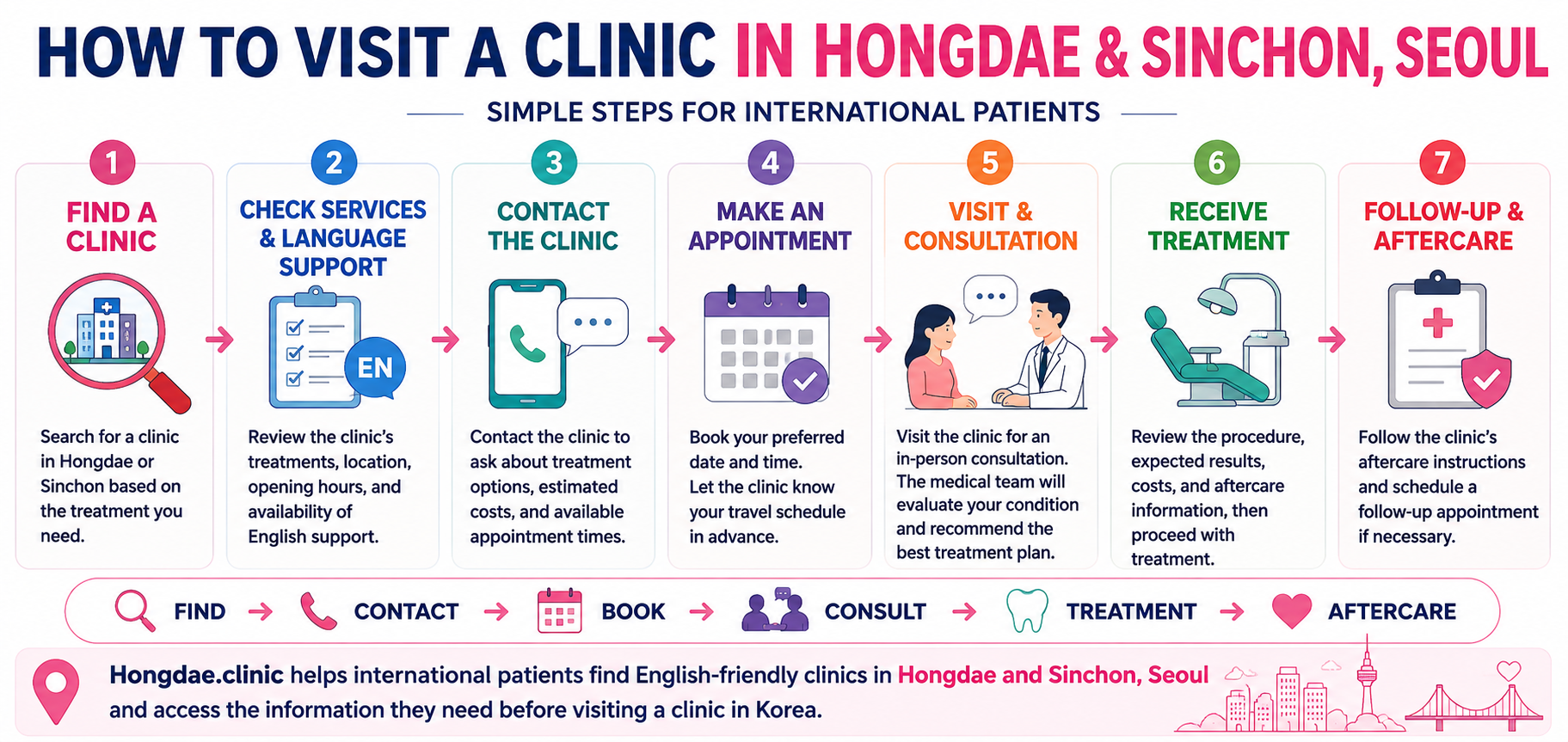
Dimple Surgery for International Patients
When contacting a plastic surgery clinic, consider asking:
- Is English consultation available?
- Is one-sided or bilateral Dimple Surgery recommended?
- Where will the dimples be positioned?
- How will the position be selected for my facial shape?
- Will the dimples initially show when I am not smiling?
- What technique will be used?
- What is the risk of disappearance or overcorrection?
- How should I care for the intraoral incision?
- How long should I stay in Korea?
- Is revision or postoperative follow-up available?
Because dimple appearance depends strongly on facial movement and individual anatomy, discussing the desired location and depth before surgery is particularly important.
Choosing a Dimple Surgery Clinic in Hongdae or Sinchon
Consider:
- Qualified plastic or facial surgeon
- Experience with Dimple Surgery
- Detailed facial and smile assessment
- Customized dimple-position planning
- Knowledge of cheek anatomy
- Awareness of the parotid duct and facial nerve
- Conservative dimple-depth planning
- Clear discussion of revision risk
- English communication
- Transparent surgery costs
Clinical evidence suggests that accurate anatomical knowledge and appropriate surgical technique are important for creating predictable dimples while minimizing complications.
Hongdae & Sinchon Medical Care
Hongdae is convenient for patients around:
Hongik University · Yeonnam-dong · Hapjeong · Sangsu · Mapo
Sinchon is convenient for patients around:
Yonsei University · Ewha Womans University · Seodaemun · Mapo
Common searches include:
- Dimple Surgery Hongdae
- Dimpleplasty Hongdae
- Cheek Dimple Surgery Hongdae
- Dimple Surgery Sinchon
- Dimple Creation Sinchon
- English speaking plastic surgery clinic Sinchon
Frequently Asked Questions
What is Dimple Surgery?
Dimple Surgery, or dimpleplasty, creates an internal connection between cheek tissues and the skin so that an indentation appears, particularly during smiling.
Will the dimple show when I am not smiling?
It may during early recovery. The dimple can initially appear deeper and visible at rest, then soften as healing progresses and become more noticeable mainly during facial animation.
Can a surgically created dimple disappear?
Yes. Disappearance and undercorrection are recognized outcomes and were the two most common reasons for revision in a large 2,048-patient clinical series.
Does Dimple Surgery leave an external scar?
Many techniques use an intraoral approach, so there may be no routine external cheek incision.
Can foreigners get Dimple Surgery in Seoul?
Yes. International patients can contact plastic surgery clinics in Seoul regarding dimple position, surgical technique, recovery, postoperative care, revision policies, and English-language support.