Hongdae & Sinchon Double Eyelid Surgery
in Seoul, Korea
Double eyelid surgery is a cosmetic procedure designed to create or enhance a defined upper eyelid crease for a more balanced eye appearance. Treatment may use incision or non-incision techniques depending on eyelid anatomy, skin condition, and aesthetic goals. Patients seeking double eyelid surgery in Hongdae or Sinchon should consider surgical technique, expected results, and recovery needs.
If you are considering creating a more defined upper-eyelid crease or adjusting an existing double eyelid fold, Double Eyelid Surgery may be considered. Also known as Asian blepharoplasty, the procedure should be customized according to eyelid anatomy, skin thickness, fat distribution, ptosis, and the patient's preferred crease shape.
Hongdae and Sinchon are convenient areas for plastic surgery consultations in Seoul, especially for international residents, students, and travelers.
What Is Double Eyelid Surgery?
Double Eyelid Surgery creates or modifies a visible crease in the upper eyelid.
Rather than changing ethnic identity, modern Asian blepharoplasty generally focuses on creating a crease that fits the patient's existing eyelid anatomy and desired appearance.
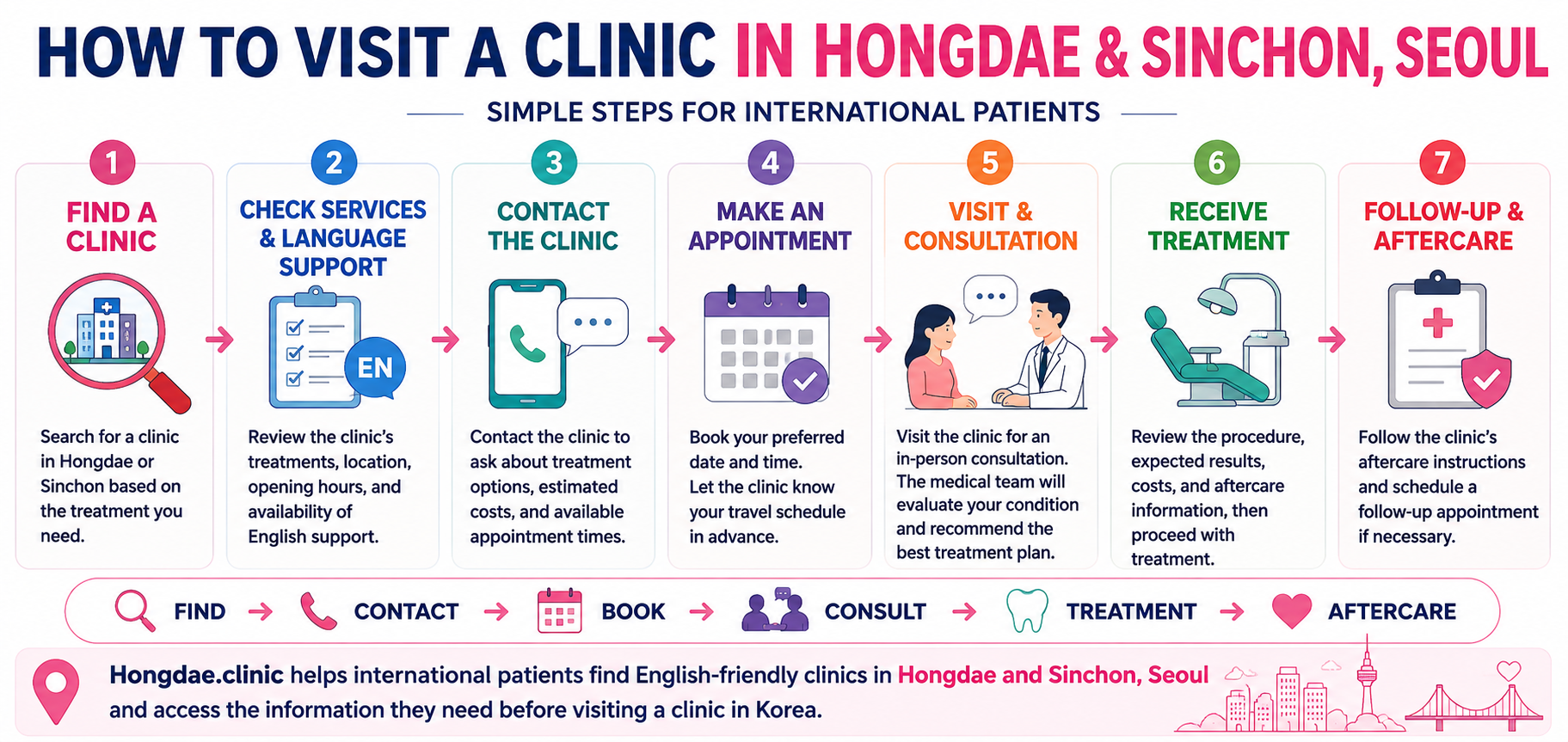
Consultation → eyelid assessment → crease design → surgery → recovery → follow-up.
When Might You Consider Double Eyelid Surgery?
The procedure may be considered for:
- Monolids without a visible upper-eyelid crease
- Weak or inconsistent eyelid folds
- Asymmetric double eyelids
- Multiple eyelid creases
- Heavy-looking upper eyelids
- Desire for a more defined crease
- Previous double eyelid surgery concerns
- Double eyelid concerns combined with ptosis
Technique selection should consider skin, upper-eyelid fat, existing crease anatomy, and eyelid-opening function.
Common Double Eyelid Surgery Methods
Non-Incisional Method
The buried-suture technique creates connections between the eyelid tissues using small openings rather than a full-length incision.
It may be considered for selected patients with relatively little excess skin, although suture-related complications or loss of the crease can occur.
Incisional Method
Incisional double eyelid surgery uses an incision along the planned crease and allows more direct adjustment of skin, muscle, fat, and crease fixation.
It may be preferred when more extensive tissue adjustment or a more stable crease is required.
Double Eyelid Surgery Process
A typical surgical process may include:
- Plastic surgery consultation
- Detailed eyelid assessment
- Evaluation of ptosis and asymmetry
- Selection of crease height and shape
- Incisional or non-incisional surgery
- Crease fixation and symmetry assessment
- Postoperative follow-up
Understanding the specific anatomy of the Asian upper eyelid is important for achieving a stable crease and minimizing complications.
Incisional vs Non-Incisional Double Eyelid Surgery
Non-incisional surgery usually involves less tissue dissection and smaller entry points, while incisional surgery provides greater access to underlying eyelid tissues.
The most appropriate method depends on:
- Skin thickness
- Amount of excess skin
- Eyelid fat
- Existing crease
- Eyelid ptosis
- Desired crease strength
- Previous eyelid surgery
There is no single technique that is best for every patient.
Double Eyelid Surgery vs Upper Blepharoplasty
Double eyelid surgery primarily creates or modifies an upper-eyelid crease, while upper blepharoplasty may focus more broadly on excess skin, fat, or age-related upper-eyelid changes.
The procedures can overlap. In some patients, creating the desired crease may also involve removing or repositioning selected upper-eyelid tissues.
Double Eyelid Surgery and Ptosis Correction
Some patients have blepharoptosis, meaning the upper eyelid itself sits lower than expected because of reduced eyelid-elevating function.
In these cases, creating a crease alone may not fully improve the eye opening. Ptosis correction can be combined with double eyelid surgery when appropriate.
A proper consultation should therefore evaluate both crease formation and eyelid-opening strength.
Double Eyelid Surgery and Epicanthoplasty
Patients with a prominent epicanthal fold may sometimes consider medial epicanthoplasty together with double eyelid surgery.
The epicanthal fold can influence how the inner part of the double eyelid crease appears, so combined treatment may be discussed when a patient wants changes to both the crease and inner eye corner.
Not every patient requires epicanthoplasty.
How Is the Eyelid Crease Designed?
The crease can vary in:
- Height
- Width
- Inner-corner shape
- Parallel or tapered appearance
- Degree of definition
- Symmetry
An excessively high or unnatural crease can be difficult to correct, so the design should be matched to the patient's anatomy rather than copied from another person's eyelids.
When Do Results Appear?
The new crease is visible after surgery, but swelling and temporary asymmetry can make the fold appear higher or stronger during early healing.
The eyelid generally becomes softer and more natural as swelling decreases and the surgical tissues settle.
Final assessment should therefore be made after sufficient healing rather than immediately after surgery.
What Is Recovery Like?
Temporary postoperative symptoms may include:
- Swelling
- Bruising
- Tenderness
- Tightness
- Temporary asymmetry
- Visible incision redness
- Temporary dryness or irritation
- Crease stiffness during early healing
Recovery depends on whether the procedure is incisional or non-incisional and whether other procedures such as ptosis correction or epicanthoplasty are performed simultaneously.
Possible Risks and Complications
Potential complications may include:
- Eyelid asymmetry
- Crease that is too high or too low
- Multiple eyelid folds
- Weakening or loss of the crease
- Visible scarring
- Suture-related problems
- Ptosis
- Dry-eye symptoms
- Unsatisfactory cosmetic results
- Need for revision surgery
Published reviews classify common complications as problems involving crease position, eyelid height, sutures, general eyelid function, and patient dissatisfaction.
Can Double Eyelid Surgery Look Natural?
Yes. Natural-looking results depend on appropriate crease height, eyelid thickness, tissue preservation, symmetry, and harmony with the patient's overall eye shape.
Research and surgical guidance emphasize individualized planning rather than creating an excessively high or standardized crease.
The goal should be a crease that appears natural both when the eyes are open and closed.
Revision Double Eyelid Surgery
Revision surgery may be considered for:
- High double eyelid crease
- Low or disappearing crease
- Multiple folds
- Significant asymmetry
- Deep or unnatural crease
- Visible scars
- Eyelid hollowness
- Surgery-related ptosis
Revision can be more complex because previous surgery creates scar tissue and abnormal tissue attachments.
Double Eyelid Surgery for International Patients
When contacting a plastic surgery clinic, consider asking:
- Is English consultation available?
- Is incisional or non-incisional surgery recommended?
- What crease height and shape suits my eyelids?
- Do I have eyelid ptosis?
- Do I need epicanthoplasty?
- Where will the scar be located?
- How long should I stay in Korea?
- Is postoperative follow-up included?
If you have previously undergone double eyelid surgery, ptosis correction, epicanthoplasty, or other eye surgery, tell the surgeon before treatment because previous procedures can affect surgical planning.
Choosing a Double Eyelid Surgery Clinic in Hongdae or Sinchon
Consider:
- Qualified plastic surgeon
- Detailed Asian eyelid assessment
- Incisional and non-incisional options
- Evaluation for eyelid ptosis
- Customized crease design
- Conservative tissue removal
- Experience with revision eyelid surgery
- English communication
- Transparent surgery costs
Proper understanding of upper-eyelid anatomy and function is important for creating a natural crease and reducing the risk of complications.
Hongdae & Sinchon Medical Care
Hongdae is convenient for patients around:
Hongik University · Yeonnam-dong · Hapjeong · Sangsu · Mapo
Sinchon is convenient for patients around:
Yonsei University · Ewha Womans University · Seodaemun · Mapo
Common searches include:
- Double Eyelid Surgery Hongdae
- Asian Blepharoplasty Hongdae
- Non-Incisional Double Eyelid Hongdae
- Double Eyelid Surgery Sinchon
- Incisional Double Eyelid Sinchon
- English speaking plastic surgery clinic Sinchon
Frequently Asked Questions
What is Double Eyelid Surgery?
Double Eyelid Surgery creates or modifies a visible upper-eyelid crease, commonly using incisional or buried-suture techniques.
Can foreigners get Double Eyelid Surgery in Seoul?
Yes. International patients can contact plastic surgery clinics in Seoul regarding consultation, surgical planning, recovery, and English-language support.
Is incisional or non-incisional surgery better?
Neither method is automatically better. The appropriate choice depends on skin thickness, eyelid fat, excess skin, desired crease, and eyelid anatomy.
Does Double Eyelid Surgery leave a scar?
Incisional surgery creates a scar along the designed eyelid crease, while non-incisional techniques use smaller openings. Scar visibility and healing vary between patients.
Can Double Eyelid Surgery be combined with ptosis correction?
Yes. When true eyelid ptosis is present,
ptosis correction and double eyelid surgery may be performed together to address both eyelid height and crease formation.