Hongdae & Sinchon Endoscopic Forehead Lift
in Seoul, Korea
Endoscopic forehead lift is a surgical procedure designed to lift sagging brows and smooth the upper forehead for a more refreshed appearance. Treatment uses small incisions and an endoscope to reposition forehead tissues while minimizing visible scarring.
Patients seeking an
endoscopic forehead lift in Hongdae or Sinchon should consider surgical technique, expected results, and recovery needs.
If you are concerned about drooping eyebrows, forehead heaviness, lateral brow descent, or a tired-looking upper eye area, an Endoscopic Forehead Lift may be considered to elevate the brow and rejuvenate the upper third of the face. The procedure uses small scalp incisions and endoscopic visualization rather than the longer incision traditionally used in a coronal forehead lift.
Hongdae and Sinchon are convenient areas for forehead and brow lift consultations in Seoul, especially for international residents, students, and travelers seeking facial rejuvenation procedures.
What Is an Endoscopic Forehead Lift?
An Endoscopic Forehead Lift, also called an endoscopic brow lift, is a surgical procedure designed to elevate descended eyebrow and forehead tissues through several relatively small incisions placed around or behind the hairline.
The surgeon uses an endoscope to visualize the deeper tissue planes while releasing selected attachments around the forehead and brow. The tissues are then repositioned and temporarily or permanently secured while healing occurs.
Consultation → brow and forehead assessment → endoscopic release → brow repositioning → fixation → recovery → follow-up.
When Might You Consider an Endoscopic Forehead Lift?
The procedure may be considered for:
- Drooping or low eyebrows
- Lateral brow descent
- Heavy-looking upper eyelids caused partly by brow position
- Forehead tissue descent
- Brow asymmetry
- Tired or angry-looking upper facial expression
- Desire for upper-face rejuvenation
- Brow concerns combined with upper eyelid surgery
The appropriate procedure should be selected according to brow position, forehead height, hairline, skin quality, eyelid anatomy, and degree of tissue descent rather than automatically choosing an endoscopic technique for every patient.
What Can an Endoscopic Forehead Lift Improve?
Drooping Eyebrows
Releasing and repositioning forehead tissues can raise a descended brow to a higher position.
A systematic review and meta-analysis found measurable long-term elevation after endoscopic brow lift, with pooled increases of approximately 3.25 mm medially, 3.86 mm centrally, and 4.35 mm laterally across the included studies.
Lateral Brow Descent
The lateral portion of the eyebrow is often particularly affected by age-related descent. Brow lift techniques can be customized to emphasize lateral elevation when this is the main concern.
Forehead and Glabellar Appearance
Endoscopic forehead surgery may also modify tissues contributing to forehead lines and vertical glabellar lines, although the degree of improvement varies according to technique and facial muscle activity.
Endoscopic Forehead Lift Surgery Process
A typical surgical process may include:
- Plastic surgery consultation
- Assessment of brow height and asymmetry
- Evaluation of forehead and hairline proportions
- Several small scalp incisions
- Endoscopic release of selected forehead attachments
- Repositioning and fixation of the brow tissues
- Postoperative follow-up
Successful brow elevation generally requires adequate release of the tissues around the supraorbital region before the brow is repositioned.
Endoscopic vs Traditional Forehead Lift
A traditional open forehead lift generally uses a longer incision, while an endoscopic lift uses several smaller access incisions.
Potential advantages of the endoscopic approach can include:
- Smaller individual incisions
- Less extensive external scarring
- Direct visualization through an endoscope
- Avoidance of a full coronal incision
- Ability to reposition deeper forehead tissues
However, open techniques remain useful for selected patients, particularly when significant skin excess, forehead height, hairline position, or specific brow anatomy makes another approach more suitable.
Current comparative evidence does not support one brow lift method as universally best for every patient.
Endoscopic Forehead Lift vs Temporal Brow Lift
An Endoscopic Forehead Lift generally addresses a broader portion of the forehead and brow complex.
A temporal or lateral brow lift focuses more selectively on the outer eyebrow through limited temporal incisions.
A recent long-term clinical series reported durable lateral brow elevation with a temporal approach, illustrating why patients whose primary concern is isolated lateral brow descent may not necessarily need a full forehead lift.
The most appropriate operation depends on which part of the eyebrow requires correction.
Endoscopic Forehead Lift vs Upper Blepharoplasty
These procedures treat different anatomical concerns.
Upper blepharoplasty primarily treats excess upper-eyelid tissue, while an Endoscopic Forehead Lift raises descended forehead and brow tissues.
Some patients who believe they have heavy eyelids actually have a combination of:
- Brow descent
- Upper-eyelid skin excess
- Eyelid ptosis
- Natural eyelid anatomy
For this reason, the brow and upper eyelid should be evaluated together before deciding which procedure is appropriate.
Can an Endoscopic Forehead Lift Make the Eyes Look More Open?
It can in selected patients.
When brow descent contributes to heaviness over the upper eyelids, elevating the brow may expose more of the upper-eyelid area and create a more open upper-face appearance.
However, the procedure does not directly correct true eyelid ptosis or every form of excess eyelid skin. Additional eyelid surgery may be required when those concerns are present.
How Is the Brow Held in Position?
After forehead tissues are released and elevated, the new position must be supported while healing occurs.
Different fixation methods include:
- Temporary suspension techniques
- Sutures
- Bone tunnels
- Absorbable fixation systems
- Other temporary or permanent fixation devices
A recent systematic review and meta-analysis comparing fixation methods found generally low complication rates and no clear difference in revision for loss of fixation between permanent and temporary bone-fixation categories.
How Long Do the Results Last?
Endoscopic brow lifting can provide measurable long-term elevation, although some degree of tissue settling or recurrent brow descent may occur.
The most recent meta-analysis found persistent elevation across the medial, central, and lateral brow at long-term follow-up.
However, a large 650-patient study found that satisfaction was higher at six months than after two or more years, demonstrating that aging, tissue relaxation, and undercorrection can influence long-term perception of results.
The operation does not stop the natural aging process.
When Do Results Appear?
The brow position changes immediately after surgery, but early results may appear exaggerated because of:
- Swelling
- Temporary tissue tightness
- Bruising
- Elevated initial fixation
- Temporary asymmetry
The forehead and eyebrows gradually settle as swelling decreases and tissues heal.
Long-term studies evaluate brow position months or years after surgery rather than relying on the immediate postoperative appearance.
What Is Recovery Like?
Temporary postoperative symptoms may include:
- Forehead swelling
- Bruising
- Scalp tightness
- Headache
- Itching
- Temporary numbness
- Temporary brow asymmetry
- Temporary weakness of forehead movement
In a study of 650 Endoscopic Forehead Lift procedures, temporary issues included itching, headache, transient facial nerve weakness, and forehead numbness, with numbness resolving on average over several months.
Recovery varies according to surgical technique, fixation method, and whether additional facial or eyelid procedures are performed.
Possible Risks and Complications
Potential complications may include:
- Bleeding or hematoma
- Infection
- Scalp numbness or altered sensation
- Brow asymmetry
- Under-correction
- Excessive brow elevation
- Alopecia around incision sites
- Forehead contour irregularities
- Facial nerve weakness
- Visible scars
- Need for revision surgery
Systematic reviews identify paresthesia, asymmetry, alopecia, scarring, and eyelid closure changes among reported complications of endoscopic brow lift procedures.
Facial Nerve Risk
Branches of the facial nerve control forehead and eyebrow movement and are located near the surgical region.
Temporary weakness can occur after endoscopic forehead surgery.
In the 650-patient long-term series, temporary unilateral facial nerve palsy was reported in a minority of patients, while older large case series have also described transient frontal branch weakness.
Permanent weakness appears substantially less common, but it remains an important risk to discuss before surgery.
Can an Endoscopic Forehead Lift Cause Hair Loss?
Yes.
Temporary or persistent alopecia around the scalp incisions can occur.
A systematic review of brow lift complications reported alopecia after endoscopic brow lift, while a large long-term series also documented permanent alopecia in a minority of patients.
Risk may depend on incision placement, tissue handling, fixation, and individual hair characteristics.
Can the Brow Drop Again?
Yes.
Some degree of recurrent brow descent or undercorrection can occur as tissues heal and aging continues.
Long-term research demonstrates measurable persistent elevation overall, but individual patients can experience relapse, undercorrection, or changes in satisfaction over time.
Stable release, appropriate fixation, and realistic initial positioning are important considerations.
Can an Endoscopic Forehead Lift Look Natural?
Yes.
Natural-looking results generally depend on:
- Appropriate brow height
- Preservation of individual eyebrow shape
- Avoiding excessive lateral elevation
- Balanced left-right symmetry
- Forehead and eyelid proportions
- Conservative surgical planning
Excessive elevation can produce a surprised appearance, which has been reported as a possible long-term complication.
The goal should therefore be balanced upper-face rejuvenation rather than lifting the brow as high as possible.
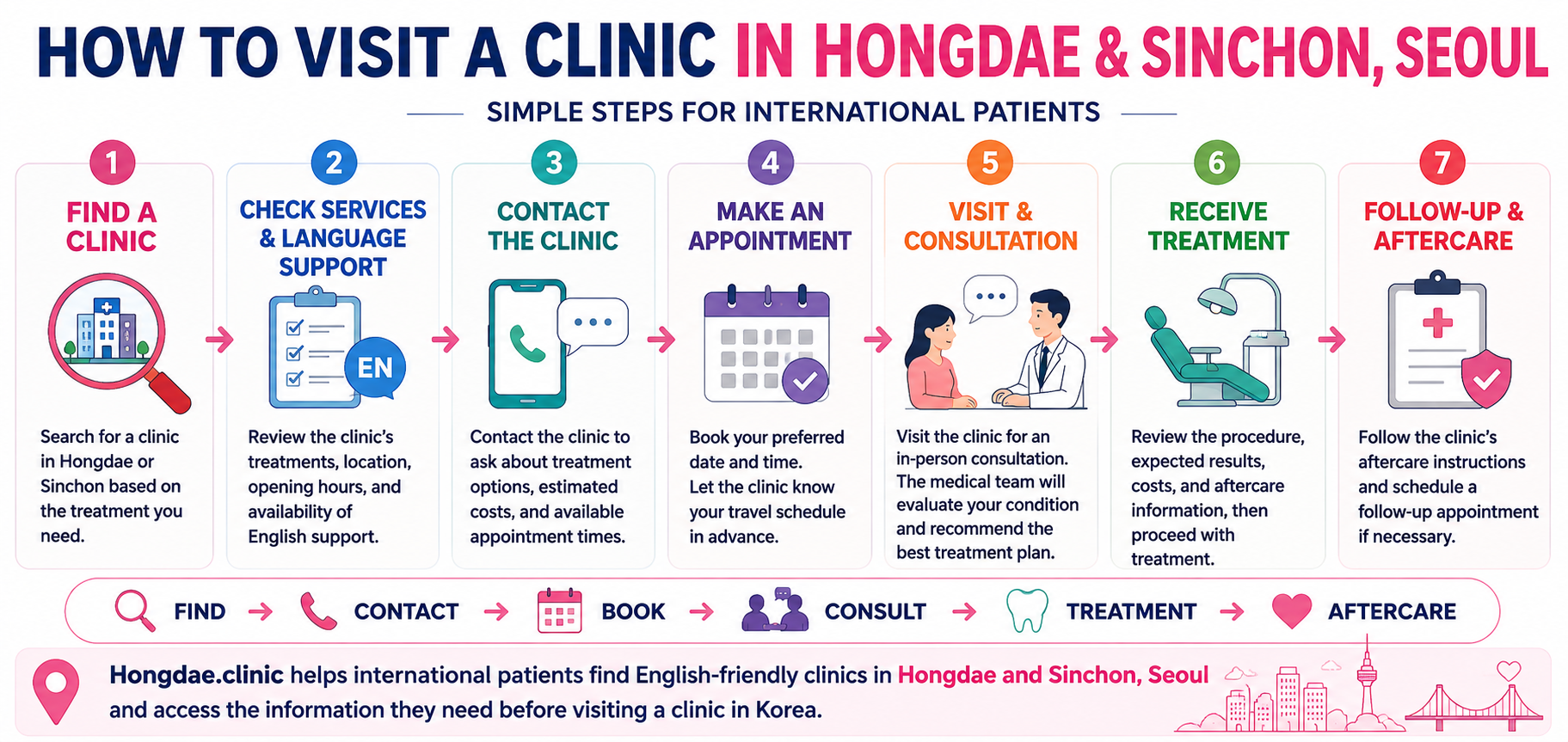
Endoscopic Forehead Lift for International Patients
When contacting a plastic surgery clinic, consider asking:
- Is English consultation available?
- Is my concern caused by brow descent or excess eyelid skin?
- Am I suitable for an endoscopic approach?
- How much brow elevation is recommended?
- Which fixation technique will be used?
- Where will the scalp incisions be located?
- What is the risk of numbness or hair loss?
- How long should I stay in Korea?
- Is postoperative follow-up included?
If you have previously undergone a forehead lift, brow lift, facelift, upper blepharoplasty, hair transplantation, or forehead surgery, tell the surgeon because previous procedures can affect surgical planning. Secondary endoscopic forehead lift has been described even after previous open brow surgery, but revision anatomy requires careful assessment.
Choosing an Endoscopic Forehead Lift Clinic in Hongdae or Sinchon
Consider:
- Qualified plastic surgeon
- Experience with endoscopic brow surgery
- Detailed brow and eyelid assessment
- Evaluation of hairline and forehead height
- Customized brow-shape planning
- Knowledge of facial nerve anatomy
- Clear explanation of fixation technique
- Discussion of alopecia and sensory changes
- English communication
- Transparent surgery costs
The available evidence shows that several brow lift techniques can provide satisfactory outcomes, making patient selection and anatomically appropriate technique choice important rather than relying on the procedure name alone.
Hongdae & Sinchon Medical Care
Hongdae is convenient for patients around:
Hongik University · Yeonnam-dong · Hapjeong · Sangsu · Mapo
Sinchon is convenient for patients around:
Yonsei University · Ewha Womans University · Seodaemun · Mapo
Common searches include:
- Endoscopic Forehead Lift Hongdae
- Endoscopic Brow Lift Hongdae
- Forehead Lift Hongdae
- Endoscopic Forehead Lift Sinchon
- Brow Lift Surgery Sinchon
- English speaking plastic surgery clinic Sinchon
Frequently Asked Questions
What is an Endoscopic Forehead Lift?
An Endoscopic Forehead Lift is a brow-lifting procedure performed through small scalp incisions using endoscopic visualization, allowing forehead tissues to be released, repositioned, and fixed at a higher position.
Is an Endoscopic Forehead Lift the same as a Brow Lift?
It is one type of brow lift. Other approaches include coronal, hairline, direct, and temporal brow lifts, and the appropriate technique depends on anatomy and the desired correction.
How long does an Endoscopic Forehead Lift last?
Long-term studies show persistent brow elevation after endoscopic surgery, although some settling, recurrent descent, or reduced satisfaction can occur over time.
Can Endoscopic Forehead Lift cause numbness or hair loss?
Yes. Temporary forehead or scalp numbness and alopecia around incision sites are recognized complications, although severity and duration vary between patients.
Can foreigners get an Endoscopic Forehead Lift in Seoul?
Yes. International patients can contact plastic surgery clinics in Seoul regarding consultation, surgical planning, recovery, postoperative monitoring, and English-language support.