Hongdae & Sinchon Epicanthoplasty
in Seoul, Korea
Epicanthoplasty is an eye surgery designed to modify the inner eyelid fold and create a more open, defined eye appearance.
The procedure may reshape the medial canthal area based on individual eyelid anatomy and aesthetic goals.
Patients seeking
epicanthoplasty in Hongdae or Sinchon should consider surgical technique, scar management, and recovery needs.
If you are concerned about prominent inner-eye folds, a short-looking horizontal eye shape, or limited exposure of the inner corners of the eyes, epicanthoplasty may be considered to reshape the medial epicanthal fold. The procedure should be customized according to eyelid anatomy, fold severity, eye spacing, and desired appearance.
Hongdae and Sinchon are convenient areas for plastic surgery consultations in Seoul, especially for international residents, students, and travelers.
What Is Epicanthoplasty?
Epicanthoplasty is eyelid surgery designed to reshape or reduce the epicanthal fold, the skin and soft-tissue fold covering part of the inner corner of the eye.
In Asian cosmetic eyelid surgery, the term most commonly refers to medial epicanthoplasty, which modifies the inner eye corner while aiming to maintain a natural appearance.
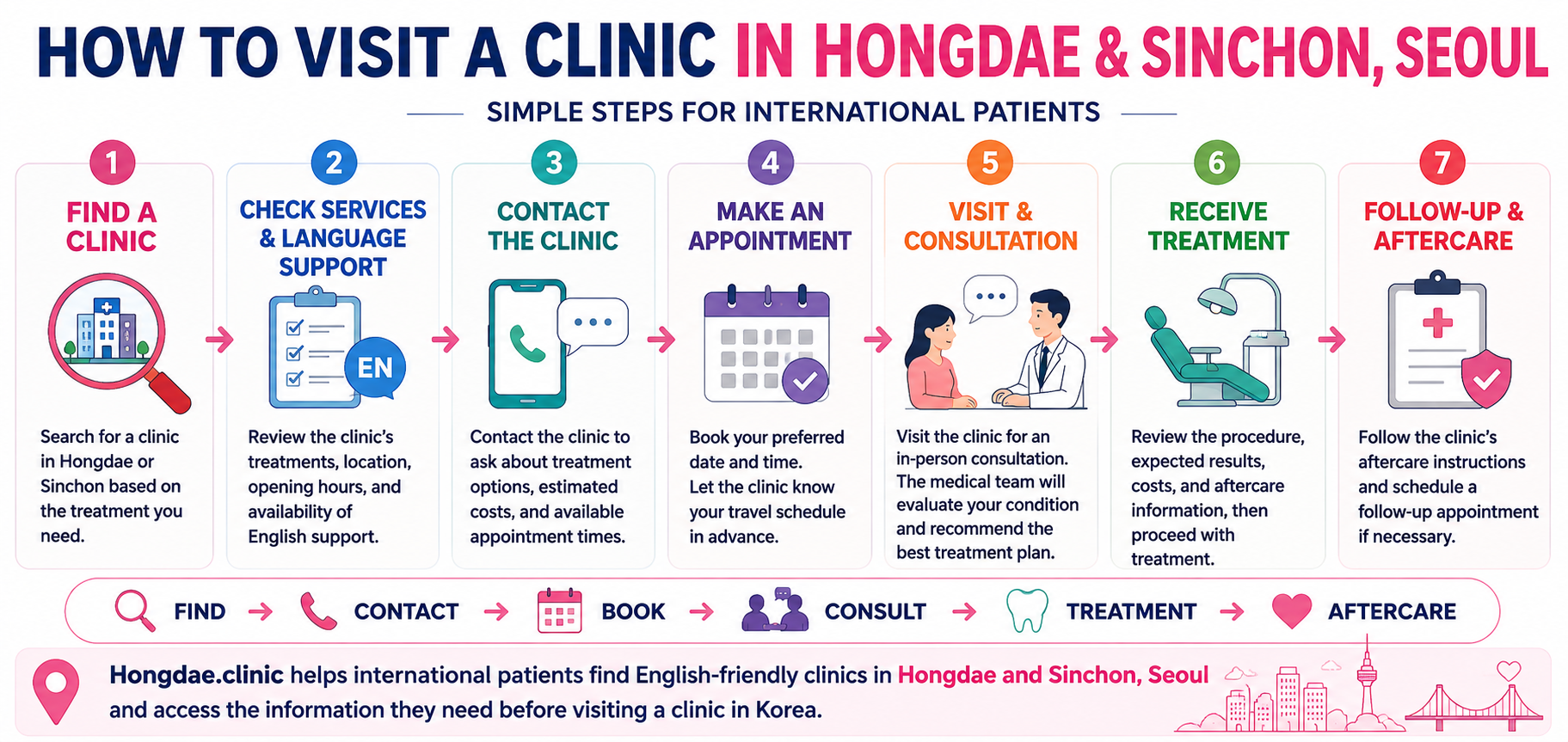
Consultation → eyelid assessment → surgical planning → epicanthoplasty → recovery → follow-up.
When Might You Consider Epicanthoplasty?
Epicanthoplasty may be considered for:
- Prominent medial epicanthal folds
- Covered inner eye corners
- Short-looking horizontal eye shape
- Wide-appearing distance between the inner corners
- Desire for greater inner-corner definition
- Eyelid asymmetry
- Combination with double eyelid surgery
The amount of correction should be based on individual anatomy rather than creating the same inner-eye shape for every patient.
Common Epicanthoplasty Goals
Inner Corner Refinement
The procedure can expose more of the medial eye corner by releasing or rearranging tissue within the epicanthal fold.
Horizontal Eye Length
Reducing a prominent fold can make the visible eye opening appear longer toward the inner corner.
Improved Eyelid Balance
Epicanthoplasty may help create better balance between the inner corner and the overall eyelid shape, particularly when combined with upper eyelid surgery.
Epicanthoplasty Treatment Process
A typical surgical process may include:
- Plastic surgery consultation
- Detailed eyelid and epicanthal-fold assessment
- Preoperative measurements and surgical design
- Small incisions around the medial eye corner
- Release and rearrangement of underlying tissue
- Careful wound closure
- Postoperative follow-up
Modern techniques place particular emphasis on releasing tissue tension while minimizing visible incisions and scar formation.
Common Epicanthoplasty Techniques
Z-Epicanthoplasty
Z-plasty techniques rearrange small skin flaps around the inner corner to reduce the epicanthal fold and redistribute tension.
Skin-Redraping Technique
Skin-redraping methods release underlying tension and reposition the skin to create a more natural medial eye contour while attempting to minimize visible scarring.
Customized Techniques
Different flap designs and tissue-release methods may be selected according to the severity and anatomical pattern of the epicanthal fold.
Epicanthoplasty vs Double Eyelid Surgery
Epicanthoplasty reshapes the inner eye corner, while double eyelid surgery creates or modifies the upper eyelid crease.
The procedures may be performed:
- Separately
- During the same operation
- As part of broader Asian eyelid surgery
Epicanthoplasty is frequently combined with upper blepharoplasty when the epicanthal fold influences the desired eyelid-crease shape.
Can Epicanthoplasty Make the Eyes Look Bigger?
Epicanthoplasty does not physically enlarge the eyeball.
Instead, reducing the epicanthal fold can expose more of the inner eye corner and increase the visible horizontal eye opening, which may create a more open appearance.
The degree of change depends on existing anatomy and how much correction can be performed naturally.
Can Epicanthoplasty Change Eye Spacing?
Epicanthoplasty can make the visible distance between the inner corners appear smaller by exposing more of the medial canthal area.
Clinical studies have documented reductions in measured inner canthal distance after medial epicanthoplasty.
However, excessive correction should be avoided because it can create an unnatural inner-eye appearance.
Does Epicanthoplasty Leave a Scar?
Some degree of scarring is possible because the procedure requires incisions around a highly visible area.
Modern techniques attempt to reduce scarring through:
- Shorter incisions
- Reduced wound tension
- Careful tissue release
- Precise wound closure
- Strategic scar placement
Scarring remains one of the most important considerations in medial epicanthoplasty.
When Do Results Appear?
The change in the inner eye corner is visible after surgery, but swelling, redness, and early scar formation can temporarily affect the appearance.
The result generally becomes more natural as swelling decreases and scars mature.
Scar redness or firmness can take several months to improve, so the final result should not be judged during early healing.
What Is Recovery Like?
Temporary postoperative symptoms may include:
- Swelling
- Bruising
- Redness
- Tenderness
- Temporary tightness
- Visible early incision lines
- Mild asymmetry during healing
Patients should follow their surgeon's instructions regarding wound care, makeup, exercise, sun protection, and scar management.
Possible Risks and Complications
Potential complications may include:
- Visible or hypertrophic scarring
- Under-correction
- Over-correction
- Asymmetry
- Recurrence of the epicanthal fold
- Unnatural inner-corner shape
- Excessive exposure of the lacrimal lake
- Need for revision surgery
Published studies specifically identify scarring and excessive medial-corner exposure as important concerns after epicanthoplasty.
Can Epicanthoplasty Look Natural?
Yes. Natural-looking results generally depend on conservative correction, appropriate tissue release, and preservation of a smooth inner-eye contour.
Modern techniques increasingly focus on reducing excessive tension and avoiding overly aggressive exposure of the medial canthus.
The goal should be improved balance rather than completely eliminating every trace of the natural epicanthal fold.
Epicanthoplasty for Asian Eyes
The epicanthal fold is a common anatomical characteristic among East Asian eyelids, although its shape, severity, and relationship with the upper eyelid crease vary significantly between individuals.
For this reason, surgery should be based on:
- Individual epicanthal-fold anatomy
- Existing double eyelid crease
- Eye spacing
- Eyelid thickness
- Inner-corner shape
- Personal aesthetic preference
Treatment should not be based on ethnicity alone.
Epicanthoplasty for International Patients
When contacting a plastic surgery clinic, consider asking:
- Is English consultation available?
- What type of epicanthal fold do I have?
- Which epicanthoplasty technique is recommended?
- How much inner-corner exposure is appropriate?
- Will double eyelid surgery also be recommended?
- Where will the scars be located?
- How long should I stay in Korea?
- Is postoperative follow-up included?
If you are visiting Korea temporarily, discuss the timing of suture removal, wound checks, and scar-care follow-up before departure.
Choosing an Epicanthoplasty Clinic in Hongdae or Sinchon
Consider:
- Qualified plastic surgeon
- Detailed eyelid and medial-canthus assessment
- Experience with Asian eyelid surgery
- Customized epicanthoplasty design
- Conservative tissue removal
- Scar-minimizing surgical technique
- Natural eye-proportion planning
- English communication
- Transparent surgery costs
There are many epicanthoplasty techniques, and current literature emphasizes selecting the procedure according to the individual anatomy and severity of the epicanthal fold.
Hongdae & Sinchon Medical Care
Hongdae is convenient for patients around:
Hongik University · Yeonnam-dong · Hapjeong · Sangsu · Mapo
Sinchon is convenient for patients around:
Yonsei University · Ewha Womans University · Seodaemun · Mapo
Common searches include:
- Epicanthoplasty Hongdae
- Inner Corner Eye Surgery Hongdae
- Medial Epicanthoplasty Hongdae
- Epicanthoplasty Sinchon
- Asian Eyelid Surgery Sinchon
- English speaking plastic surgery clinic Sinchon
Frequently Asked Questions
What is epicanthoplasty?
Epicanthoplasty is surgery that reshapes or reduces the epicanthal fold around the inner corner of the eye.
Can foreigners get epicanthoplasty in Seoul?
Yes. International patients can contact plastic surgery clinics in Seoul regarding consultation, surgical planning, recovery, and English-language support.
Is epicanthoplasty the same as double eyelid surgery?
No. Epicanthoplasty modifies the inner eye corner, while double eyelid surgery primarily creates or adjusts the upper eyelid crease. The procedures are often performed together.
Does epicanthoplasty leave scars?
Scarring is possible. Modern techniques aim to minimize it by reducing incision length and releasing wound tension, but individual scar formation varies.
Can the epicanthal fold return after surgery?
Recurrence or under-correction can occur, although modern tension-releasing and customized techniques are designed to reduce this risk.