Hongdae & Sinchon Eye Lift Surgery
in Seoul, Korea
Eye lift surgery is a procedure designed to improve drooping or sagging around the eyes for a more refreshed and balanced appearance. Treatment may involve upper or lower eyelid correction depending on individual anatomy and aging concerns.
Patients seeking
eye lift surgery in Hongdae or Sinchon should consider surgical approach, expected results, and recovery needs.
If you are concerned about heavy upper eyelids, excess eyelid skin, drooping brows, or a tired-looking eye area, eye lift surgery may be considered to create a more open and refreshed appearance. “Eye lift” is a broad term rather than one standardized operation, so the appropriate procedure depends on whether the main concern comes from the eyelid skin, eyebrow position, eyelid-opening muscles, or a combination of these factors.
Hongdae and Sinchon are convenient areas for plastic surgery consultations in Seoul, especially for international residents, students, and travelers.
What Is Eye Lift Surgery?
Eye lift surgery commonly refers to surgical procedures designed to improve aging or drooping around the upper eye area.
Depending on the patient's anatomy, treatment may include upper blepharoplasty, brow lifting, ptosis correction, or a combination of procedures. Proper assessment of the brow and upper eyelid as one aesthetic unit is important when planning treatment.
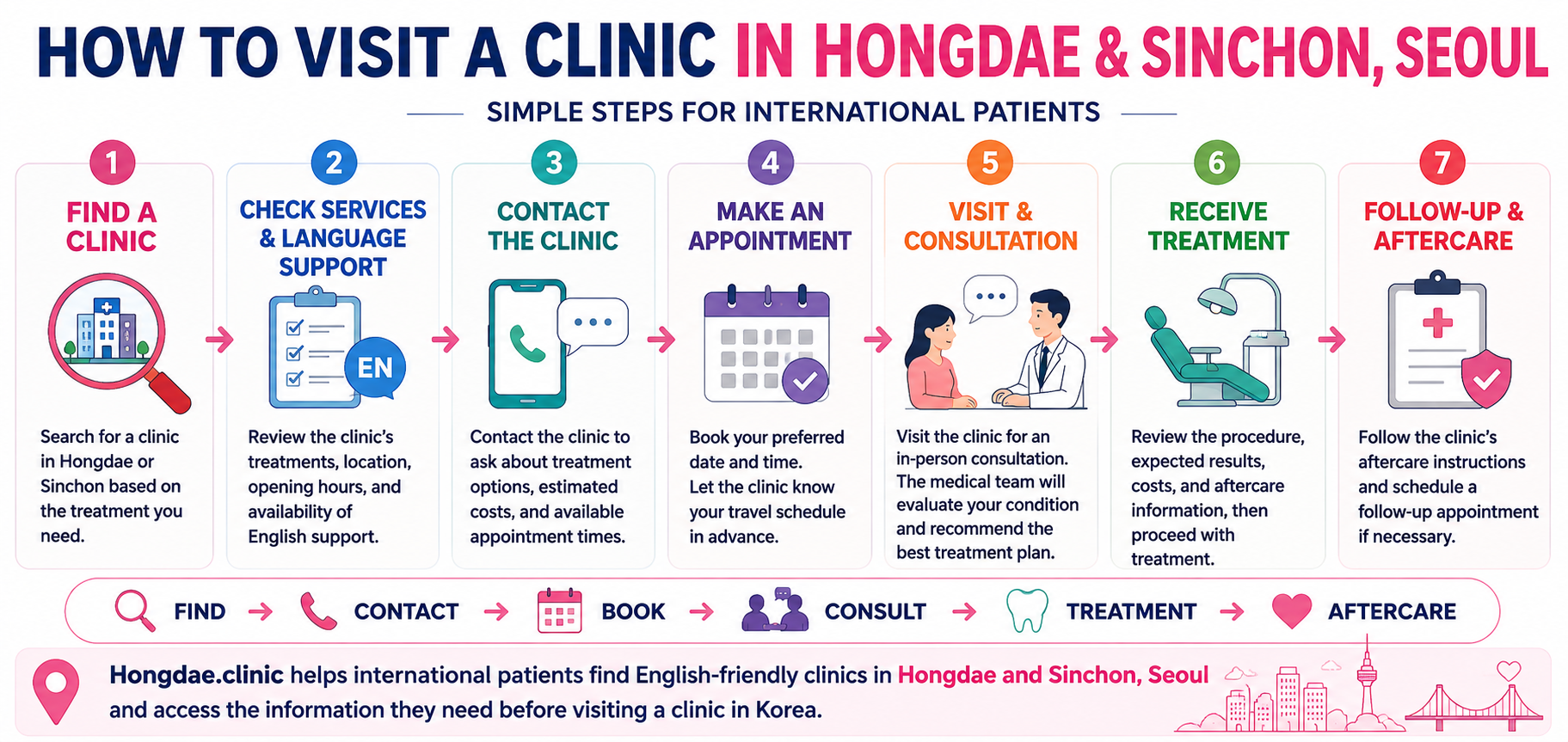
Consultation → eyelid assessment → surgical planning → eye lift surgery → recovery → follow-up.
When Might You Consider Eye Lift Surgery?
Eye lift surgery may be considered for:
- Excess upper eyelid skin
- Heavy-looking eyelids
- Drooping eyebrows
- Lateral eyelid hooding
- Eyelid asymmetry
- Reduced upper eyelid definition
- Ptosis affecting the eye opening
- Aging-related changes around the eyes
A detailed examination is important because excess eyelid skin, brow descent, and true eyelid ptosis are different conditions and may require different treatments.
Common Eye Lift Procedures
Upper Blepharoplasty
Upper blepharoplasty removes or repositions selected excess skin and, when appropriate, other eyelid tissues to improve upper-eyelid contour. Systematic reviews report generally high patient satisfaction following appropriately performed upper blepharoplasty.
Brow Lift
A brow lift addresses drooping eyebrow position and forehead tissues rather than simply removing eyelid skin.
Ptosis Correction
Ptosis surgery addresses an eyelid that sits too low because of problems involving the muscles or structures responsible for elevating the upper eyelid. Ptosis correction may sometimes be performed together with blepharoplasty.
Eye Lift Surgery Process
A typical surgical process may include:
- Plastic surgery consultation
- Detailed eyelid and brow assessment
- Evaluation of eyelid symmetry and function
- Customized surgical design
- Upper eyelid, brow, or ptosis correction
- Careful wound closure
- Postoperative follow-up
Pre-existing brow position, eyelid ptosis, asymmetry, and volume changes should be evaluated before upper eyelid surgery.
Eye Lift vs Upper Blepharoplasty
Upper blepharoplasty specifically focuses on the upper eyelids, while “eye lift” can refer more broadly to procedures involving the eyelids, eyebrow position, or both.
For example, removing upper-eyelid skin alone may not fully address a patient whose heaviness primarily results from brow ptosis. Evaluation of the brow-upper-eyelid relationship is therefore important before deciding on surgery.
Eye Lift vs Brow Lift
A brow lift raises or repositions the eyebrow area, while upper eyelid surgery primarily addresses tissues of the eyelid itself.
Some patients require only one procedure, while others may benefit from a combined approach. Studies have also found that eyebrow position can change after upper-eyelid surgery, making preoperative brow assessment particularly important.
Can Eye Lift Surgery Make the Eyes Look Bigger?
Eye lift surgery does not enlarge the eyeball itself.
Removing excess upper-eyelid skin or correcting eyelid ptosis can make more of the eye visible and may create a more open or alert appearance. Upper blepharoplasty can also increase the visible upper-eyelid platform and, in selected functional cases, improve the visual field.
Functional Eye Lift Surgery
Upper eyelid surgery is not always performed only for cosmetic reasons.
When excess eyelid tissue interferes with vision, upper blepharoplasty may improve visual-field function and vision-related quality of life in selected patients.
If the eyelid itself is abnormally low, evaluation for true ptosis is also important before deciding which surgery is appropriate.
When Do Results Appear?
Changes are visible after surgery, but swelling and bruising can temporarily affect eyelid shape and symmetry.
The eye area generally becomes more natural as postoperative swelling decreases and incision lines mature.
Because brow position and eyelid tissues can continue adjusting after surgery, final results should be evaluated after adequate healing rather than during the early postoperative period.
What Is Recovery Like?
Temporary postoperative symptoms may include:
- Swelling
- Bruising
- Tenderness
- Tightness
- Temporary dryness or irritation
- Mild asymmetry
- Temporary changes in eyelid sensation
Studies of upper blepharoplasty report generally favorable outcomes, although eyelid surgery can temporarily affect the ocular surface, eyelid closure, or sensation in some patients.
Possible Risks and Complications
Potential complications may include:
- Bleeding
- Infection
- Visible scarring
- Eyelid asymmetry
- Dry-eye symptoms
- Difficulty fully closing the eyes
- Under- or over-correction
- Changes in eyelid position
- Need for revision surgery
A recent meta-analysis found a higher rate of lagophthalmos, or incomplete eyelid closure, with techniques involving both muscle and skin excision compared with skin-only excision, highlighting the importance of conservative and individualized surgical planning.
Can Eye Lift Surgery Correct Asymmetry?
Selected eyelid asymmetry can be improved, but perfect symmetry cannot always be guaranteed.
The surgeon should evaluate:
- Eyebrow height
- Eyelid crease position
- Amount of excess skin
- Eyelid-opening strength
- Existing ptosis
- Orbital anatomy
Pre-existing asymmetry and ptosis are important factors to identify before upper eyelid surgery because they can influence the postoperative result.
Eye Lift Surgery for Asian Eyes
Asian eyelid surgery may require particular attention to eyelid crease anatomy, brow position, skin thickness, and individual aesthetic preference.
Eye lift surgery should therefore be customized rather than automatically creating a high or deeply defined eyelid crease.
A meta-analysis also found measurable postoperative changes in brow position after procedures including upper blepharoplasty, double-eyelid surgery, and ptosis correction, reinforcing the importance of evaluating the entire upper-eye region.
Eye Lift Surgery for International Patients
When contacting a plastic surgery clinic, consider asking:
- Is English consultation available?
- Is my concern caused by eyelid skin, brow position, or ptosis?
- Do I need upper blepharoplasty?
- Is a brow lift or ptosis correction also recommended?
- Where will the incision be located?
- What downtime should I expect?
- How long should I stay in Korea?
- Is postoperative follow-up included?
If you have dry eyes, previous eye surgery, vision problems, or previous eyelid procedures, tell the surgeon before treatment because these factors may affect surgical planning.
Choosing an Eye Lift Surgery Clinic in Hongdae or Sinchon
Consider:
- Qualified plastic surgeon
- Detailed eyelid and brow assessment
- Evaluation for true eyelid ptosis
- Conservative skin and tissue removal
- Attention to eyelid function
- Customized surgical planning
- Clear discussion of scars and recovery
- English communication
- Transparent surgery costs
Successful upper-eye rejuvenation depends on accurately identifying whether the main problem comes from the brow, eyelid skin, eyelid muscles, volume changes, or several factors together.
Hongdae & Sinchon Medical Care
Hongdae is convenient for patients around:
Hongik University · Yeonnam-dong · Hapjeong · Sangsu · Mapo
Sinchon is convenient for patients around:
Yonsei University · Ewha Womans University · Seodaemun · Mapo
Common searches include:
- Eye Lift Surgery Hongdae
- Upper Eyelid Surgery Hongdae
- Blepharoplasty Hongdae
- Eye Lift Surgery Sinchon
- Upper Eyelid Lift Sinchon
- English speaking plastic surgery clinic Sinchon
Frequently Asked Questions
What is eye lift surgery?
Eye lift surgery is a broad term that may include upper blepharoplasty, brow lifting, ptosis correction, or combinations of these procedures depending on the cause of the drooping or heavy eye appearance.
Can foreigners get eye lift surgery in Seoul?
Yes. International patients can contact plastic surgery clinics in Seoul regarding consultation, surgical planning, recovery, and English-language support.
Is an eye lift the same as blepharoplasty?
Not necessarily. Blepharoplasty specifically treats eyelid tissues, while the term eye lift may also include brow lifting or ptosis correction.
Can eye lift surgery improve vision?
Yes, in selected patients whose excess upper-eyelid tissue obstructs their visual field. Systematic reviews have reported improvements in visual field and vision-related quality of life after functional upper blepharoplasty.
Can eye lift surgery correct drooping eyelids?
It depends on the cause. Excess skin may be treated with
blepharoplasty, while true eyelid ptosis may require surgery addressing the eyelid-elevating structures.