Hongdae & Sinchon Fat Transfer Butt Augmentation
in Seoul, Korea
Fat transfer butt augmentation is a surgical procedure designed to enhance buttock volume and shape using fat taken from other areas of the body. Treatment typically includes liposuction, fat processing, and careful fat injection based on individual body proportions and aesthetic goals. Patients seeking fat transfer butt augmentation in Hongdae or Sinchon should consider surgical technique, expected results, and recovery needs.
If you are concerned about limited buttock projection, flat gluteal contours, hip dips, or an imbalance between the waist and hips, Fat Transfer Butt Augmentation may be considered to reshape the buttocks using your own fat. Also called gluteal fat grafting or Brazilian Butt Lift (BBL), the procedure combines Liposuction with fat transfer to increase selected areas of the buttocks.
Because gluteal fat grafting has historically been associated with pulmonary fat embolism, modern safety recommendations emphasize placing fat only in the subcutaneous layer above the gluteal fascia and using real-time ultrasound to confirm the cannula position during injection.
Hongdae and Sinchon are convenient areas for Fat Transfer Butt Augmentation consultations in Seoul, especially for international residents and travelers considering body-contouring procedures.
What Is Fat Transfer Butt Augmentation?
Fat Transfer Butt Augmentation uses fat harvested from another part of the body to increase or reshape buttock volume.
Common donor areas include:
- Abdomen
- Waist
- Flanks
- Lower back
- Thighs
- Other areas with suitable subcutaneous fat
The harvested fat is processed and transferred into selected parts of the buttocks. Prospective studies using ultrasound and three-dimensional measurements have demonstrated measurable increases in buttock projection and subcutaneous fat thickness after gluteal fat grafting.
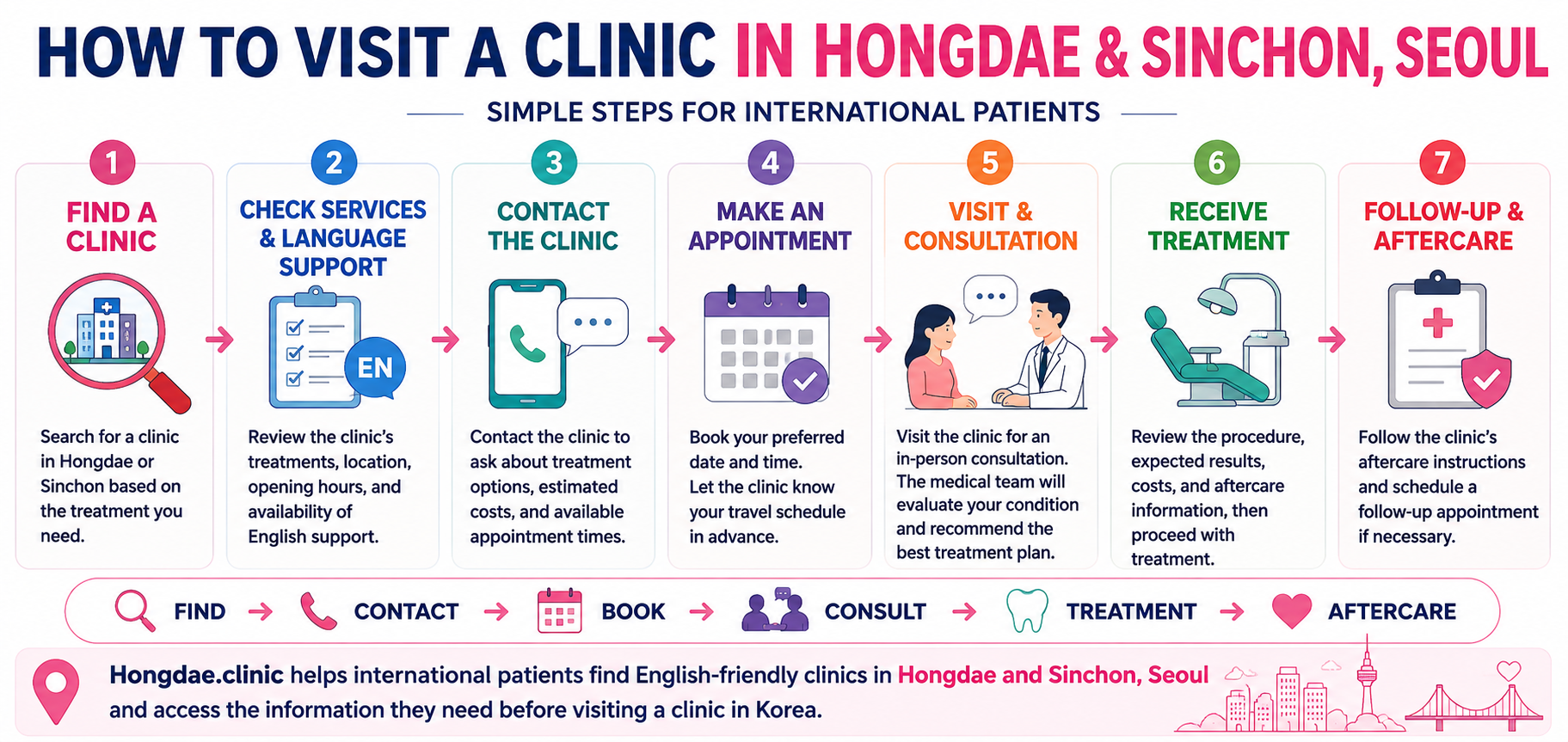
Consultation → donor-area assessment → Liposuction → fat processing → ultrasound-guided subcutaneous fat transfer → recovery → follow-up.
When Might You Consider Fat Transfer Butt Augmentation?
Fat Transfer Butt Augmentation may be considered for:
- Flat or under-projected buttocks
- Limited upper-buttock fullness
- Hip dips
- Left-right asymmetry
- Desire for rounder buttock contours
- Desire for improved waist-to-hip proportions
- Adequate donor fat for transfer
- Preference for autologous fat rather than implants
The achievable result depends on available donor fat, existing buttock anatomy, skin quality, safe subcutaneous capacity, and the amount of transferred fat that survives long term.
How Does Fat Transfer Butt Augmentation Work?
1. Liposuction
Fat is harvested from selected donor regions, often including the abdomen, waist, flanks, back, or thighs.
The Liposuction component can contribute significantly to the overall silhouette because removing waist and flank fat may make the buttocks appear more prominent even before considering the transferred volume.
2. Fat Processing
The harvested tissue is prepared for reinjection.
Processing techniques differ between surgeons, and not every harvested fat cell will ultimately survive after transfer.
3. Fat Injection
The prepared fat is placed strategically into the buttock region to modify:
- Projection
- Upper-pole fullness
- Lateral contours
- Hip dips
- Symmetry
Current multi-society safety guidance supports subcutaneous-only fat placement above the gluteal fascia, with real-time ultrasound used to visualize the cannula during injection.
Fat Transfer Butt Augmentation Surgery Process
A typical procedure may include:
- Plastic surgery consultation
- Assessment of donor fat and body proportions
- Evaluation of buttock shape and skin quality
- Liposuction of selected donor areas
- Processing of harvested fat
- Ultrasound-guided subcutaneous fat injection
- Postoperative monitoring and follow-up
In a retrospective series of 1,815 ultrasound-guided gluteal fat-transfer patients, all fat over the gluteal muscle was placed in the subcutaneous plane. The overall postoperative complication rate was 4%, with seroma, localized skin ischemia, and surgical-site infection among the most common complications; no macroscopic fat embolism or mortality occurred in that series.
Why Is Ultrasound Guidance Important?
Ultrasound allows the surgeon to see the cannula relative to the subcutaneous tissue and underlying gluteal fascia while fat is being injected.
This is important because external landmarks alone cannot confirm the exact depth of the cannula throughout the procedure. Professional plastic-surgery organizations support real-time ultrasound as a safety measure to help confirm that injections remain above the muscle fascia.
A recent 177-patient study using Doppler ultrasound-guided subcutaneous gluteal fat grafting reported hematomas, seromas, and one wound dehiscence but no deep vein thrombosis, pulmonary embolism, infection, or death in that cohort.
Why Should Fat Stay Above the Gluteal Muscle?
The gluteal muscles contain large blood vessels that communicate with the central circulation.
Historical safety research involving 198,857 reported gluteal fat-grafting procedures found that surgeons injecting into the deep muscle experienced significantly higher rates of fatal and nonfatal pulmonary fat embolism.
For this reason, current safety guidance emphasizes avoiding intramuscular injection and keeping transferred fat within the subcutaneous space above the fascia.
Pulmonary Fat Embolism
Pulmonary fat embolism is the most serious procedure-specific risk of gluteal fat grafting.
It may occur when fat enters injured deep gluteal veins and travels to the lungs. Historical task-force data documented both fatal and nonfatal pulmonary fat emboli and found a strong association with deep intramuscular injection.
After widespread safety recommendations were introduced, a subsequent international surgeon survey found that reported pulmonary fat embolism decreased from approximately 1 in 1,030 recent procedures to 1 in 2,492, alongside major reductions in deep-muscle injection.
How Much Fat Survives?
Not all transferred fat survives permanently.
A prospective study of Asian patients using ultrasound-assisted fat transfer and three-dimensional measurements estimated retention at approximately:
- 77.9% at 3 months
- 64.7% at 6 months
Patient satisfaction was also high in that study.
Another prospective controlled study estimated approximately 66% fat retention after buttock fat transfer based on ultrasound and photographic measurements.
These are study averages rather than guaranteed individual outcomes.
Does Fat Continue to Change After Surgery?
Yes.
Some of the early postoperative volume consists of swelling, while some transferred fat will not establish a permanent blood supply and will gradually be absorbed.
A prospective study of 50 patients treated with subcutaneous-only gluteal fat grafting found that increased subcutaneous thickness remained measurable at 12 months, although thickness decreased from the immediate postoperative measurement as the graft stabilized.
The final result should therefore not be judged immediately after surgery.
Fat Transfer Butt Augmentation vs Buttock Implants
These procedures use different methods.
Fat Transfer Butt Augmentation
- Uses your own fat
- Requires suitable donor fat
- Includes Liposuction
- Allows contouring of the waist and buttocks together
- Some transferred volume is naturally absorbed
Buttock Implants
- Use manufactured implants
- Do not require substantial donor fat
- Provide predetermined implant volume
- Require creation of an implant pocket
- Have implant-specific risks such as infection, displacement, capsular contracture, and wound problems
Patients with insufficient donor fat for their desired augmentation may need to discuss implant-based or more limited augmentation options. A clinical series has also described combining implants with subcutaneous fat grafting in patients who lacked sufficient fat for augmentation with grafting alone.
Can Fat Transfer Improve Hip Dips?
It may.
Fat can be strategically added around selected lateral hip and buttock areas to create a smoother transition.
The degree of correction depends on:
- Pelvic anatomy
- Existing fat distribution
- Available donor fat
- Skin quality
- Safe subcutaneous capacity
Ultrasound research demonstrates that the thickness of the gluteal subcutaneous layer varies considerably with factors such as BMI, which means safe injection capacity is individualized.
Can It Create an Hourglass Shape?
Fat Transfer Butt Augmentation may improve the waist-to-hip relationship, particularly when Liposuction of the waist and flanks is performed at the same time.
A prospective Asian study using three-dimensional imaging demonstrated significant improvement in body proportions after ultrasound-assisted gluteal fat grafting.
However, the procedure cannot change skeletal structures such as the pelvis or rib cage, so the achievable silhouette varies between patients.
Can Very Thin Patients Have Fat Transfer Butt Augmentation?
Not always.
Patients need enough suitable donor fat to obtain the desired augmentation without creating excessive Liposuction or irregularities at the donor sites.
When donor fat is limited, possible approaches may include:
- More modest augmentation
- Staged fat transfer
- Alternative buttock augmentation procedures
The amount injected should be determined by safe tissue capacity and available donor fat rather than a predetermined volume target.
Can Too Much Fat Be Transferred?
Yes.
The objective should not be to inject the maximum possible volume.
Safe planning should consider:
- Thickness of the subcutaneous tissue
- Buttock anatomy
- Skin capacity
- Donor-site limitations
- Maintaining fat above the gluteal fascia
A large recent series of 7,000 consecutive procedures using a standardized subcutaneous-only protocol reported no pulmonary fat embolism, deep vein thrombosis, or pulmonary embolism in the cohort, reinforcing the importance of strict anatomical safety protocols rather than aggressive deep-volume injection.
Can Fat Transfer Butt Augmentation Look Natural?
Yes.
Natural-looking results generally depend on:
- Balanced waist-to-hip proportions
- Appropriate buttock projection
- Smooth hip transitions
- Symmetrical fat placement
- Conservative donor-site Liposuction
- Allowing for expected fat resorption
Prospective ultrasound and 3D studies show that autologous fat transfer can produce measurable increases in gluteal projection while maintaining surviving subcutaneous fat over time.
What Is Recovery Like?
Temporary postoperative effects may include:
- Swelling
- Bruising
- Buttock tenderness
- Liposuction-site soreness
- Firmness
- Temporary numbness
- Temporary asymmetry
- Fluid collections
Postoperative instructions regarding sitting, sleeping position, compression garments, activity, and pressure on grafted areas vary according to the surgeon and specific procedure. International patients should receive a clear postoperative plan before traveling home. Professional safety guidance also emphasizes direct surgeon involvement in postoperative care, including for patients who travel for surgery.
Seroma After Fat Transfer Butt Augmentation
A seroma is a collection of postoperative fluid.
In the 1,815-patient ultrasound-guided series, seroma occurred in approximately 1.2% of patients.
Another 185-patient series using ultrasound-guided gluteal fat grafting reported seroma as the most frequent complication, occurring in approximately 5.4% of patients.
Rates vary according to surgical technique, Liposuction extent, patient characteristics, and how complications are defined.
Fat Necrosis
Some transferred fat can fail to survive and develop fat necrosis, potentially resulting in firmness, lumps, oil cysts, or contour abnormalities.
In the recent 7,000-procedure subcutaneous-only clinical series, fat necrosis was reported in approximately 1.9% of cases.
Small areas may require observation, while symptomatic or persistent problems may need additional evaluation or treatment.
Possible Risks and Complications
Potential complications include:
- Bleeding or hematoma
- Seroma
- Infection
- Fat necrosis
- Skin ischemia
- Donor-site irregularities
- Buttock asymmetry
- Excessive fat resorption
- Venous thromboembolism
- Pulmonary fat embolism
- Need for revision surgery
The 1,815-patient ultrasound-guided series reported a 4% overall postoperative complication rate, while the larger 7,000-case subcutaneous-only series reported no embolic events but did document several minor postoperative complications. These findings support improved safety with modern techniques but do not mean the procedure is risk-free.
Can Results Change With Weight?
Yes.
Transferred fat that successfully survives becomes living fat tissue.
Significant weight loss may reduce buttock volume, while weight gain may enlarge the remaining transferred and native fat cells. Maintaining a relatively stable body weight can therefore help preserve predictable proportions.
Will I Need a Second Fat Transfer?
Possibly.
Additional fat grafting may be considered when:
- Significant fat absorption occurs
- More projection is desired
- Residual hip dips remain
- Left-right asymmetry persists
- The first procedure intentionally used conservative volume
Because a significant portion of transferred fat can be absorbed during the first several months, the need for additional augmentation should usually be assessed after the surviving graft volume has stabilized.
Fat Transfer Butt Augmentation for International Patients
When contacting a plastic surgery clinic, consider asking:
- Is English consultation available?
- Will the fat be injected only above the gluteal fascia?
- Is real-time ultrasound used during fat injection?
- Who personally performs the fat injection?
- Which donor areas will be treated?
- How much augmentation is realistic for my anatomy?
- How is blood-clot risk assessed?
- What sitting and sleeping restrictions are recommended?
- How long should I stay in Korea?
- When is long-distance flying appropriate?
- Is postoperative follow-up included?
Professional safety organizations specifically emphasize real-time ultrasound, subcutaneous-only fat placement, qualified surgeons, appropriate facility standards, and reliable pre- and postoperative physician involvement.
Choosing a Fat Transfer Butt Augmentation Clinic in Hongdae or Sinchon
Consider:
- Qualified plastic surgeon
- Experience with gluteal fat grafting
- Real-time ultrasound guidance
- Subcutaneous-only injection above the fascia
- Detailed donor-area assessment
- Conservative fat-transfer planning
- Appropriate anesthesia and surgical monitoring
- Clear emergency and postoperative protocols
- English communication
- Transparent surgery costs
For gluteal fat grafting in particular, safety questions should include where the fat is placed, whether the cannula is continuously visualized with ultrasound, who performs critical surgical steps, and how complications are managed after discharge.
Hongdae & Sinchon Medical Care
Hongdae is convenient for patients around:
Hongik University · Yeonnam-dong · Hapjeong · Sangsu · Mapo
Sinchon is convenient for patients around:
Yonsei University · Ewha Womans University · Seodaemun · Mapo
Common searches include:
- Fat Transfer Butt Augmentation Hongdae
- Buttock Fat Transfer Hongdae
- Gluteal Fat Grafting Hongdae
- Fat Transfer Butt Augmentation Sinchon
- Buttock Augmentation Sinchon
- English speaking plastic surgery clinic Sinchon
Frequently Asked Questions
What is Fat Transfer Butt Augmentation?
Fat Transfer Butt Augmentation combines Liposuction with autologous fat grafting to the buttocks to improve projection, shape, hip contours, and waist-to-hip proportions.
Is Fat Transfer Butt Augmentation the same as a BBL?
Generally, yes. Brazilian Butt Lift, gluteal fat grafting, and Fat Transfer Butt Augmentation commonly describe the same basic concept of transferring harvested body fat into the buttocks.
Why is ultrasound guidance important?
Ultrasound helps the surgeon confirm that the injection cannula remains within the subcutaneous layer above the gluteal fascia, which is a key modern safety recommendation.
Does all transferred fat survive?
No. Some fat is naturally absorbed. A prospective Asian study estimated approximately 64.7% retention at six months, although individual survival varies.
Can foreigners get Fat Transfer Butt Augmentation in Seoul?
Yes. International patients can contact plastic surgery clinics in Seoul regarding donor-area assessment, ultrasound-guided subcutaneous fat transfer, recovery, postoperative restrictions, follow-up planning, and English-language support.