Hongdae & Sinchon Inverted Nipple Correction
in Seoul, Korea
Inverted nipple correction is a surgical procedure designed to release or reshape tissue that causes the nipple to turn inward.
Treatment is customized based on the degree of inversion, individual anatomy, and aesthetic or functional concerns.
Patients seeking
inverted nipple correction in Hongdae or Sinchon should consider surgical technique, scarring, and recovery needs.
If you are concerned about nipples that remain pulled inward, have difficulty projecting outward, or cause cosmetic or breastfeeding concerns, inverted nipple correction may be considered. Treatment should be customized according to the severity of inversion, underlying tissue restriction, nipple sensation, and future breastfeeding plans.
Hongdae and Sinchon are convenient areas for plastic surgery consultations in Seoul, especially for international residents, students, and travelers.
What Is Inverted Nipple Correction?
Inverted Nipple Correction is a procedure designed to release the tissues pulling the nipple inward and help maintain a more naturally projecting nipple position.
Different surgical techniques may use tissue release, internal sutures, dermal flaps, traction, or selective treatment of restrictive milk ducts. The technique should be selected according to the severity of inversion and whether preserving breastfeeding function is important.
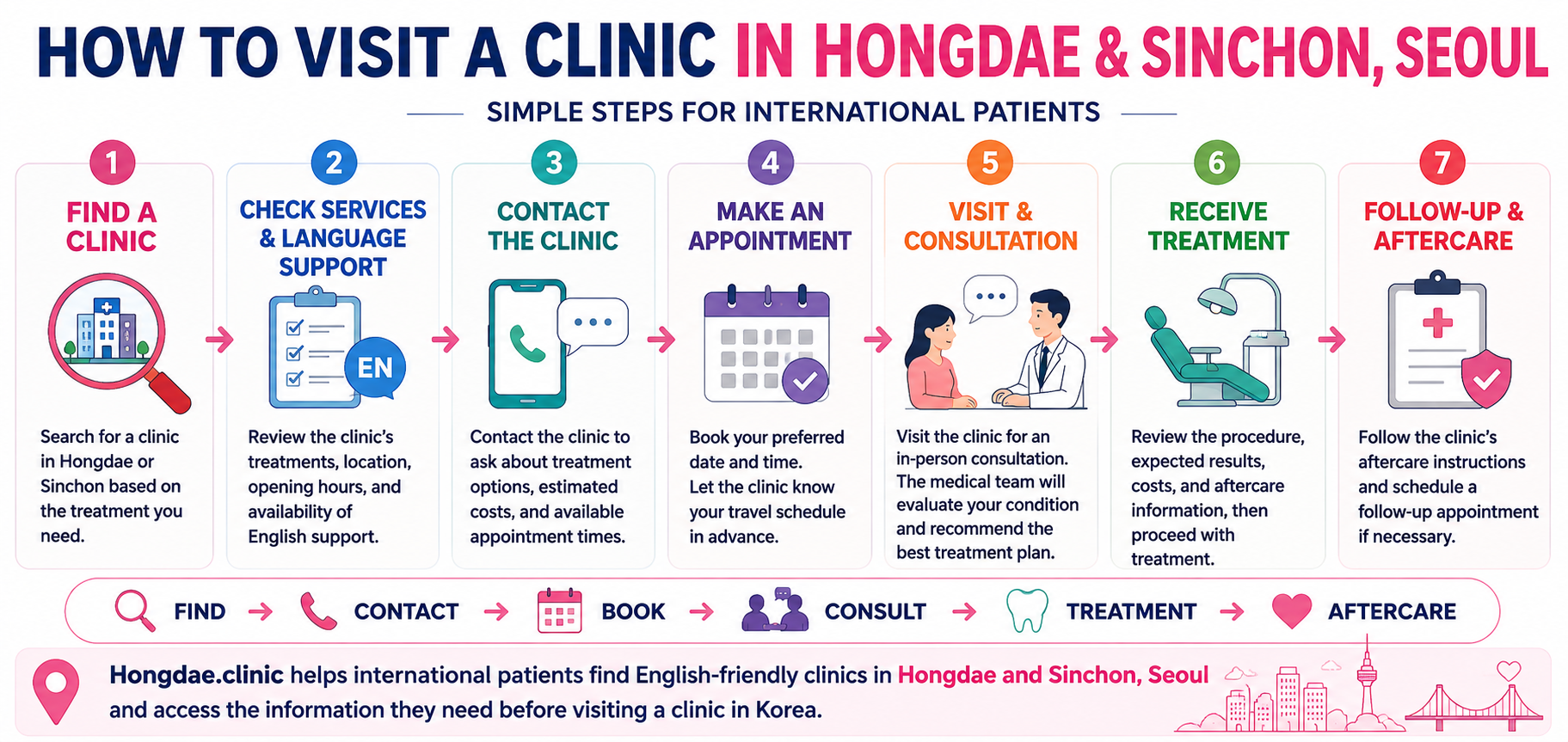
Consultation → nipple assessment → severity grading → surgical planning → correction → recovery → follow-up.
When Might You Consider Inverted Nipple Correction?
Treatment may be considered for:
- Nipples that remain pulled inward
- Difficulty maintaining nipple projection
- Bilateral or unilateral nipple inversion
- Cosmetic concerns
- Difficulty with nipple hygiene
- Recurrent irritation
- Breastfeeding concerns
- Recurrent inversion after previous correction
Some inverted nipples are congenital, while others may develop later. New or sudden nipple inversion should be medically evaluated before cosmetic correction, because acquired inversion can occasionally be associated with underlying breast disease.
Grades of Inverted Nipples
A commonly used classification divides nipple inversion into three grades.
Grade I
The nipple can be easily pulled outward and generally maintains its projection.
Mild fibrosis or tissue restriction is usually present.
Grade II
The nipple can be pulled outward but tends to retract again.
This is associated with greater fibrosis and tissue restriction beneath the nipple.
Grade III
The nipple is severely inverted and difficult to pull outward manually.
More extensive tissue release or structural support may be required in severe cases.
Inverted Nipple Correction Process
A typical surgical process may include:
- Plastic surgery consultation
- Assessment of nipple inversion grade
- Evaluation of nipple symmetry and projection
- Discussion of future breastfeeding plans
- Release of restrictive tissues
- Internal support or tissue reconstruction
- Postoperative follow-up
Several techniques have been developed specifically to maintain nipple projection while minimizing damage to lactiferous ducts and sensory structures.
Duct-Preserving Inverted Nipple Correction
For patients who may want to breastfeed in the future, a surgeon may consider a technique designed to preserve the milk ducts whenever anatomically possible.
Published approaches include:
- Selective tissue release
- Dermal flap support
- Internal sutures
- Gradual traction
- Selective dissection around lactiferous ducts
Clinical studies have reported successful correction while maintaining lactation potential using selected duct-preserving techniques.
Duct-Dividing Techniques
Severe nipple inversion can involve dense fibrous tissue and shortened structures beneath the nipple.
In selected severe cases, achieving sufficient projection may require partial or complete division of restrictive lactiferous ducts. This can improve correction but may compromise future breastfeeding ability.
Patients who want future breastfeeding should therefore discuss this issue clearly before surgery.
Surgery vs Non-Surgical Correction
Mild nipple inversion may sometimes respond to traction or suction-based approaches.
A randomized study involving grade I and II inverted nipples found that a gradual distraction method could increase nipple projection while preserving breastfeeding function.
More severe or recurrent inversion may require surgical correction because stronger fibrous attachments can prevent stable outward projection.
Can Inverted Nipple Correction Preserve Breastfeeding?
Potentially, yes.
Several techniques specifically aim to preserve the lactiferous ducts, and clinical reports have documented successful breastfeeding after selected procedures.
However, breastfeeding ability cannot be guaranteed. The risk depends on:
- Severity of inversion
- Surgical technique
- Amount of tissue release required
- Condition of the milk ducts
- Previous nipple surgery
Patients planning future pregnancy should discuss duct preservation before choosing a procedure.
Can Nipple Sensation Be Preserved?
Preserving nipple sensation and blood supply is an important goal during correction.
Clinical studies using selective dissection and traction techniques have reported preservation of nipple sensation, but temporary or permanent sensory changes remain possible with nipple surgery.
More extensive tissue dissection may carry greater risk.
Does Inverted Nipple Correction Leave a Scar?
Yes, although incisions are generally designed to remain relatively small and discreet.
Depending on the technique, incisions may be positioned:
- At the nipple base
- Along the nipple-areola junction
- Within the areolar skin
Dermal-flap techniques have been described with scars positioned along the nipple-areola junction to help reduce their visibility.
Scar appearance varies according to surgical technique and individual healing.
When Do Results Appear?
Nipple projection is usually visible immediately after correction, but swelling and temporary shape changes may affect the early appearance.
Some techniques also use postoperative traction or support to maintain the nipple position while internal tissues heal.
The nipple gradually settles as swelling decreases and scar tissue matures.
What Is Recovery Like?
Temporary postoperative symptoms may include:
- Swelling
- Tenderness
- Bruising
- Temporary numbness or sensitivity
- Incision redness
- Mild asymmetry
- Temporary nipple firmness
Patients may need to avoid direct compression or excessive pressure on the nipple during early healing, depending on the surgical technique.
Postoperative instructions should be followed carefully to protect the corrected nipple position.
Possible Risks and Complications
Potential complications may include:
- Recurrence of inversion
- Infection
- Bleeding
- Visible scarring
- Nipple asymmetry
- Under- or over-correction
- Changes in nipple sensation
- Delayed wound healing
- Impaired breastfeeding
- Compromise of nipple blood supply
- Need for revision surgery
Clinical studies of inverted nipple correction specifically identify recurrence, sensory changes, lactation problems, and nipple blood-supply complications as important considerations.
Can an Inverted Nipple Come Back?
Yes. Recurrence is possible after correction.
A seven-year clinical series using a technique designed to minimize duct disruption reported recurrence in some patients, demonstrating that even established surgical approaches cannot guarantee permanent correction.
Severe inversion and previous failed surgery may make stable correction more challenging.
Revision Inverted Nipple Correction
Revision surgery may be considered when the nipple becomes inverted again after previous treatment.
Revision cases can be more difficult because of:
- Scar tissue
- Previous duct division
- Reduced available tissue
- Recurrent fibrosis
- Changes in nipple blood supply
Specialized reconstructive approaches, including tissue support or grafting, have been described for difficult recurrent cases.
Can Inverted Nipple Correction Look Natural?
Yes. Natural-looking correction aims to create stable but not excessive nipple projection while maintaining an appropriate relationship between the nipple and areola.
The treatment plan should balance:
- Nipple projection
- Diameter
- Symmetry
- Sensation
- Blood supply
- Breastfeeding priorities
Different degrees of inversion require different surgical approaches, so the maximum possible projection is not necessarily the best aesthetic result.
Inverted Nipple Correction for International Patients
When contacting a plastic surgery clinic, consider asking:
- Is English consultation available?
- What grade of nipple inversion do I have?
- Can my milk ducts be preserved?
- Could surgery affect breastfeeding?
- What technique is recommended?
- Where will the scars be located?
- What is the risk of recurrence?
- How long should I stay in Korea?
- Is postoperative follow-up included?
If your nipple inversion developed recently rather than being present for many years, mention this during consultation so appropriate breast evaluation can be performed before cosmetic treatment.
Choosing an Inverted Nipple Correction Clinic in Hongdae or Sinchon
Consider:
- Qualified plastic surgeon
- Experience with nipple and breast surgery
- Accurate grading of nipple inversion
- Duct-preserving options when appropriate
- Attention to nipple sensation and blood supply
- Clear discussion of breastfeeding
- Management options for recurrence
- English communication
- Transparent surgery costs
The appropriate technique should be selected according to severity, anatomy, previous surgery, and the importance of preserving lactation function.
Hongdae & Sinchon Medical Care
Hongdae is convenient for patients around:
Hongik University · Yeonnam-dong · Hapjeong · Sangsu · Mapo
Sinchon is convenient for patients around:
Yonsei University · Ewha Womans University · Seodaemun · Mapo
Common searches include:
- Inverted Nipple Correction Hongdae
- Inverted Nipple Surgery Hongdae
- Nipple Correction Hongdae
- Inverted Nipple Correction Sinchon
- Nipple Inversion Surgery Sinchon
- English speaking plastic surgery clinic Sinchon
Frequently Asked Questions
What is Inverted Nipple Correction?
Inverted nipple correction is a procedure that releases restrictive tissues beneath the nipple and creates support to maintain outward projection. Different techniques may preserve or divide the milk ducts depending on the severity of inversion.
Can foreigners get Inverted Nipple Correction in Seoul?
Yes. International patients can contact plastic surgery clinics in Seoul regarding consultation, surgical planning, recovery, and English-language support.
Can I breastfeed after Inverted Nipple Correction?
Breastfeeding may remain possible when duct-preserving techniques are used, but it cannot be guaranteed. More extensive correction may require treatment of structures involved in lactation.
Can an inverted nipple return after surgery?
Yes. Recurrence can occur, particularly in more severe or previously operated cases.
Should a newly inverted nipple be checked before cosmetic surgery?
Yes.
New or sudden nipple inversion should receive medical breast evaluation before cosmetic correction, because acquired nipple inversion can sometimes be associated with underlying breast disease.