Hongdae & Sinchon Midface Lift
in Seoul, Korea
Midface lift is a surgical procedure designed to elevate sagging cheek tissues and improve the contour of the central face.
Treatment may help restore cheek volume and soften folds around the nose and mouth based on individual facial anatomy.
Patients seeking a
midface lift in Hongdae or Sinchon should consider surgical technique, expected results, and recovery needs.
If you are concerned about sagging cheeks, a deep lower eyelid–cheek junction, tear trough hollowing, or age-related descent of the central face, a Midface Lift may be considered to reposition the cheek and malar tissues. Unlike a traditional lower facelift that primarily targets the jawline and jowls, Midface Lift techniques focus on the cheek, infraorbital region, and central facial tissues.
Hongdae and Sinchon are convenient areas for Midface Lift consultations in Seoul, especially for international residents, students, and travelers seeking facial rejuvenation procedures.
What Is a Midface Lift?
A Midface Lift is a surgical procedure designed to elevate descended tissues of the cheek and malar region.
Depending on the technique, the surgeon may reposition the malar fat pad, sub-orbicularis oculi fat (SOOF), cheek soft tissues, and tissues around the lower eyelid–cheek junction. Clinical series have shown improvement in cheek position, infraorbital hollowing, and the transition between the lower eyelid and cheek.
Consultation → midface and eyelid assessment → tissue release → cheek elevation → fixation → recovery → follow-up.
When Might You Consider a Midface Lift?
A Midface Lift may be considered for:
- Sagging or descended cheeks
- Flattened malar contour
- Deep lower eyelid–cheek junction
- Tear trough or nasojugal hollowing
- Age-related midface descent
- Selected nasolabial-fold concerns
- Lower-eyelid support problems associated with midface descent
- Desire for central facial rejuvenation
Patient selection is important because Midface Lift surgery is most useful when the concern involves soft-tissue descent, rather than isolated fine wrinkles or simple volume loss alone.
What Areas Can a Midface Lift Improve?
Sagging Cheeks
One of the main goals is to elevate the descended cheek tissues toward a more youthful position.
A seven-year observational study of 350 Midface Lift patients reported favorable patient and evaluator satisfaction, with improvement particularly in the malar eminence and nasojugal region depending on the lifting vector used.
Lower Eyelid–Cheek Junction
Midface elevation can smooth the transition between the lower eyelid and cheek by repositioning soft tissues upward.
Clinical studies have demonstrated improvement in lower-eyelid fullness, malar projection, and lid-cheek contour after subperiosteal Midface Lift techniques.
Tear Trough and Nasojugal Groove
Selected Midface Lift techniques can improve the nasojugal groove or tear trough region, particularly when the hollowing is related to tissue descent.
In the 350-patient observational study, transosseous periorbital fixation was particularly effective for improving the nasojugal groove.
Common Midface Lift Techniques
Endoscopic Midface Lift
An Endoscopic Midface Lift uses relatively limited incisions, often around the temporal scalp and sometimes the mouth, combined with endoscopic visualization.
A clinical series of 67 endoscopic facial procedures reported measurable cheek elevation and improvements in malar volume and nasolabial contour after endoscopic Midface Lift.
Subperiosteal Midface Lift
A subperiosteal technique elevates facial tissues along the surface of the facial bones beneath the periosteum.
Clinical studies have used this approach for aesthetic cheek elevation as well as selected lower-eyelid retraction problems.
Lower Eyelid Approach
Selected Midface Lift techniques use a lower-eyelid incision to access and reposition the midcheek.
A clinical series of 184 patients using a lower-eyelid approach reported significant improvement in the lid-cheek junction, cheek prominence, eye bags, and nasolabial region.
Midface Lift Surgery Process
A typical surgical process may include:
- Plastic or facial surgery consultation
- Assessment of cheek descent and facial volume
- Evaluation of lower-eyelid position
- Selection of endoscopic, subperiosteal, or other approach
- Release of selected midface retaining structures
- Elevation and fixation of cheek tissues
- Postoperative monitoring and follow-up
Different fixation vectors can affect different parts of the midface, which is why surgical planning should be customized rather than using one lifting direction for every patient.
Midface Lift vs Facelift
These procedures overlap but generally emphasize different areas.
Midface Lift
- Focuses on the cheeks and central face
- Can improve the lower eyelid–cheek junction
- Repositions descended malar tissues
- May soften selected nasolabial concerns
Facelift
- More commonly focuses on jowls and lower-face descent
- Improves jawline definition
- May include the neck
- Can use SMAS or deep-plane techniques
A Midface Lift is therefore not automatically a replacement for a Facelift when significant jowling or neck laxity is present.
Midface Lift vs Deep Plane Facelift
A Deep Plane Facelift can include substantial cheek mobilization as part of a broader lower-face rejuvenation procedure, while a dedicated Midface Lift focuses more specifically on the central cheek and infraorbital region.
The best choice depends on whether the primary concern is:
- Midcheek descent
- Jowls
- Jawline laxity
- Neck aging
- Lower-eyelid–cheek transition
- A combination of these concerns
More extensive surgery is not automatically better; the operation should match the actual pattern of facial aging.
Midface Lift vs Facial Fat Grafting
These procedures address different components of facial aging.
Midface Lift
- Repositions descended tissues
- Changes the location of existing cheek volume
- Can improve structural sagging
Facial Fat Grafting
- Adds volume
- Treats hollowing and volume deficiency
- Does not directly lift significantly descended tissues
Some patients have both tissue descent and volume loss. In a randomized controlled trial of 56 patients, combining subperiosteal Midface Lift with lipofilling produced higher FACE-Q satisfaction than Midface Lift alone in patients with negative lower-eyelid vectors.
Can a Midface Lift Improve Nasolabial Folds?
It may soften them, but complete correction should not be expected.
Some Midface Lift series have reported improvement in nasolabial folds after cheek elevation, while other studies have found the procedure less effective for deep nasolabial folds than for malar projection or lower-eyelid–cheek contour.
The folds are influenced by several factors, including facial anatomy, volume distribution, tissue descent, and facial movement.
Can a Midface Lift Improve Under-Eye Hollows?
Yes, particularly when the hollow appearance results partly from descent of the cheek below the lower eyelid.
Subperiosteal and midcheek lift studies have demonstrated improvement in the infraorbital hollow and lid-cheek junction.
However, isolated tear trough volume deficiency may sometimes be better addressed with fat repositioning, fat grafting, or another treatment.
Midface Lift and Lower Blepharoplasty
Midface Lift surgery may be combined with Lower Blepharoplasty when eye bags, tear trough deformity, and cheek descent occur together.
A large retrospective series involving 1,152 Asian patients treated with supraperiosteal fat repositioning and Midface Lift reported generally favorable results; lower-eyelid ectropion requiring additional treatment occurred in a small proportion of patients undergoing the transcutaneous approach.
This combination requires careful lower-eyelid support because aggressive surgery around the eyelid can increase the risk of malposition.
Can a Midface Lift Support the Lower Eyelid?
Yes, in selected patients.
Midface elevation has also been used reconstructively to improve lower-eyelid retraction and ectropion when cheek descent contributes to insufficient lower-eyelid support.
However, aesthetic Midface Lift surgery and reconstructive lower-eyelid surgery are not identical, and additional procedures may be required when significant eyelid malposition is present.
Can a Midface Lift Look Natural?
Yes.
Natural-looking results generally depend on:
- Appropriate cheek elevation
- Balanced lifting vectors
- Preserving natural facial expression
- Avoiding excessive lateral widening
- Maintaining smooth eyelid–cheek transition
- Combining volume restoration only when necessary
The goal should be to restore the cheek to a more balanced position rather than creating an excessively high or overfilled midface.
Does a Midface Lift Leave Scars?
Scar location depends on the surgical approach.
Incisions may be positioned:
- Within the temporal hairline
- Inside the mouth
- Along a lower-eyelid incision
- Through a combination of these approaches
Endoscopic and subperiosteal techniques may use relatively small or concealed access incisions, but no surgical approach is completely scar-free.
When Do Results Appear?
Cheek elevation is present immediately after surgery, but the early appearance is affected by:
- Swelling
- Bruising
- Temporary tightness
- Facial asymmetry
- Initial over-elevation
The midface becomes more natural as swelling resolves and tissues settle.
Clinical studies evaluating Midface Lift outcomes have commonly followed patients for months or years, emphasizing that the early postoperative appearance should not be treated as the final result.
What Is Recovery Like?
Temporary postoperative effects may include:
- Facial swelling
- Bruising
- Cheek tightness
- Temporary numbness
- Temporary asymmetry
- Lower-eyelid swelling
- Temporary changes in smile
- Temporary sensory changes around the cheek
A clinical series of endoscopic facial lifting reported complications including temporary frontal branch weakness, infraorbital nerve paresthesia, hematoma, and temporary smile asymmetry.
Recovery varies according to the technique and whether brow, eyelid, facelift, or fat-grafting procedures are performed simultaneously.
Possible Risks and Complications
Potential complications may include:
- Bleeding or hematoma
- Infection
- Temporary numbness
- Facial asymmetry
- Under-correction
- Overcorrection
- Facial nerve weakness
- Lower-eyelid retraction
- Scleral show
- Ectropion
- Unnatural cheek position
- Need for revision surgery
Lower-eyelid malposition is particularly important when the surgical approach involves the lower eyelid. Clinical and anatomical research has linked injury or weakness of the orbicularis oculi innervation with postoperative scleral show or ectropion.
Facial Nerve Risk
Facial nerve branches pass near the temporal and cheek regions involved in some Midface Lift techniques.
Temporary facial nerve weakness has been reported in clinical series, particularly with certain dissection approaches. In one early endoscopic-assisted series, transient frontal branch weakness occurred with an anterograde temporal technique and resolved within several weeks.
Careful knowledge of facial nerve anatomy is therefore important.
Lower Eyelid Ectropion Risk
Ectropion occurs when the lower eyelid turns outward or loses proper contact with the eye.
This can be associated with:
- Lower-eyelid weakness
- Excessive tissue tension
- Scar formation
- Previous blepharoplasty
- Injury to orbicularis innervation
An anatomical and clinical study of 102 Midface Lift patients performed through lower blepharoplasty incisions identified two ectropion cases associated with pretarsal orbicularis denervation.
How Long Do Midface Lift Results Last?
A Midface Lift is intended to provide long-lasting tissue repositioning, but it does not stop facial aging.
Long-term appearance may be influenced by:
- Skin elasticity
- Facial anatomy
- Weight changes
- Volume loss
- Ongoing tissue descent
- Surgical fixation
A randomized study with mean follow-up of about two years found durable patient-reported outcomes after subperiosteal Midface Lift, particularly when volume deficiency was also treated with fat grafting.
Revision Midface Lift
Revision treatment may be considered for:
- Residual cheek descent
- Facial asymmetry
- Under-correction
- Lower-eyelid malposition
- Recurrent tissue descent
- Volume deficiency
- Concerns after previous facial surgery
Previous blepharoplasty, facelift, fat grafting, or Midface Lift surgery can change normal tissue planes, making secondary surgery more complex.
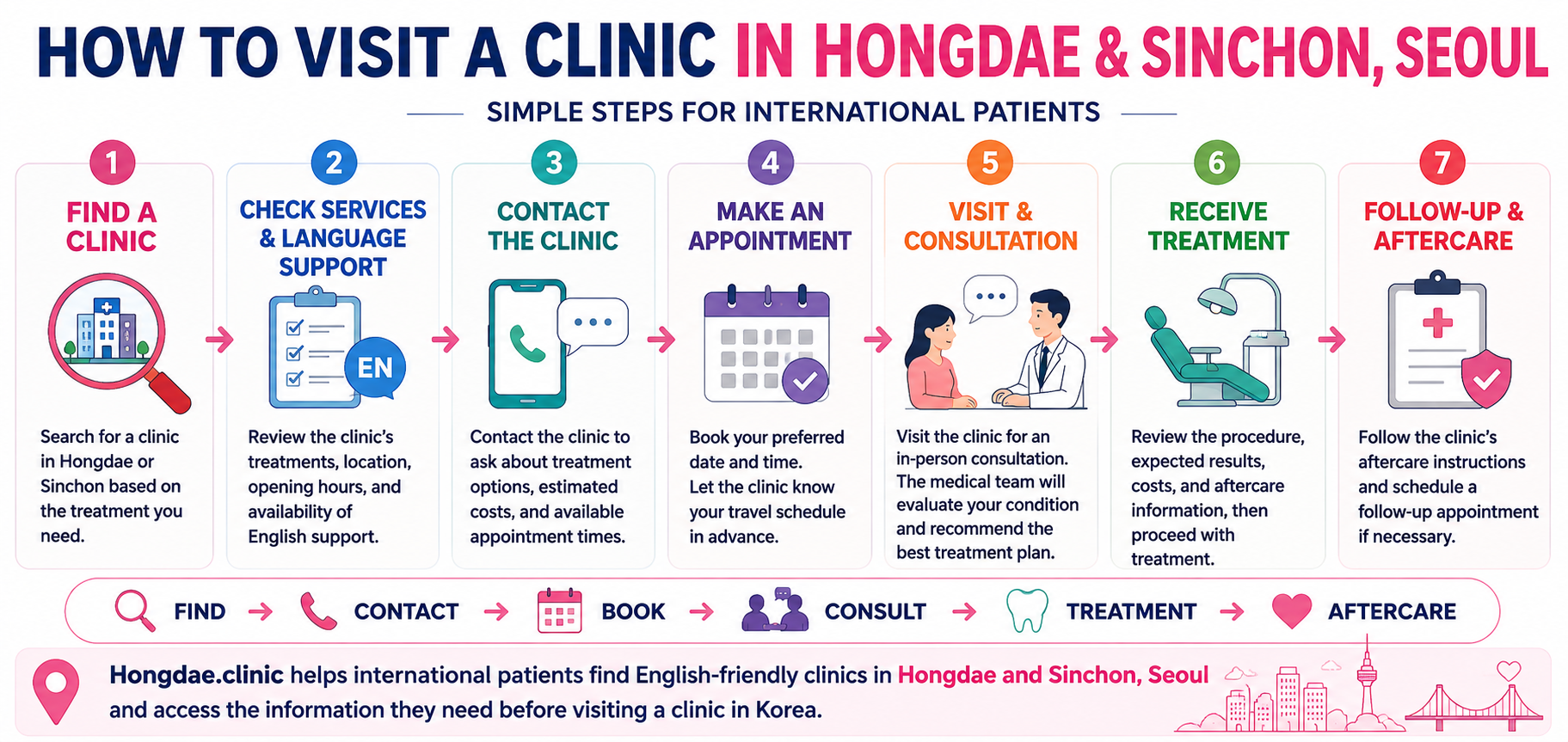
Midface Lift for International Patients
When contacting a plastic surgery clinic, consider asking:
- Is English consultation available?
- Is my concern caused by cheek descent or volume loss?
- Which Midface Lift technique is recommended?
- Will the procedure involve the lower eyelid?
- Do I need fat grafting as well?
- What is the risk of ectropion or lower-eyelid retraction?
- Where will the incisions be located?
- What downtime should I expect?
- How long should I stay in Korea?
- Is postoperative follow-up included?
If you have previously undergone Lower Blepharoplasty, Facial Fat Grafting, Facelift, Brow Lift, or other cheek surgery, tell the surgeon because previous treatment may affect surgical planning.
Choosing a Midface Lift Clinic in Hongdae or Sinchon
Consider:
- Qualified plastic or facial surgeon
- Experience with Midface Lift surgery
- Detailed cheek and lower-eyelid assessment
- Knowledge of facial nerve anatomy
- Evaluation of lower-eyelid support
- Customized lifting-vector planning
- Ability to distinguish sagging from volume loss
- Clear discussion of ectropion and asymmetry risks
- English communication
- Transparent surgery costs
Clinical research shows that different Midface Lift vectors and approaches affect different anatomical regions, making individualized planning particularly important.
Hongdae & Sinchon Medical Care
Hongdae is convenient for patients around:
Hongik University · Yeonnam-dong · Hapjeong · Sangsu · Mapo
Sinchon is convenient for patients around:
Yonsei University · Ewha Womans University · Seodaemun · Mapo
Common searches include:
- Midface Lift Hongdae
- Cheek Lift Hongdae
- Endoscopic Midface Lift Hongdae
- Midface Lift Sinchon
- Cheek Rejuvenation Sinchon
- English speaking plastic surgery clinic Sinchon
Frequently Asked Questions
What is a Midface Lift?
A Midface Lift surgically elevates descended cheek and malar tissues to improve central facial sagging and the lower eyelid–cheek transition.
Can a Midface Lift improve tear troughs?
It may improve tear trough or nasojugal hollowing when the problem is partly caused by midface descent, although isolated volume loss may require fat repositioning or grafting.
Is a Midface Lift the same as a Facelift?
No. A Midface Lift primarily targets the cheeks and central face, while a conventional Facelift more commonly addresses the lower face, jowls, and jawline.
Can a Midface Lift cause ectropion?
Yes. Lower-eyelid retraction, scleral show, and ectropion are recognized risks, particularly with approaches involving the lower eyelid.
Can foreigners get a Midface Lift in Seoul?
Yes. International patients can contact plastic surgery clinics in Seoul regarding facial assessment, technique selection, surgical planning, recovery, postoperative monitoring, and English-language support.