Hongdae & Sinchon Open Rhinoplasty
in Seoul, Korea
Open rhinoplasty is a nose surgery performed through a small external incision, allowing detailed access to the nasal structure.
The procedure may reshape the bridge, tip, nostrils, or overall nasal proportions based on individual anatomy and goals.
Patients seeking
open rhinoplasty in Hongdae or Sinchon should consider surgical approach, expected results, and recovery needs.
If you are considering nose reshaping that requires detailed access to the nasal framework, open rhinoplasty may be recommended depending on your anatomy and surgical goals. This approach allows the surgeon to directly visualize and modify the nasal cartilage and bone during surgery.
Hongdae and Sinchon are convenient areas for plastic surgery consultations in Seoul, especially for international residents, students, and travelers.
What Is Open Rhinoplasty?
Open rhinoplasty, also called external rhinoplasty, is performed using incisions inside the nostrils together with a small incision across the columella, the strip of tissue between the nostrils.
The nasal skin is carefully lifted to provide direct access to the underlying cartilage, nasal bones, septum, and tip structures.
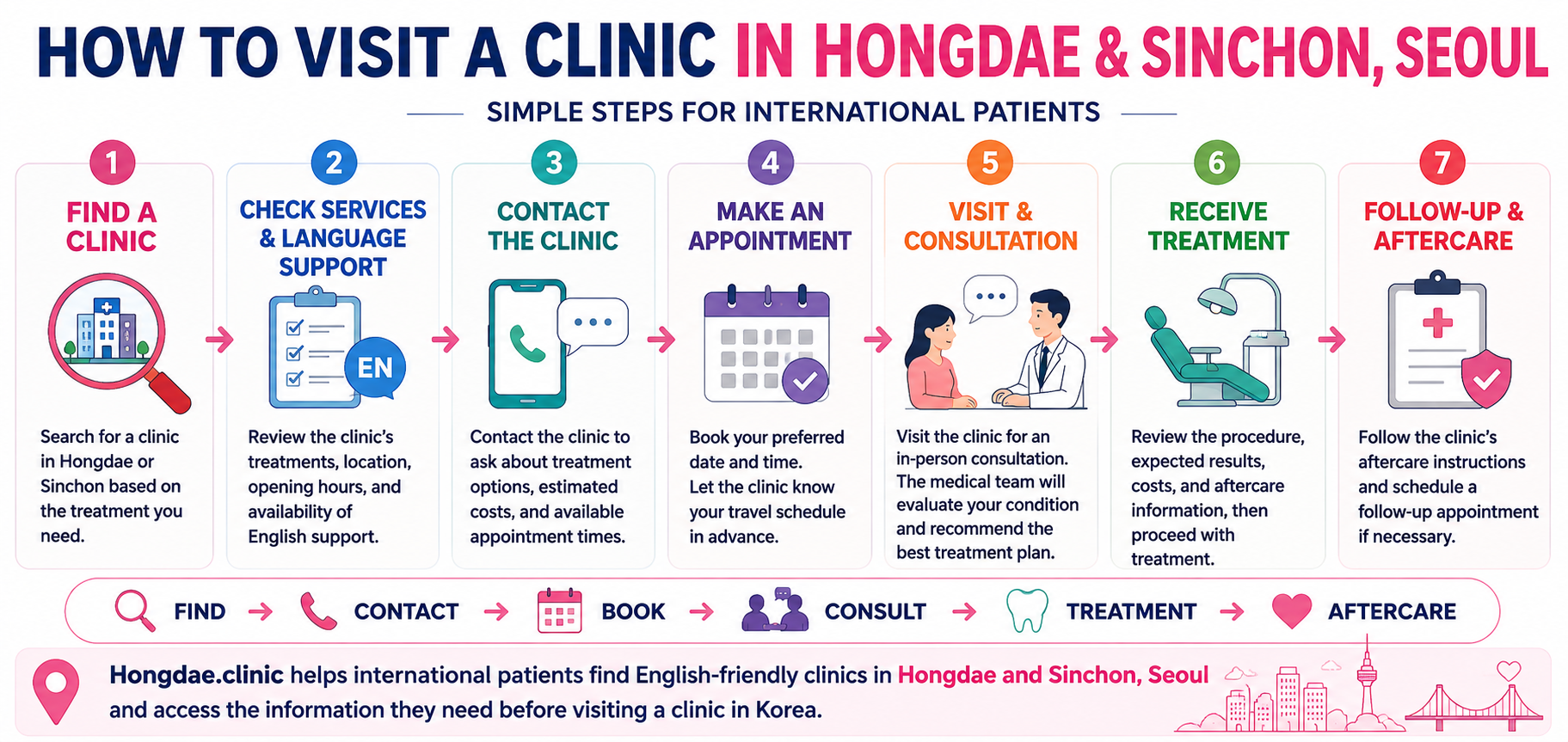
Consultation → facial analysis → surgical planning → open rhinoplasty → recovery → follow-up.
When Might You Consider Open Rhinoplasty?
Open rhinoplasty may be considered for concerns such as:
- Nasal tip reshaping
- Significant nasal asymmetry
- Deviated nose
- Low or high nasal bridge
- Short nose
- Structural nasal problems
- Revision rhinoplasty
- Complex cartilage grafting
The appropriate surgical approach depends on nasal anatomy, previous surgery, structural requirements, and aesthetic goals. Current evidence does not show that open rhinoplasty is universally superior to closed rhinoplasty.
Common Open Rhinoplasty Goals
Nasal Tip Refinement
Direct exposure can help the surgeon reshape, reposition, or support the tip cartilage with greater visualization.
Bridge & Structural Correction
The nasal bridge and underlying framework may be reduced, augmented, straightened, or reconstructed according to the surgical plan.
Nasal Asymmetry
Open access can be useful for selected complex noses requiring detailed correction of cartilage, bone, or septal asymmetry.
Open Rhinoplasty Treatment Process
A typical surgical process may include:
- Plastic surgery consultation
- Detailed facial and nasal assessment
- Photography and surgical planning
- Internal and transcolumellar incisions
- Cartilage and bone modification
- Grafting or structural support when needed
- Closure and postoperative follow-up
The open approach provides broad visualization of the nasal framework, which can be particularly useful when detailed structural reconstruction is required.
Open Rhinoplasty vs Closed Rhinoplasty
Open rhinoplasty includes a transcolumellar incision, while closed rhinoplasty generally uses incisions placed inside the nostrils.
Open rhinoplasty provides wider direct exposure of the nasal structures, while closed rhinoplasty avoids the routine external columellar incision.
A systematic review comparing the two approaches found no clear overall advantage in patient outcomes, meaning the best technique depends on the individual case and surgeon's planned correction.
What Are the Potential Advantages of Open Rhinoplasty?
Possible advantages may include:
- Wide visualization of nasal anatomy
- Precise tip cartilage modification
- Easier placement of structural grafts
- Detailed correction of asymmetry
- Useful access for complex reconstruction
- Helpful approach for selected revision cases
These advantages can make the open technique particularly useful when substantial structural work is required.
Does Open Rhinoplasty Leave a Scar?
Yes. Traditional open rhinoplasty involves a small external incision across the columella.
The scar often becomes less noticeable as healing progresses, but scar appearance varies between patients. Because the incision is external, patients with a history of abnormal or prominent scarring should discuss this with their surgeon before surgery.
When Do Results Appear?
Changes in nasal shape become visible after surgery, but swelling can temporarily hide the final result.
The bridge usually becomes clearer earlier, while swelling around the nasal tip can take longer to resolve.
Final results should therefore be evaluated after sufficient healing rather than immediately after surgery.
What Is Recovery Like?
Temporary postoperative symptoms may include:
- Swelling
- Bruising around the eyes
- Nasal congestion
- Tenderness
- Temporary numbness
- Tip swelling
- Mild asymmetry during early healing
The amount and duration of swelling depend on the extent of surgery, individual healing, and whether significant tip or structural reconstruction was performed.
Possible Risks and Complications
As with any rhinoplasty, possible risks include:
- Bleeding
- Infection
- Scarring
- Persistent swelling
- Nasal asymmetry
- Breathing difficulties
- Changes in sensation
- Graft-related problems
- Unsatisfactory cosmetic results
- Need for revision surgery
Open and closed rhinoplasty both have potential complications, and current research does not demonstrate that one approach consistently produces better overall outcomes.
Revision Open Rhinoplasty
Open rhinoplasty is often considered when revision surgery requires detailed visualization of structures altered by a previous operation.
Revision treatment may address:
- Nasal asymmetry
- Tip deformity
- Implant or graft problems
- Structural weakness
- Shortened or contracted nose
- Breathing problems
- Unsatisfactory previous results
Scar tissue and previous cartilage removal can make revision rhinoplasty more complex, so individualized surgical planning is especially important.
Open Rhinoplasty for International Patients
When contacting a plastic surgery clinic, consider asking:
- Is English consultation available?
- Why is open rhinoplasty recommended for my nose?
- What changes are planned for the bridge and tip?
- Will cartilage grafting be required?
- Where will graft material come from?
- Will breathing or septal problems also be treated?
- How long should I stay in Korea?
- Is postoperative follow-up included?
If you are visiting Korea temporarily, discuss how long you should remain in Seoul for splint removal, suture removal, and early postoperative checks.
Choosing an Open Rhinoplasty Clinic in Hongdae or Sinchon
Consider:
- Qualified plastic surgeon
- Detailed facial and nasal analysis
- Experience with open rhinoplasty
- Ability to perform both open and closed approaches
- Experience with cartilage grafting
- Functional breathing assessment
- Customized surgical planning
- English communication
- Transparent surgery costs
Open and closed approaches should be viewed as complementary techniques, with selection based on the individual nose and the corrections required.
Hongdae & Sinchon Medical Care
Hongdae is convenient for patients around:
Hongik University · Yeonnam-dong · Hapjeong · Sangsu · Mapo
Sinchon is convenient for patients around:
Yonsei University · Ewha Womans University · Seodaemun · Mapo
Common searches include:
- Open Rhinoplasty Hongdae
- Nose Surgery Hongdae
- Rhinoplasty Hongdae
- Open Rhinoplasty Sinchon
- Nose Surgery Sinchon
- English speaking plastic surgery clinic Sinchon
Frequently Asked Questions
What is open rhinoplasty?
Open rhinoplasty uses internal nasal incisions together with a small incision across the columella to provide direct access to the nasal cartilage and bone.
Can foreigners get open rhinoplasty in Seoul?
Yes. International patients can contact plastic surgery clinics in Seoul regarding consultation, surgical planning, recovery, and English-language support.
Is open rhinoplasty better than closed rhinoplasty?
Not always. Research has not established one approach as universally better. The appropriate technique depends on nasal anatomy, surgical complexity, and treatment goals.
Does open rhinoplasty leave a visible scar?
A small columellar scar is created, although it often becomes less noticeable with healing. Individual scar appearance can vary.
When is open rhinoplasty commonly considered?
It may be particularly useful for
complex tip reshaping, significant asymmetry, structural reconstruction, cartilage grafting, or selected revision rhinoplasty cases because it provides wide exposure of the nasal framework.