Hongdae & Sinchon Ptosis Correction
in Seoul, Korea
Ptosis correction is a surgical procedure designed to lift drooping upper eyelids and improve eye opening, symmetry, and overall appearance. Treatment adjusts the eyelid lifting muscles based on individual eyelid function, anatomy, and degree of drooping.
Patients seeking
ptosis correction in Hongdae or Sinchon should consider surgical technique, functional needs, and recovery time.
If you are concerned about drooping upper eyelids, difficulty keeping the eyes open, eyelid asymmetry, or a tired-looking appearance, ptosis correction may be considered. Blepharoptosis occurs when the upper eyelid margin sits lower than expected, and treatment should be planned according to the severity of drooping, eyelid muscle function, symmetry, and individual anatomy.
Hongdae and Sinchon are convenient areas for plastic surgery consultations in Seoul, especially for international residents, students, and travelers.
What Is Ptosis Correction?
Ptosis correction is surgery designed to raise a drooping upper eyelid by adjusting the structures responsible for eyelid elevation.
Depending on the cause and severity of ptosis, surgery may involve the levator aponeurosis, Müller muscle, or frontalis-related techniques. The choice of procedure depends heavily on eyelid-opening function and individual anatomy.
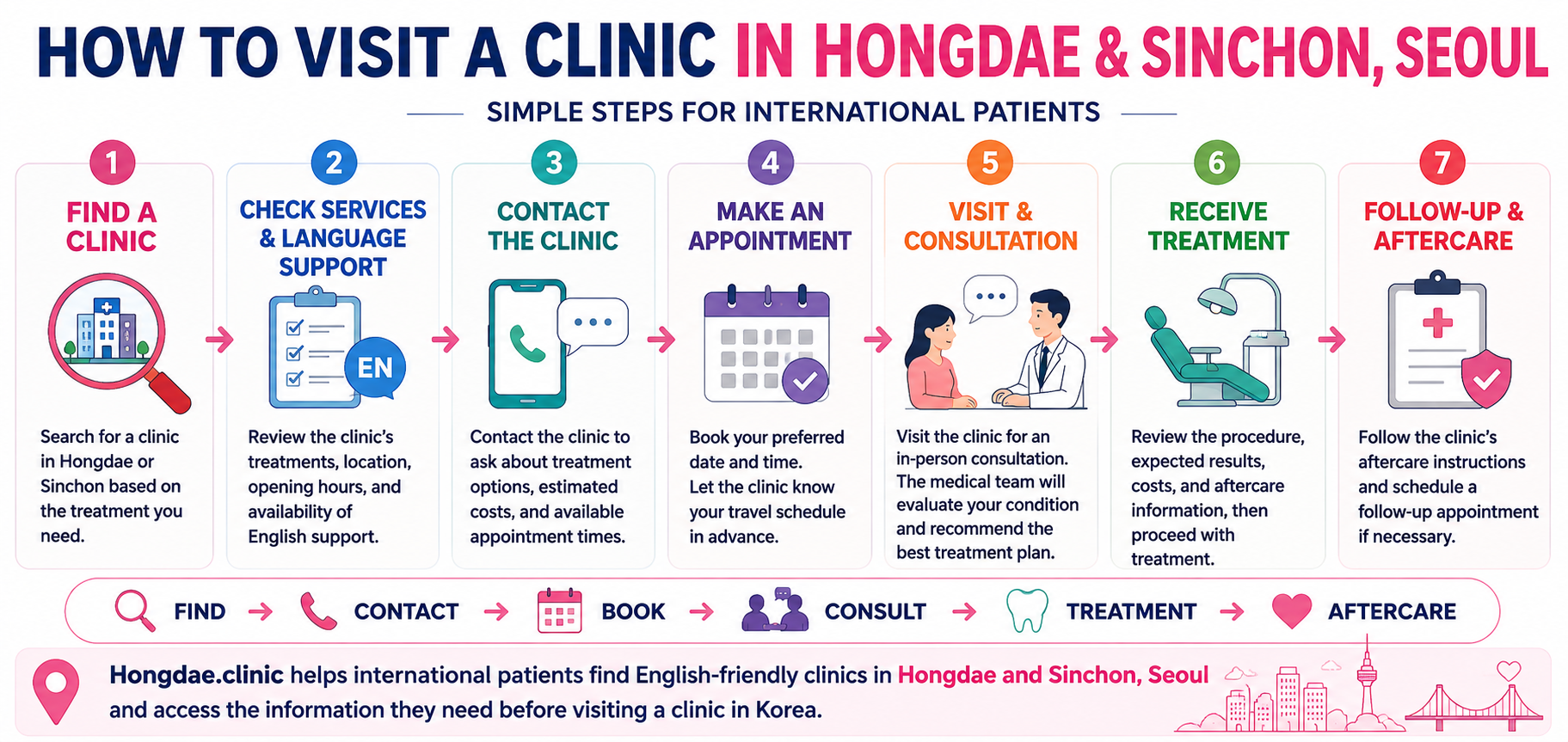
Consultation → eyelid-function assessment → surgical planning → ptosis correction → recovery → follow-up.
When Might You Consider Ptosis Correction?
Ptosis correction may be considered for:
- Drooping upper eyelids
- One eye appearing smaller than the other
- Difficulty opening the eyes fully
- Tired or sleepy-looking eyes
- Compensatory eyebrow raising
- Forehead tension when opening the eyes
- Eyelid asymmetry
- Ptosis combined with double eyelid concerns
Even subtle ptosis can affect upper-eyelid appearance, particularly when patients compensate by using the forehead muscles to lift the brows.
Common Types of Ptosis Correction
Levator Advancement
Levator advancement adjusts the levator aponeurosis, one of the main structures responsible for raising the upper eyelid.
Clinical studies in Asian patients have shown that levator advancement can improve eyelid height and symmetry when appropriately customized.
Müller Muscle-Conjunctival Resection
Müller muscle-conjunctival resection (MMCR) uses a posterior eyelid approach to shorten tissues that contribute to eyelid elevation.
It is typically considered in selected patients based on eyelid function and preoperative assessment. Both MMCR and external levator advancement have demonstrated effectiveness for ptosis correction.
Frontalis-Based Correction
For more severe congenital ptosis or poor levator function, procedures involving the frontalis muscle may be considered instead of relying only on the levator mechanism.
Ptosis Correction Treatment Process
A typical surgical process may include:
- Plastic surgery consultation
- Measurement of upper-eyelid position
- Assessment of levator muscle function
- Evaluation of brow compensation and asymmetry
- Selection of the appropriate surgical technique
- Adjustment of eyelid height and contour
- Postoperative follow-up
In Asian patients, surgical planning may also consider double eyelid crease position, brow compensation, eye dominance, and the relationship between the levator and eyelid crease.
Ptosis Correction vs Upper Blepharoplasty
Ptosis correction raises the eyelid margin itself, while upper blepharoplasty primarily removes or reshapes excess upper-eyelid tissue.
A patient can have excess skin without true ptosis, ptosis without significant excess skin, or both conditions at the same time.
Because the treatments address different anatomical problems, removing eyelid skin alone may not fully correct a low eyelid margin.
Ptosis Correction vs Double Eyelid Surgery
Double eyelid surgery creates or modifies an upper-eyelid crease, while ptosis correction improves the eyelid's ability to open.
The two procedures are frequently combined in Asian eyelid surgery when a patient has both blepharoptosis and a desired change in the double eyelid crease.
Proper planning is important because changing eyelid height can also influence the appearance of the crease.
Can Ptosis Correction Make the Eyes Look Bigger?
Ptosis correction does not enlarge the eyeball.
Instead, raising a drooping upper eyelid can expose more of the visible eye opening, creating a more open and alert appearance.
Clinical studies assessing ptosis correction commonly measure this change using margin reflex distance 1 (MRD1), which represents the distance between the upper eyelid margin and the corneal light reflex.
Can Ptosis Correction Improve Eyelid Asymmetry?
Yes, selected asymmetry caused by differences in eyelid height can be improved.
However, perfect symmetry cannot always be guaranteed because eyelid position can be influenced by:
- Levator strength
- Brow position
- Existing eyelid crease
- Eye dominance
- Previous surgery
- Natural facial asymmetry
Postoperative asymmetry remains one of the important considerations in ptosis surgery, particularly when one eyelid has different muscle function from the other.
Ptosis Correction for Asian Eyes
Asian upper-eyelid anatomy can differ significantly between individuals in terms of crease formation, soft-tissue thickness, levator anatomy, epicanthal folds, and brow compensation.
Studies specifically involving Asian patients have shown that precise evaluation of the levator mechanism is important when determining how much advancement is required.
Treatment should therefore be customized according to:
- Degree of ptosis
- Levator function
- Eyelid crease
- Eyelid thickness
- Brow position
- Desired eye shape
Ptosis Correction and Brow Position
People with ptosis may unconsciously raise their eyebrows to help open the eyes.
After ptosis correction, this compensatory forehead activity may decrease, which can cause the eyebrow position to appear lower than before surgery.
A clinical study involving East Asian patients found changes in brow position after levator advancement and upper eyelid surgery, making preoperative brow assessment important.
When Do Results Appear?
The eyelid position changes immediately after surgery, but swelling, bruising, and temporary asymmetry can affect the early appearance.
The eyelid contour generally becomes more natural as swelling decreases and the tissues settle.
Because ptosis correction requires precise adjustment of eyelid height, final symmetry should not be judged too early during recovery.
What Is Recovery Like?
Temporary postoperative symptoms may include:
- Swelling
- Bruising
- Tenderness
- Tightness
- Temporary asymmetry
- Dry or irritated eyes
- Difficulty fully closing the eyelids
- Temporary changes in eyelid sensation
The degree of recovery depends on the surgical technique and whether ptosis correction is combined with double eyelid surgery or upper blepharoplasty.
Possible Risks and Complications
Potential complications may include:
- Under-correction
- Over-correction
- Eyelid asymmetry
- Irregular eyelid contour
- Lagophthalmos
- Dry-eye symptoms
- Visible scarring
- Crease asymmetry
- Residual ptosis
- Need for revision surgery
Clinical studies comparing ptosis techniques have reported cases of under-correction, over-correction, lagophthalmos, and reoperation, although outcomes vary according to technique and patient selection.
Can Ptosis Return After Surgery?
Residual or recurrent ptosis can occur.
Possible reasons include:
- Insufficient initial correction
- Tissue stretching over time
- Scar changes
- Progressive age-related changes
- Differences in eyelid muscle function
Revision surgery may be considered when significant residual drooping remains. MMCR has also been studied as a revision option after previous external levator surgery in appropriately selected patients.
Can Ptosis Correction Look Natural?
Yes. Natural-looking results generally depend on balancing:
- Eyelid height
- Eyelid contour
- Left-right symmetry
- Double eyelid crease
- Brow position
- Normal eyelid closure
The goal is not simply to raise the eyelid as high as possible. Overcorrection can create an unnatural appearance or interfere with normal eyelid closure, so conservative and precise adjustment is important.
Ptosis Correction for International Patients
When contacting a plastic surgery clinic, consider asking:
- Is English consultation available?
- How severe is my ptosis?
- How strong is my levator function?
- Which ptosis correction technique is recommended?
- Do I also need double eyelid surgery?
- Will my eyebrow position change?
- What downtime should I expect?
- How long should I stay in Korea?
- Is postoperative follow-up included?
If you have previously undergone double eyelid surgery, ptosis correction, upper blepharoplasty, or other eye surgery, tell the surgeon because previous procedures can affect the anatomy and treatment plan.
Choosing a Ptosis Correction Clinic in Hongdae or Sinchon
Consider:
- Qualified plastic surgeon
- Detailed eyelid-function assessment
- Measurement of ptosis severity
- Experience with Asian eyelid anatomy
- Customized levator adjustment
- Evaluation of brow compensation
- Natural eyelid-crease planning
- English communication
- Transparent surgery costs
Ptosis correction requires more than cosmetic crease design because the surgeon must evaluate and adjust the functional eyelid-elevating mechanism while maintaining symmetry and normal eyelid closure.
Hongdae & Sinchon Medical Care
Hongdae is convenient for patients around:
Hongik University · Yeonnam-dong · Hapjeong · Sangsu · Mapo
Sinchon is convenient for patients around:
Yonsei University · Ewha Womans University · Seodaemun · Mapo
Common searches include:
- Ptosis Correction Hongdae
- Droopy Eyelid Surgery Hongdae
- Ptosis Surgery Hongdae
- Ptosis Correction Sinchon
- Eyelid Ptosis Surgery Sinchon
- English speaking plastic surgery clinic Sinchon
Frequently Asked Questions
What is ptosis correction?
Ptosis correction is surgery that raises a drooping upper eyelid by adjusting the structures responsible for eyelid elevation, such as the levator mechanism or Müller muscle.
Can foreigners get ptosis correction in Seoul?
Yes. International patients can contact plastic surgery clinics in Seoul regarding consultation, surgical planning, recovery, and English-language support.
Is ptosis correction the same as double eyelid surgery?
No. Ptosis correction changes eyelid height and opening function, while double eyelid surgery primarily creates or modifies the eyelid crease. The procedures can be combined when both concerns are present.
Can ptosis correction fix uneven eyes?
It may improve asymmetry caused by different upper-eyelid heights, although perfect symmetry cannot be guaranteed because brow position, muscle strength, and natural facial asymmetry can also affect the result.
Can ptosis come back after surgery?
Yes. Residual or recurrent drooping can occasionally occur, and selected patients may require revision surgery depending on the cause and remaining eyelid function.