Hongdae & Sinchon Revision Double Eyelid Surgery
in Seoul, Korea
Revision double eyelid surgery is a secondary procedure designed to correct asymmetry, scarring, an unclear crease, or other concerns after previous eyelid surgery. Treatment is customized based on existing scar tissue, eyelid anatomy, and the desired crease shape. Patients seeking revision double eyelid surgery in Hongdae or Sinchon should consider surgical complexity, previous procedures, and recovery needs.
If you are concerned about an asymmetric, excessively high, deep, weak, multiple, or unnatural eyelid crease after previous double eyelid surgery, revision double eyelid surgery may be considered. Revision procedures are generally more complex than primary surgery because scar tissue, adhesions, altered anatomy, and reduced available tissue can affect surgical planning.
Hongdae and Sinchon are convenient areas for plastic surgery consultations in Seoul, especially for international residents, students, and travelers.
What Is Revision Double Eyelid Surgery?
Revision Double Eyelid Surgery, also called secondary Asian blepharoplasty, is performed to correct cosmetic or functional concerns after previous double eyelid surgery.
Common revision problems include high or low creases, deep folds, multiple creases, asymmetry, scars, pretarsal fullness, eyelid hollowness, and ptosis.
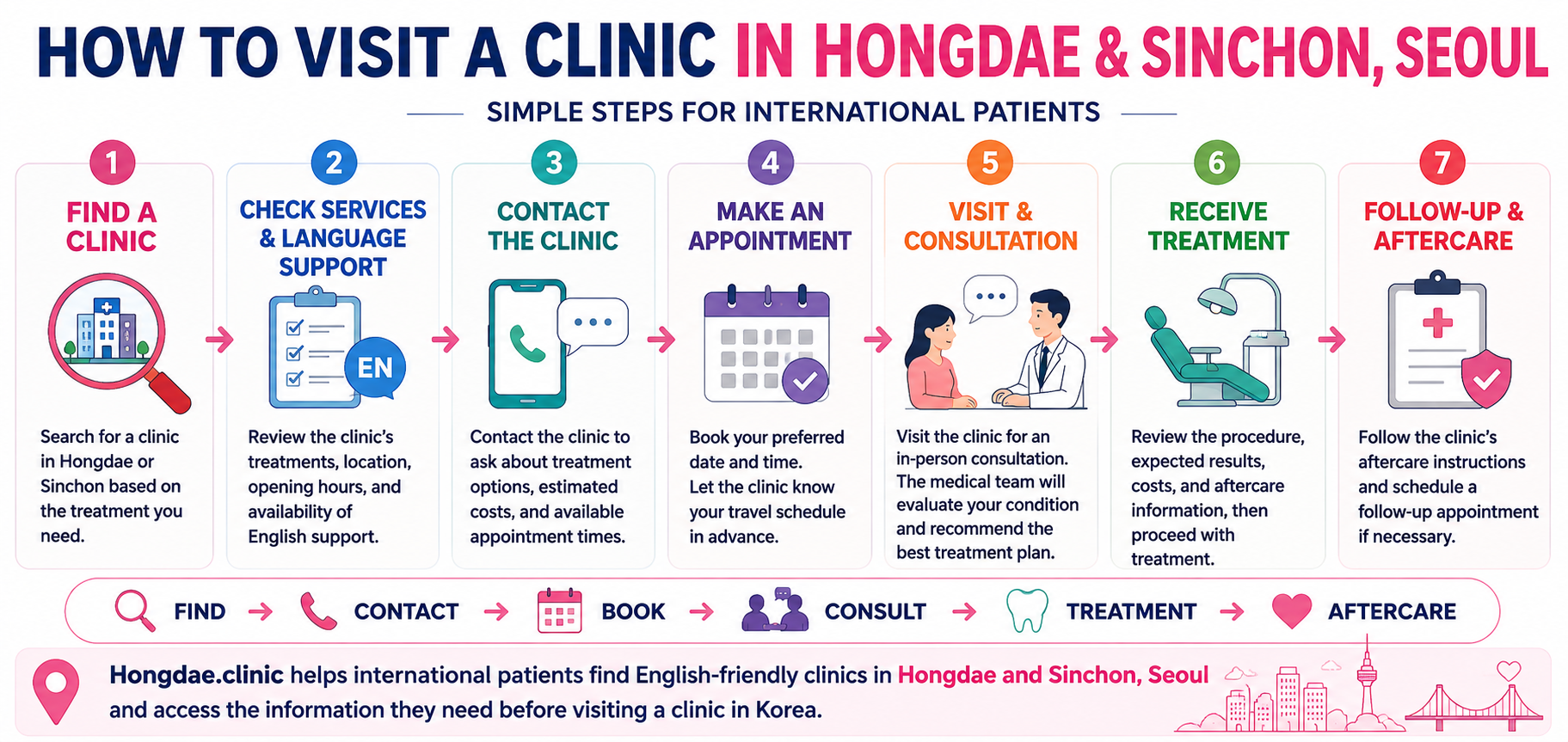
Consultation → previous surgery assessment → scar evaluation → revision planning → corrective surgery → recovery → follow-up.
When Might You Consider Revision Double Eyelid Surgery?
Revision may be considered for:
- Double eyelid asymmetry
- Crease that is too high
- Crease that is too low
- Deep or unnatural eyelid crease
- Weak or disappearing crease
- Multiple or triple eyelid folds
- Visible or depressed scars
- Upper-eyelid hollowness
- Persistent swelling or fullness
- Ptosis after previous surgery
Revision planning should identify the underlying anatomical cause, rather than simply creating another crease over the previous one.
Common Revision Double Eyelid Concerns
High Double Eyelid Crease
An excessively high crease may create an unnatural appearance and can occur together with upper-eyelid depression, scar adhesion, or ptosis.
Correction may require releasing the previous adhesion, lowering the crease, and restoring missing tissue or volume when necessary.
Multiple or Triple Eyelid Folds
Multiple unwanted folds may develop when abnormal adhesions form between eyelid tissues after surgery.
Published revision techniques emphasize complete scar release, preservation of available tissue, and prevention of new adhesions.
Asymmetric Creases
One eyelid may have a different crease height, depth, length, or shape from the other.
Asymmetric crease formation is among the common deformities seen in patients undergoing revision upper blepharoplasty.
Revision Double Eyelid Surgery Process
A typical revision process may include:
- Plastic surgery consultation
- Review of previous eyelid procedures
- Assessment of crease height and symmetry
- Evaluation of scar tissue and adhesions
- Release or reconstruction of previous fixation
- Creation of a new customized eyelid crease
- Postoperative follow-up
Because revision cases may have limited tissue and multiple previous surgical changes, surgical planning can be considerably more challenging than primary double eyelid surgery.
Primary vs Revision Double Eyelid Surgery
Primary double eyelid surgery creates a crease in previously untreated eyelid tissues.
Revision double eyelid surgery must work around existing scars, adhesions, tissue removal, and previous fixation points.
Patients who have undergone several operations can have more severe adhesions and less available tissue for reconstruction, making additional revision increasingly complex.
Correcting a High Eyelid Crease
A high crease is one of the more challenging revision concerns.
Treatment may involve:
- Releasing the previous high adhesion
- Creating a lower crease
- Restoring the natural tissue-gliding plane
- Repositioning remaining eyelid fat
- Fat grafting when volume is insufficient
- Correcting associated ptosis when necessary
Recent studies describe reconstruction of the gliding tissue plane and restoration of volume as important components of high-crease correction.
Correcting Deep or Unnatural Creases
A crease may appear excessively deep when previous surgery creates strong or abnormal tissue attachments.
Revision surgery may require releasing scar adhesions and reconstructing more natural tissue relationships before creating the new fold. A recent clinical study described anatomical restoration and scar-tissue flap techniques for patients with persistently deep creases after previous surgery.
The goal is usually a softer, more natural-looking crease, not simply reducing crease height.
Revision Surgery for Multiple Eyelid Folds
Multiple creases can be especially difficult when a patient has already undergone more than one eyelid operation.
Correction may involve releasing old scar tissue and using remaining orbicularis muscle, orbital fat, or other soft tissue to reduce the chance of abnormal tissues adhering again.
The more previous surgery has altered the eyelid, the more important tissue preservation becomes.
Revision Double Eyelid Surgery and Ptosis
Some revision patients also have blepharoptosis, where the upper eyelid margin sits lower than expected.
Ptosis can exist before the original surgery or become more noticeable after an unsuccessful eyelid procedure. Revision planning should therefore evaluate both crease shape and eyelid-opening function.
When necessary, ptosis correction may be incorporated into the revision procedure.
Can Lost Eyelid Volume Be Restored?
Yes, in selected patients.
Previous surgery may leave the upper eyelid looking hollow or depressed, particularly when tissue has been removed or scarred.
Revision techniques described in the literature include:
- Preaponeurotic fat repositioning
- Local fat flaps
- Autologous fat grafting
- Dermis-fat grafting in selected cases
These approaches may help restore volume and separate abnormal scar adhesions.
Does Revision Surgery Leave Another Scar?
Revision surgery usually works through or near the existing upper-eyelid crease incision when an incisional approach is required.
However, scar tissue from the previous operation cannot simply be ignored. The surgeon may need to release, revise, or reconstruct scarred tissue to improve the crease.
Scar appearance after revision varies according to:
- Previous scar severity
- Number of previous surgeries
- Remaining eyelid tissue
- Surgical technique
- Individual healing
When Do Results Appear?
Revision eyelid surgery can involve more tissue dissection than primary surgery, so early swelling and temporary asymmetry may make the crease appear different from the final result.
Scar tissue and tissue position continue to mature during recovery. Published revision studies generally assess outcomes after several months rather than immediately after surgery.
Patients should therefore avoid judging the final crease too early.
What Is Recovery Like?
Temporary postoperative symptoms may include:
- Swelling
- Bruising
- Tightness
- Tenderness
- Temporary asymmetry
- Visible incision redness
- Temporary numbness
- Crease stiffness during healing
Recovery can vary substantially depending on how much scar release and reconstruction are required and whether ptosis correction or volume restoration is performed.
Possible Risks and Complications
Potential complications may include:
- Persistent asymmetry
- Crease that remains too high or low
- Multiple folds
- Weak or disappearing crease
- Visible scarring
- Persistent hollowness
- Ptosis
- Under- or over-correction
- Scar readhesion
- Need for additional revision surgery
Revision Asian blepharoplasty is considered challenging because several complications may occur simultaneously and available tissue may already be limited.
Can Revision Double Eyelid Surgery Look Natural?
Yes, but the achievable result depends on the condition of the eyelid after previous surgery.
Natural-looking revision generally focuses on:
- Appropriate crease height
- Softer crease depth
- Improved symmetry
- Restored eyelid volume
- Reduced abnormal adhesions
- Normal eyelid-opening function
Current revision literature emphasizes identifying the cause of each deformity and rebuilding normal eyelid anatomy rather than simply repeating the original operation.
Revision Double Eyelid Surgery for International Patients
When contacting a plastic surgery clinic, consider asking:
- Is English consultation available?
- What caused the problem with my previous crease?
- Is scar adhesion present?
- Can my crease be lowered or reshaped?
- Do I have upper-eyelid volume loss?
- Do I also need ptosis correction?
- What recovery should I expect?
- How long should I stay in Korea?
- Is postoperative follow-up included?
If possible, bring information about your previous surgery technique, date, and any additional eyelid procedures to the consultation.
Choosing a Revision Double Eyelid Surgery Clinic in Hongdae or Sinchon
Consider:
- Qualified plastic surgeon
- Experience with revision Asian blepharoplasty
- Detailed scar and adhesion assessment
- Evaluation of eyelid ptosis
- Ability to correct high, low, or multiple folds
- Volume-restoration techniques when necessary
- Conservative tissue preservation
- English communication
- Transparent surgery costs
Revision surgery should be planned according to the specific cause of the previous result, because different deformities require different reconstructive strategies.
Hongdae & Sinchon Medical Care
Hongdae is convenient for patients around:
Hongik University · Yeonnam-dong · Hapjeong · Sangsu · Mapo
Sinchon is convenient for patients around:
Yonsei University · Ewha Womans University · Seodaemun · Mapo
Common searches include:
- Revision Double Eyelid Surgery Hongdae
- Double Eyelid Revision Hongdae
- High Eyelid Crease Correction Hongdae
- Revision Double Eyelid Surgery Sinchon
- Asian Blepharoplasty Revision Sinchon
- English speaking plastic surgery clinic Sinchon
Frequently Asked Questions
What is Revision Double Eyelid Surgery?
Revision Double Eyelid Surgery corrects problems after previous double eyelid surgery, including high or low creases, asymmetry, multiple folds, scars, hollowness, and ptosis.
Why is revision surgery more difficult than the first operation?
Previous surgery can create scar tissue, abnormal adhesions, altered anatomy, and reduced available tissue, making reconstruction more complex.
Can a high double eyelid crease be lowered?
Yes, in selected cases. Correction may involve releasing the previous high adhesion, recreating a lower fold, and restoring missing tissue or volume.
Can multiple eyelid folds be corrected?
Yes. Revision techniques may release abnormal adhesions and reposition soft tissue to prevent unwanted folds from reforming, although severe repeat-surgery cases can be more challenging.
Can foreigners get revision double eyelid surgery in Seoul?
Yes. International patients can contact plastic surgery clinics in Seoul regarding revision consultation, surgical planning, recovery, and English-language support.