Hongdae & Sinchon Revision Rhinoplasty
in Seoul, Korea
Revision rhinoplasty is a secondary nose surgery designed to correct functional or aesthetic concerns after a previous rhinoplasty.
Treatment may address the bridge, tip, asymmetry, scar tissue, or structural support based on individual needs.
Patients seeking
revision rhinoplasty in Hongdae or Sinchon should consider surgical complexity, previous procedures, and recovery needs.
If you are concerned about nasal asymmetry, breathing problems, an unnatural shape, implant or graft issues, or an unsatisfactory result after previous nose surgery, revision rhinoplasty may be considered. Revision surgery is generally more complex than primary rhinoplasty because previous surgery can alter cartilage, scar tissue, blood supply, and structural support.
Hongdae and Sinchon are convenient areas for plastic surgery consultations in Seoul, especially for international residents, students, and travelers.
What Is Revision Rhinoplasty?
Revision rhinoplasty, also called secondary rhinoplasty, is surgery performed to correct aesthetic or functional concerns after a previous rhinoplasty.
The procedure may involve reshaping existing structures, removing or replacing implants, correcting scar-related deformities, or rebuilding areas where cartilage support has been weakened. Revision patients frequently have a combination of aesthetic and functional concerns.
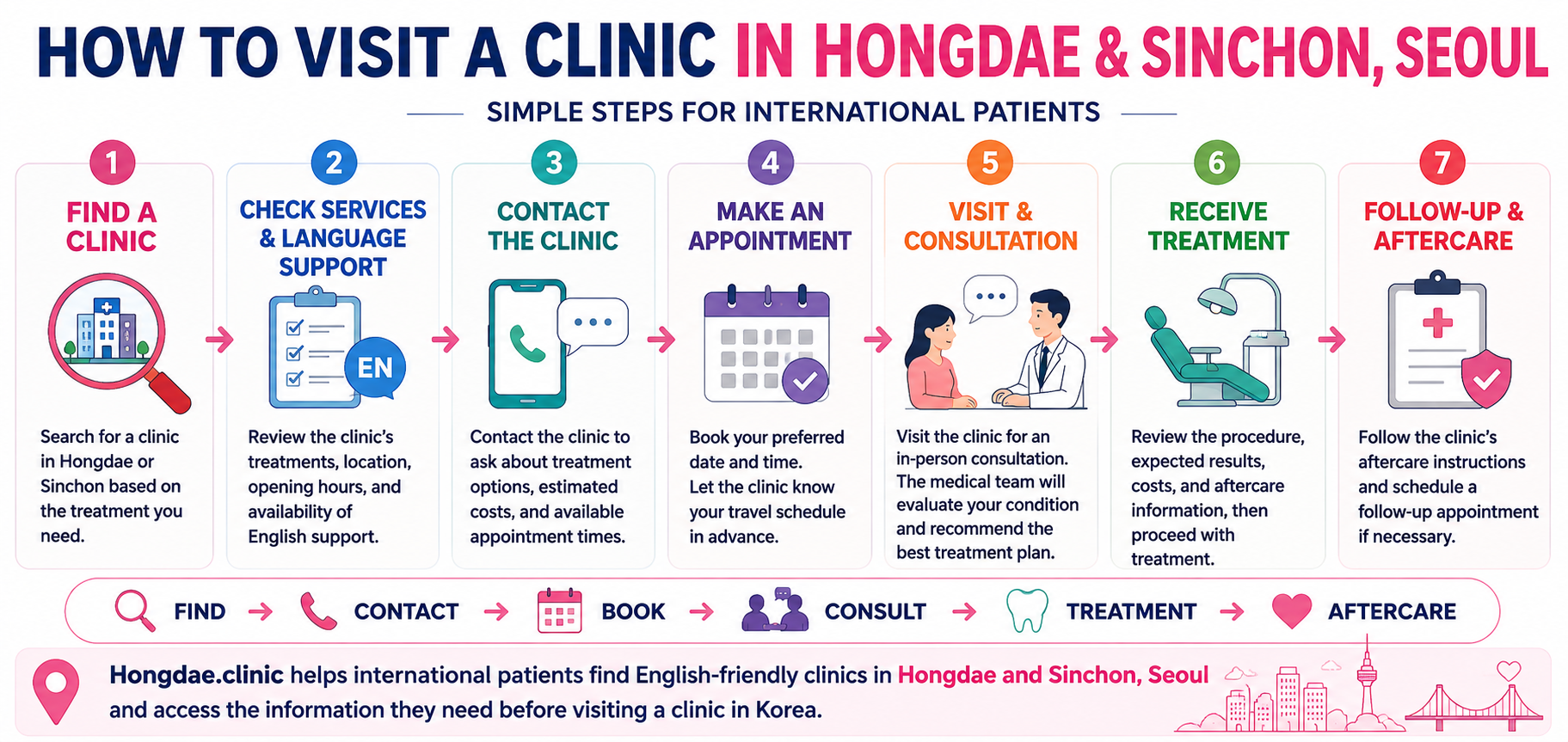
Consultation → previous surgery assessment → surgical planning → revision rhinoplasty → recovery → follow-up.
When Might You Consider Revision Rhinoplasty?
Revision rhinoplasty may be considered for:
- Persistent nasal asymmetry
- Drooping or poorly defined nasal tip
- Residual dorsal hump
- Over-reduced nasal bridge
- Implant or graft concerns
- Shortened or contracted nose
- Nasal obstruction
- Unsatisfactory previous results
A detailed evaluation is necessary because the surgeon must identify both the visible deformity and the structural cause beneath it.
Common Revision Rhinoplasty Concerns
Tip Deformity
Previous surgery may leave the tip drooping, asymmetric, over-projected, under-projected, or lacking structural support.
Bridge Problems
Revision surgery may address a residual hump, excessive bridge reduction, irregular contour, implant problems, or asymmetry.
Breathing Problems
Previous rhinoplasty can sometimes contribute to narrowing or weakness of the nasal valves. Functional revision may use structural grafting to improve airflow when appropriate.
Revision Rhinoplasty Treatment Process
A typical surgical process may include:
- Plastic surgery consultation
- Review of previous rhinoplasty history
- Detailed internal and external nasal examination
- Photography and surgical planning
- Scar tissue and structural assessment
- Cartilage reconstruction or grafting when needed
- Postoperative recovery and follow-up
Revision cases often require more complex reconstructive techniques and cartilage from outside the septum compared with primary rhinoplasty.
Primary vs Revision Rhinoplasty
Primary rhinoplasty is the first surgical operation on the nose, while revision rhinoplasty corrects problems after previous surgery.
Revision surgery can be more challenging because:
- Normal anatomy may already be altered
- Scar tissue may limit tissue movement
- Septal cartilage may have been previously removed
- Structural support may be weakened
- Additional graft material may be required
One comparative study found that revision patients more frequently required complex reconstruction and extranasal cartilage grafts than primary rhinoplasty patients.
Which Cartilage Can Be Used?
Revision rhinoplasty often requires cartilage to rebuild or strengthen the nasal framework.
Possible graft sources include:
- Remaining septal cartilage
- Ear cartilage
- Rib cartilage
The appropriate source depends on how much cartilage remains from the previous operation and how much structural support is required. Revision cases more commonly require cartilage from outside the nose than primary cases.
When Can Revision Rhinoplasty Be Performed?
In most cases, revision surgery should not be performed too soon after the original rhinoplasty.
Published revision-rhinoplasty guidance generally recommends waiting about one year after the previous surgery so swelling can settle and scar tissue can mature. Smaller corrections may occasionally be considered earlier depending on the individual situation.
Revision Rhinoplasty for Breathing Problems
Revision rhinoplasty can address both appearance and nasal function.
Functional concerns may involve:
- Internal nasal valve narrowing
- External nasal valve weakness
- Collapsed sidewalls
- Septal abnormalities
- Scar-related narrowing
- Structural instability
A meta-analysis of functional rhinoplasty studies found significant improvement in patient-reported nasal obstruction after appropriate nasal-valve surgery.
Open vs Closed Revision Rhinoplasty
Revision rhinoplasty may be performed through an open or closed approach.
Complex revision cases often benefit from open access because it allows direct visualization of altered cartilage, scar tissue, and grafting areas.
However, the surgical approach should be chosen according to:
- Previous surgical technique
- Amount of scar tissue
- Tip deformity
- Structural weakness
- Need for grafting
- Functional concerns
The goal is to select the approach that provides adequate access while protecting the remaining nasal tissues.
When Do Results Appear?
Revision rhinoplasty results develop gradually as swelling decreases and scar tissue remodels.
Revision noses may experience prolonged swelling because the tissues have already undergone previous surgery. Research comparing primary and revision cases has documented differences in postoperative soft-tissue swelling over the healing period.
Final results should therefore be evaluated only after sufficient long-term healing.
What Is Recovery Like?
Temporary postoperative symptoms may include:
- Swelling
- Bruising
- Nasal congestion
- Tenderness
- Temporary numbness
- Tip stiffness
- Mild asymmetry during early healing
Recovery depends on the complexity of reconstruction, amount of scar tissue, grafting requirements, and individual healing response.
Possible Risks and Complications
Potential risks may include:
- Bleeding
- Infection
- Persistent swelling
- Nasal asymmetry
- Breathing problems
- Scar-related irregularities
- Graft or implant complications
- Unsatisfactory cosmetic results
- Need for another revision
Revision rhinoplasty carries additional complexity compared with primary surgery, and one comparative study reported a higher rate of further revision among revision patients than among primary rhinoplasty patients.
Can Revision Rhinoplasty Look Natural?
Yes, but treatment should focus on restoring proportion and structural stability rather than simply making additional reductions.
A successful revision plan may involve rebuilding weakened areas, preserving healthy remaining tissue, and correcting only the features responsible for the patient's functional or aesthetic concerns.
Realistic expectations are especially important because previous surgery may limit how much the nose can safely be changed.
Revision Rhinoplasty for International Patients
When contacting a plastic surgery clinic, consider asking:
- Is English consultation available?
- Does the surgeon frequently perform revision rhinoplasty?
- What caused my current nasal problem?
- Will cartilage grafting be required?
- Will ear or rib cartilage be needed?
- Can breathing problems be corrected simultaneously?
- How long should I stay in Korea?
- Is postoperative follow-up included?
Bring any available information about your previous surgery, including operation dates, implant type, cartilage grafts, surgical records, and before-and-after photographs.
Choosing a Revision Rhinoplasty Clinic in Hongdae or Sinchon
Consider:
- Qualified plastic surgeon
- Extensive revision rhinoplasty experience
- Detailed internal and external nasal assessment
- Experience with cartilage reconstruction
- Functional breathing evaluation
- Ability to manage implant or graft complications
- Realistic surgical planning
- English communication
- Transparent surgery costs
Revision rhinoplasty requires careful diagnosis of changes created by the previous operation and a customized reconstructive plan.
Hongdae & Sinchon Medical Care
Hongdae is convenient for patients around:
Hongik University · Yeonnam-dong · Hapjeong · Sangsu · Mapo
Sinchon is convenient for patients around:
Yonsei University · Ewha Womans University · Seodaemun · Mapo
Common searches include:
- Revision Rhinoplasty Hongdae
- Secondary Rhinoplasty Hongdae
- Revision Nose Surgery Hongdae
- Revision Rhinoplasty Sinchon
- Nose Revision Surgery Sinchon
- English speaking plastic surgery clinic Sinchon
Frequently Asked Questions
What is revision rhinoplasty?
Revision rhinoplasty is a secondary nose surgery performed to correct aesthetic or functional problems after a previous rhinoplasty.
Can foreigners get revision rhinoplasty in Seoul?
Yes. International patients can contact plastic surgery clinics in Seoul regarding consultation, surgical planning, recovery, and English-language support.
When can I have revision rhinoplasty?
Most revision procedures are generally delayed until around one year after the previous rhinoplasty so swelling can decrease and scar tissue can mature.
Is revision rhinoplasty more difficult than the first surgery?
Often, yes. Previous surgery may create scar tissue, altered anatomy, reduced cartilage availability, and weakened structural support, making reconstruction more complex.
Will I need rib or ear cartilage?
Possibly. When sufficient septal cartilage is no longer available,
ear or rib cartilage may be considered for additional structural support, depending on the extent of reconstruction required.