Hongdae & Sinchon SMAS Facelift
in Seoul, Korea
SMAS facelift is a surgical procedure designed to lift deeper facial tissues and improve sagging in the cheeks, jawline, and lower face. Treatment repositions the SMAS layer and may remove excess skin to create a firmer, more defined facial contour.
Patients seeking an
SMAS facelift in Hongdae or Sinchon should consider surgical technique, expected results, and recovery needs.
If you are concerned about jowls, sagging cheeks, loose lower-face skin, or reduced jawline definition, a SMAS Facelift may be considered to reposition deeper facial tissues rather than tightening the skin alone. The procedure works with the superficial musculoaponeurotic system (SMAS), a fibromuscular layer beneath the skin that plays an important role in modern facelift surgery.
Hongdae and Sinchon are convenient areas for facelift consultations in Seoul, especially for international residents, long-term visitors, and travelers seeking facial rejuvenation procedures.
What Is a SMAS Facelift?
A SMAS Facelift is a surgical facial rejuvenation procedure that lifts, folds, removes, or repositions selected portions of the SMAS beneath the facial skin.
Rather than relying primarily on skin tension, SMAS techniques provide deeper structural support and may improve jowls, cheek descent, lower-face laxity, and jawline contour. Multiple SMAS techniques exist, and current evidence does not identify one method as universally superior.
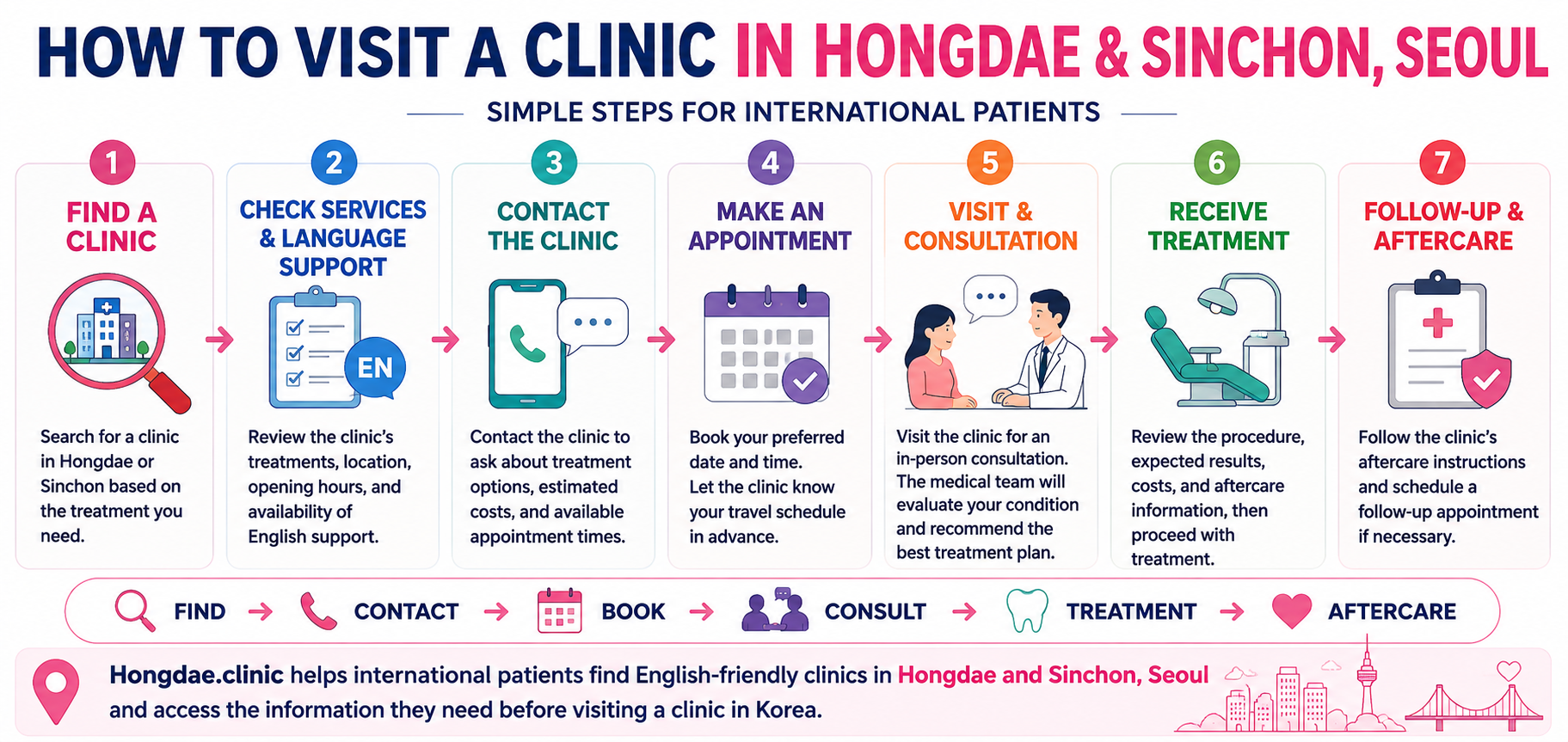
Consultation → facial assessment → surgical planning → SMAS repositioning → skin redraping → recovery → follow-up.
When Might You Consider a SMAS Facelift?
A SMAS Facelift may be considered for:
- Sagging cheeks
- Prominent jowls
- Loose lower-face skin
- Reduced jawline definition
- Deepening facial folds
- Lower-face tissue descent
- Early or moderate neck laxity
- Facial aging not adequately improved with non-surgical treatments
The appropriate facelift technique should be selected according to facial anatomy, degree of aging, skin quality, previous surgery, and desired correction.
What Is the SMAS Layer?
The superficial musculoaponeurotic system is a connective and muscular layer located beneath the facial skin and subcutaneous tissue.
Modern facelift techniques use this layer to help reposition descended facial tissues and restore facial contour. Different operations manipulate the SMAS in different ways, ranging from relatively limited folding techniques to broader flap elevation.
Common SMAS Facelift Techniques
SMAS Plication
SMAS plication folds the SMAS and secures it with sutures without creating a large SMAS flap.
It is one of the most commonly described SMAS facelift techniques and can provide structural tightening while limiting deeper dissection.
SMASectomy
A SMASectomy removes a selected strip of SMAS tissue before the remaining layer is tightened and secured.
The technique can reduce tissue redundancy while supporting the lower face and jawline.
SMAS Flap
A SMAS flap technique involves surgically elevating part of the SMAS so it can be repositioned more directly.
This allows greater tissue mobilization but also involves more extensive dissection than simple plication.
SMAS Facelift Treatment Process
A typical surgical process may include:
- Plastic surgery consultation
- Assessment of facial and neck aging
- Customized incision and lifting-vector planning
- Elevation of selected facial tissues
- SMAS tightening or repositioning
- Skin redraping without excessive tension
- Careful closure and postoperative follow-up
The exact operation varies because the term “SMAS Facelift” includes several different surgical techniques.
SMAS Facelift vs Skin-Only Facelift
A skin-only facelift primarily relies on skin redraping and removal, while a SMAS Facelift also treats deeper supportive tissues.
Modern facelift surgery generally emphasizes deeper-layer repositioning because facial aging involves soft-tissue descent as well as skin laxity.
Using deeper structural support may also allow the skin to be closed with less reliance on excessive tension.
SMAS Facelift vs Deep Plane Facelift
Both procedures treat tissues beneath the skin, but the surgical planes differ.
A SMAS Facelift manipulates the SMAS through techniques such as plication, SMASectomy, or flap elevation, while a Deep Plane Facelift generally extends dissection beneath the SMAS and beyond selected retaining ligaments.
Recent systematic reviews found that both approaches can provide high satisfaction and strong aesthetic outcomes, while available comparative evidence remains insufficient to establish one technique as universally superior.
A prospective study published in 2026 also found no significant difference between deep plane and SMAS plication groups in early satisfaction, rejuvenation ratings, recovery duration, or overall complication rates.
Can a SMAS Facelift Improve Jowls?
Yes.
The SMAS contributes to support of the cheek and lower face, so repositioning it can improve jowling and jawline definition.
A FACE-Q study of patients undergoing a high extended SMAS facelift reported high satisfaction with the cheeks, nasolabial folds, and lower face/jawline after surgery.
The amount of improvement depends on tissue descent, neck anatomy, and underlying facial structure.
Can a SMAS Facelift Improve the Neck?
It may improve selected lower-face and upper-neck concerns, but a SMAS Facelift is not automatically the same as a full Neck Lift.
Patients with significant:
- Platysma bands
- Loose neck skin
- Submental fullness
- Poor neck-chin definition
may require additional platysmaplasty, neck lift, or neck contouring.
The exact areas included should therefore be confirmed during consultation.
Does a SMAS Facelift Treat Nasolabial Folds?
Repositioning cheek and facial tissues may soften the appearance of nasolabial folds, but the procedure cannot guarantee complete elimination.
Facial folds are influenced by:
- Tissue descent
- Facial volume
- Skeletal anatomy
- Skin quality
- Facial movement
Patients undergoing high SMAS facelift surgery have reported high postoperative satisfaction with nasolabial-fold appearance.
Can a SMAS Facelift Look Natural?
Yes.
Natural-looking facelift surgery generally focuses on:
- Repositioning deeper tissues
- Appropriate lifting direction
- Conservative skin tension
- Balanced cheek contour
- Natural jawline definition
- Preservation of individual facial characteristics
Systematic reviews of SMAS facelift techniques report high patient satisfaction across multiple approaches.
The goal should be a refreshed appearance rather than an excessively tight or dramatically altered face.
Does a SMAS Facelift Leave Scars?
Yes.
Incisions are commonly placed around areas such as:
- The sideburn
- In front of the ear
- Around natural ear contours
- Behind the ear
- Nearby hair-bearing areas
The exact scar pattern depends on the surgical technique and whether the neck is treated.
Unfavorable scarring remains a recognized complication of facelift surgery, although scar visibility varies according to skin characteristics, wound tension, surgical technique, and individual healing.
When Do Results Appear?
Facial repositioning is visible after surgery, but swelling, bruising, and temporary tissue tightness can affect the early appearance.
A prospective comparison of SMAS plication and deep plane facelift patients reported a median recovery period of approximately 25.5 days in the SMAS group, although individual recovery varies considerably.
A separate prospective FACE-Q study found significant improvement in patient-reported facial appearance by three months after face and neck lift surgery, with improvements maintained through later follow-up.
What Is Recovery Like?
Temporary postoperative symptoms may include:
- Swelling
- Bruising
- Facial tightness
- Tenderness
- Temporary numbness
- Incision redness
- Temporary asymmetry
- Temporary facial weakness in uncommon cases
Recovery varies depending on the extent of SMAS dissection, neck treatment, additional procedures, and individual healing.
Possible Risks and Complications
Potential complications may include:
- Hematoma
- Seroma
- Infection
- Visible or widened scars
- Skin-healing problems
- Temporary numbness
- Facial nerve weakness
- Skin necrosis
- Hairline changes
- Facial asymmetry
- Need for revision surgery
A systematic review of 27 studies involving 6,086 SMAS facelift patients found generally high satisfaction but variable complication rates between SMAS techniques.
A broader review of rhytidectomy complications identified hematoma, unfavorable scarring, neurapraxia, and seroma among commonly reported complications.
Facial Nerve Risk
Facelift surgery is performed near branches of the facial nerve, which control facial movement.
A recent systematic review and meta-analysis covering more than 15,000 facelift procedures estimated pooled motor nerve injury at less than 1%, with permanent motor nerve injury reported much less frequently.
Most nerve problems reported in comparative studies are temporary, but permanent weakness remains a possible complication that should be discussed before surgery.
Hematoma After SMAS Facelift
Hematoma is an accumulation of blood beneath the surgical tissues and is one of the most important early facelift complications.
A recent systematic review found hematoma remained the most frequently reported category among facelift complications in the literature.
Previous meta-analysis data also found that major hematoma rates vary between different SMAS techniques, reinforcing the importance of careful bleeding control and postoperative monitoring.
How Long Does a SMAS Facelift Last?
SMAS Facelift results are intended to be long-lasting, but surgery does not stop the aging process.
Future appearance continues to be influenced by:
- Skin elasticity
- Genetics
- Sun exposure
- Weight changes
- Tissue quality
- Continued aging
Current systematic-review evidence does not establish one SMAS or deep-layer facelift technique as clearly superior for long-term longevity.
Revision SMAS Facelift
Revision facelift surgery may be considered when significant facial aging develops again or concerns remain after previous surgery.
Revision cases can be more complex because previous surgery may create:
- Scar tissue
- Thinner SMAS
- Altered anatomical planes
- Reduced tissue mobility
- Changes in skin and blood supply
A recent systematic review of secondary rhytidectomy identified fibrosis and altered tissue planes as common challenges in revision facelift surgery.
SMAS Facelift for International Patients
When contacting a plastic surgery clinic, consider asking:
- Is English consultation available?
- Which SMAS technique is recommended?
- Is SMAS plication, SMASectomy, or flap surgery planned?
- Do I also need a Neck Lift?
- Which areas of the face will be treated?
- Where will the scars be located?
- What downtime should I expect?
- How long should I stay in Korea?
- Is postoperative follow-up included?
If you have previously undergone a facelift, thread lift, neck lift, facial liposuction, filler treatment, or energy-based lifting procedure, tell the surgeon because previous treatment may affect surgical planning.
Choosing a SMAS Facelift Clinic in Hongdae or Sinchon
Consider:
- Qualified plastic surgeon
- Experience with SMAS facelift techniques
- Detailed facial and neck assessment
- Knowledge of facial nerve anatomy
- Customized SMAS treatment
- Natural lifting-vector planning
- Clear discussion of hematoma and nerve risks
- Experience with revision facelift surgery
- English communication
- Transparent surgery costs
Current evidence suggests that several SMAS techniques can produce favorable outcomes, and surgeon expertise, anatomy, and patient selection are important when determining the most appropriate approach.
Hongdae & Sinchon Medical Care
Hongdae is convenient for patients around:
Hongik University · Yeonnam-dong · Hapjeong · Sangsu · Mapo
Sinchon is convenient for patients around:
Yonsei University · Ewha Womans University · Seodaemun · Mapo
Common searches include:
- SMAS Facelift Hongdae
- Facelift Surgery Hongdae
- SMAS Lift Hongdae
- SMAS Facelift Sinchon
- Face and Neck Lift Sinchon
- English speaking plastic surgery clinic Sinchon
Frequently Asked Questions
What is a SMAS Facelift?
A SMAS Facelift is a facial rejuvenation procedure that tightens or repositions the superficial musculoaponeurotic system beneath the skin to improve facial sagging and lower-face contour.
Is a SMAS Facelift the same as a Deep Plane Facelift?
No. Both work beneath the skin, but the depth and extent of tissue dissection differ. Current comparative evidence shows favorable outcomes with both approaches and does not establish one as universally superior.
Can a SMAS Facelift improve jowls?
Yes. Repositioning the SMAS can improve lower-face tissue descent, jowls, and jawline definition in appropriately selected patients.
Can facial nerve injury occur?
Yes. Temporary facial nerve weakness is a recognized risk. A recent meta-analysis found pooled motor nerve injury below 1%, while permanent injury was much less common.
Can foreigners get a SMAS Facelift in Seoul?
Yes. International patients can contact plastic surgery clinics in Seoul regarding consultation, technique selection, surgical planning, recovery, postoperative monitoring, and English-language support.