Hongdae & Sinchon Temple Lift
in Seoul, Korea
Temple lift is a surgical procedure designed to lift the outer brow and temple area for a more refreshed and defined appearance.
Treatment may help improve mild sagging around the outer eyes and upper face based on individual facial anatomy.
Patients seeking a
temple lift in Hongdae or Sinchon should consider surgical technique, expected results, and recovery needs.
If you are concerned about drooping outer eyebrows, lateral upper-eye heaviness, or age-related sagging around the temples, a Temple Lift may be considered to elevate and support the lateral brow and temporal tissues. In cosmetic surgery, the term commonly refers to a temporal or lateral brow lift, although some more extensive “temporal facelift” techniques also elevate portions of the midface.
Hongdae and Sinchon are convenient areas for Temple Lift consultations in Seoul, especially for international residents, students, and travelers seeking upper-face rejuvenation procedures.
What Is a Temple Lift?
A Temple Lift, also called a temporal brow lift or lateral brow lift, is a surgical procedure designed primarily to elevate the outer third of the eyebrow and adjacent temporal tissues.
The procedure usually uses a limited incision around or within the temporal hairline. Depending on the technique, tissues may be released in a subcutaneous or deeper plane and then repositioned and secured to create controlled lateral brow elevation.
Consultation → brow and temple assessment → temporal incision → tissue release → lateral elevation → fixation → recovery → follow-up.
When Might You Consider a Temple Lift?
A Temple Lift may be considered for:
- Drooping outer eyebrows
- Lateral brow ptosis
- Upper-eye hooding related to brow descent
- Temporal soft-tissue laxity
- Asymmetry of the brow tails
- Desire for subtle upper-face rejuvenation
- Desire for a more elevated lateral brow
- Brow concerns combined with upper blepharoplasty
Long-term clinical experience suggests that temporal techniques are particularly useful when the main concern involves the lateral portion of the eyebrow rather than significant central or medial brow descent.
What Areas Can a Temple Lift Improve?
Lateral Brow Descent
The outer eyebrow often shows noticeable age-related descent.
A recent 20-year clinical series involving more than 500 lateral temporal brow lifts reported consistent and durable lateral brow elevation with high patient satisfaction.
Upper-Eyelid Hooding
When the outer brow drops, skin can appear heavier over the lateral upper eyelid.
Elevating the brow tail may reduce this brow-related lateral hooding, although true upper-eyelid skin excess may still require blepharoplasty. A long-term temporal lift series reported improvement in both lateral hooding and eyebrow position in more than 90% of reviewed cases at extended follow-up.
Temporal Region
Some temporal lift techniques also reposition adjacent temple tissues, helping create a smoother transition between the eyebrow, temple, and upper cheek. More extensive temporal facelift techniques can additionally incorporate midface elevation.
Temple Lift Surgery Process
A typical procedure may include:
- Plastic or facial surgery consultation
- Assessment of eyebrow position and asymmetry
- Evaluation of hairline and temporal hair density
- Customized incision and lifting-vector planning
- Release of selected temporal tissues
- Elevation and fixation of the lateral brow
- Careful closure and postoperative follow-up
The fixation method can influence postoperative brow position and stability. A clinical comparison of three fixation methods found that the final brow position differed according to the stabilization technique used.
Temple Lift vs Brow Lift
A Brow Lift is the broader category.
A Temple Lift generally emphasizes the lateral eyebrow and temporal region, while other Brow Lift techniques may provide greater treatment of the central or medial forehead.
Brow Lift options may include:
- Temporal Brow Lift
- Endoscopic Brow Lift
- Direct Brow Lift
- Hairline Brow Lift
- Coronal Brow Lift
A Temple Lift may be particularly attractive for patients who need selective outer-brow elevation rather than a complete forehead lift.
Temple Lift vs Endoscopic Forehead Lift
These procedures differ in extent.
Temple Lift
- Primarily targets the lateral brow
- Uses limited temporal access
- May require less central forehead dissection
- Can be performed as a relatively localized operation
Endoscopic Forehead Lift
- Usually addresses a broader forehead area
- Can elevate medial, central, and lateral brow regions
- Uses several scalp incisions
- Requires endoscopic release and fixation
A 10-year retrospective analysis of endoscopic temporal brow lifting found average elevation of approximately 1.8–1.9 mm across measured brow points, with a low reported complication rate in that series.
Temple Lift vs Upper Blepharoplasty
These procedures treat different anatomical problems.
Temple Lift
- Repositions the lateral eyebrow
- Treats brow-related upper-eye heaviness
- Does not directly remove upper-eyelid skin
Upper Blepharoplasty
- Removes or reshapes selected upper-eyelid tissues
- Treats eyelid skin excess
- Does not directly reposition the temporal brow
Some patients have both concerns and may undergo combined treatment.
However, a randomized study comparing temporal brow lift with internal browpexy during upper blepharoplasty found that brow elevation differed between techniques at six months, illustrating why the procedure should be selected according to the patient's specific anatomy rather than assuming one approach is always more durable.
Temple Lift vs Midface Lift
A traditional Temple Lift is primarily an upper-face procedure.
A Midface Lift targets descended cheek tissues and the lower eyelid–cheek junction.
However, the terminology can become confusing because certain modern “temporal facelift” procedures use the temporal approach to mobilize both the brow and midface. A 250-patient temporal facelift series incorporated deep-plane midface elevation, brow lifting, and canthopexy as part of one broader operation.
Patients should therefore ask exactly which facial regions are included when a clinic uses the term “Temple Lift.”
Can a Temple Lift Make the Eyes Look More Open?
It can when lateral brow descent contributes to upper-eye heaviness.
Elevating the outer brow may:
- Reduce lateral hooding
- Reveal more upper-eyelid area
- Improve the brow-eye relationship
- Create a lighter upper-face appearance
A large clinical series of temporal brow lifting reported satisfactory lateral brow elevation in approximately 94% of patients, supporting its effectiveness for lateral brow repositioning.
The procedure does not directly correct true eyelid ptosis.
Can a Temple Lift Create a Cat-Eye Effect?
A Temple Lift can alter the position of the outer brow, which may influence the perceived shape of the upper eye region.
However, a standard temporal brow lift does not automatically reposition the lateral canthus.
More extensive procedures that include canthopexy can affect both brow and outer-eye position. For example, published temporal facelift techniques have combined brow lifting with canthopexy and midface elevation.
Patients seeking a specific “cat-eye” appearance should ask whether the plan involves only the brow or also the lateral canthus.
How Much Does the Brow Lift?
The amount varies according to:
- Preoperative brow position
- Tissue laxity
- Surgical technique
- Fixation method
- Desired eyebrow shape
A temporal brow fixation study demonstrated substantial lateral elevation after surgery with some settling during the first year.
The goal should generally be balanced elevation rather than maximum lift.
Can a Temple Lift Correct Brow Asymmetry?
Yes, selected asymmetry may be improved by using different lifting vectors or fixation positions on each side.
A clinical series of subcutaneous temporal brow lifts included patients undergoing unilateral surgery specifically for eyebrow asymmetry, with generally favorable results.
Perfect symmetry cannot be guaranteed because differences may also originate from:
- Forehead muscle activity
- Eyelid anatomy
- Facial nerve function
- Skeletal structure
- Natural eyebrow shape
Does a Temple Lift Leave a Scar?
Yes.
The incision is usually placed within or close to the temporal hairline, depending on the technique.
A 28-patient clinical series using a subcutaneous temporal brow lift reported scars rated as good or excellent by most patients and the surgeon.
Scar visibility still depends on:
- Hair density
- Incision placement
- Skin characteristics
- Surgical tension
- Individual healing
Patients with thin temporal hair should discuss incision placement carefully.
Can a Temple Lift Cause Hair Loss?
Yes.
Temporary or localized alopecia around the temporal incision is a recognized complication.
In a 519-patient lateral brow lift series, limited alopecia occurred in nine patients.
Another temporal facelift series reported one case of alopecia along the temporal suture line.
Careful incision design and handling of the hair follicles may help reduce this risk.
Facial Nerve Risk
The temporal region contains the frontal branch of the facial nerve, which contributes to forehead and eyebrow movement.
Temporary weakness can occur after temporal lifting.
In a 519-patient lateral brow lift series, five patients developed frontal-branch neurapraxia.
A more extensive 250-patient temporal facelift series reported temporary unilateral frontal-branch neuropraxia in 5.6% of patients, with spontaneous recovery in the studied cases.
Permanent nerve injury appears uncommon in published series but remains an important risk to discuss.
Temporary Numbness After Temple Lift
Altered sensation around the temple or scalp may occur temporarily.
In the recent 20-year experience with lateral temporal subcutaneous brow lifting, the main reported complication was temporary temporal hypoesthesia, while permanent nerve injury was not observed in that clinical series.
Numbness usually reflects temporary disturbance of small sensory nerves during dissection.
Can the Brow Drop Again?
Yes.
Some settling or recurrence of brow descent can occur as tissues heal and aging continues.
A long-term series using a temporal galeapexy technique reported a relapse rate below 10% after five years among patients with extended follow-up.
Another fixation study documented partial settling between six and twelve months, demonstrating that early postoperative elevation may not represent the final brow position.
How Long Do Temple Lift Results Last?
Results can be long-lasting, but durability varies by technique and anatomy.
A long-term temporal lift series found that more than 90% of reviewed patients maintained marked improvement in lateral hooding and eyebrow position after at least five years.
However, the brow continues to age, and recurrence may occur.
For comparison, long-term endoscopic brow-lift research also demonstrates measurable elevation several years after surgery, although some brow regions show greater settling than others.
When Do Results Appear?
Brow elevation is visible immediately after surgery, but the early appearance may be affected by:
- Swelling
- Bruising
- Temporary over-elevation
- Tissue tightness
- Left-right differences
- Incision swelling
The eyebrows gradually settle as healing progresses.
Clinical fixation studies demonstrate that some change in eyebrow height occurs during the first postoperative year.
What Is Recovery Like?
Temporary postoperative symptoms may include:
- Temple swelling
- Bruising
- Scalp tightness
- Tenderness
- Temporary numbness
- Temporary brow asymmetry
- Temporary weakness of forehead movement
- Incision redness
In a 270-patient temporal lift series, reported complications included hematoma, temporary alopecia, and temporary frontal muscle weakness, with the weakness resolving within several months in the reported cases.
Recovery is more extensive when the procedure is combined with a Midface Lift, canthopexy, facelift, or eyelid surgery.
Possible Risks and Complications
Potential complications may include:
- Bleeding or hematoma
- Infection
- Visible scarring
- Temporal numbness
- Temporary facial nerve weakness
- Alopecia around the incision
- Brow asymmetry
- Under-correction
- Excessive elevation
- Recurrent brow descent
- Temporal depression
- Need for revision surgery
Published temporal lift series demonstrate generally favorable safety profiles but confirm that nerve weakness, alopecia, relapse, hematoma, and contour changes can occur.
Can a Temple Lift Look Natural?
Yes.
Natural-looking results generally depend on:
- Appropriate lateral brow height
- Preservation of natural eyebrow shape
- Balanced left-right elevation
- Avoiding excessive arching
- Smooth temple contour
- Harmony with the eyelids and forehead
Modern temporal brow lift techniques emphasize selective elevation of the lateral eyebrow rather than lifting every part of the brow equally.
The goal should be a refreshed upper face rather than an excessively elevated or surprised appearance.
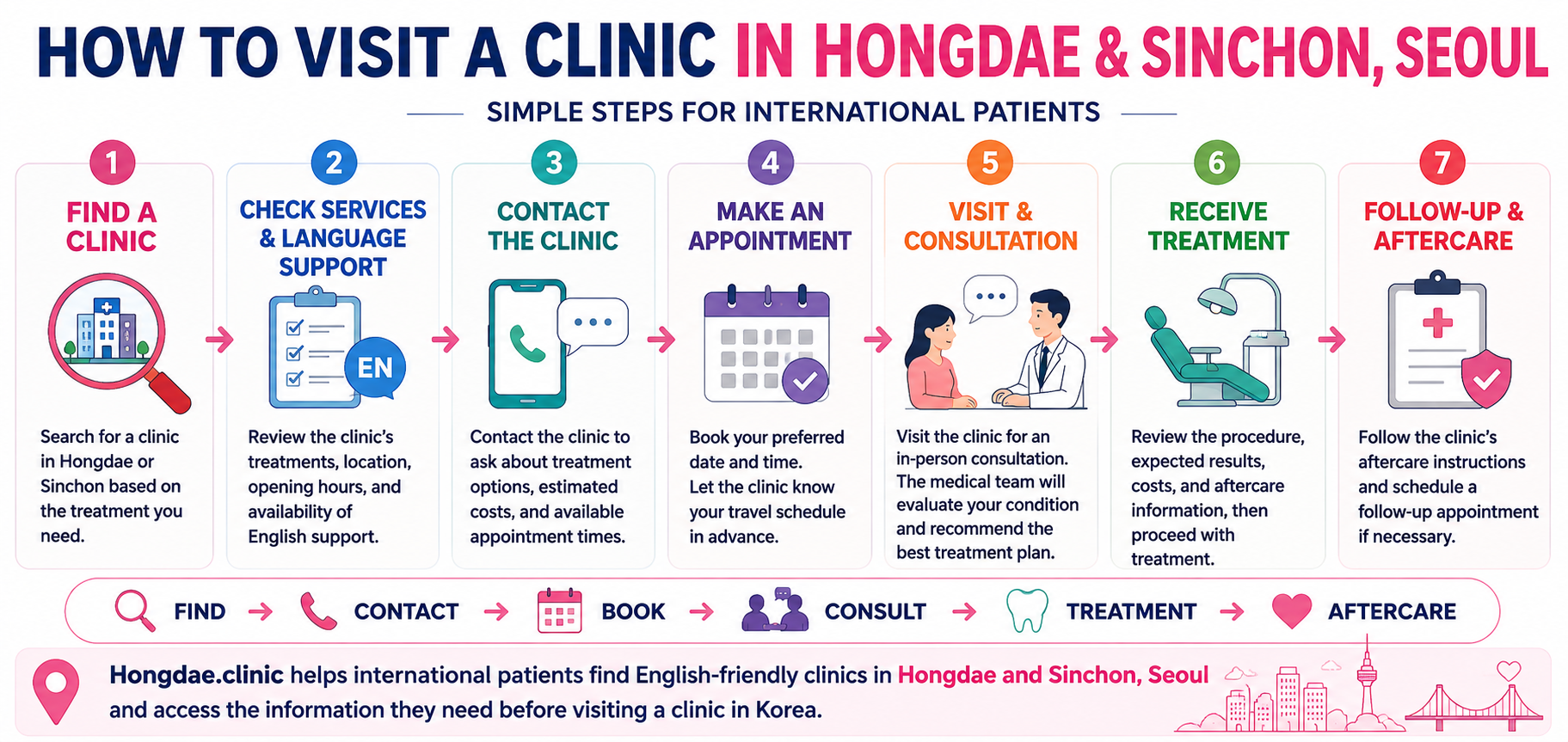
Temple Lift for International Patients
When contacting a plastic surgery clinic, consider asking:
- Is English consultation available?
- Is my concern mainly lateral brow descent?
- Is a Temple Lift or full Brow Lift more appropriate?
- Which tissue plane will be used?
- Where will the temporal incision be located?
- How will the brow be fixed?
- What is the risk of hair loss or numbness?
- Could the facial nerve be affected?
- How long should I stay in Korea?
- Is postoperative follow-up included?
If you have previously undergone Brow Lift, Endoscopic Forehead Lift, Sub Brow Lift, Upper Blepharoplasty, hair transplantation, or Facelift surgery, tell the surgeon because previous procedures can affect surgical anatomy and planning.
Choosing a Temple Lift Clinic in Hongdae or Sinchon
Consider:
- Qualified plastic or facial surgeon
- Experience with temporal brow lifting
- Detailed brow and eyelid assessment
- Evaluation of temporal hair density
- Knowledge of frontal facial nerve anatomy
- Customized lifting-vector planning
- Reliable fixation technique
- Clear discussion of alopecia and relapse
- English communication
- Transparent surgery costs
Clinical studies show that Temple Lift outcomes depend on appropriate patient selection, tissue-release technique, fixation, and precise lateral brow positioning rather than the procedure name alone.
Hongdae & Sinchon Medical Care
Hongdae is convenient for patients around:
Hongik University · Yeonnam-dong · Hapjeong · Sangsu · Mapo
Sinchon is convenient for patients around:
Yonsei University · Ewha Womans University · Seodaemun · Mapo
Common searches include:
- Temple Lift Hongdae
- Temporal Brow Lift Hongdae
- Lateral Brow Lift Hongdae
- Temple Lift Sinchon
- Temporal Lift Sinchon
- English speaking plastic surgery clinic Sinchon
Frequently Asked Questions
What is a Temple Lift?
A Temple Lift is a limited upper-face lifting procedure that primarily elevates the lateral eyebrow and temporal tissues, usually through an incision around the temporal hairline.
Is a Temple Lift the same as a Brow Lift?
A Temple Lift is one type of Brow Lift. It mainly targets the outer eyebrow, while endoscopic or other forehead-lift techniques can address a broader portion of the brow.
Can a Temple Lift improve hooded eyes?
It may improve lateral upper-eyelid hooding when low brow position contributes to the problem. Significant eyelid skin excess may still require Upper Blepharoplasty.
Can a Temple Lift cause hair loss or numbness?
Yes. Localized alopecia and temporary temporal numbness are recognized risks, although permanent nerve problems were uncommon in the clinical series reviewed.
Can foreigners get a Temple Lift in Seoul?
Yes. International patients can contact plastic surgery clinics in Seoul regarding brow assessment, technique selection, surgical planning, recovery, postoperative monitoring, and English-language support.