Hongdae & Sinchon Tip Plasty
in Seoul, Korea
Tip plasty is a surgical procedure designed to refine the shape, projection, or definition of the nasal tip.
Treatment may involve reshaping cartilage based on individual nasal structure and facial proportions.
Patients seeking
tip plasty in Hongdae or Sinchon should consider surgical technique, expected results, and recovery needs.
If you are concerned about a bulbous, drooping, short, under-projected, or poorly defined nasal tip, tip plasty may be considered to refine the shape and projection of the tip while maintaining overall facial balance. Nasal tip surgery requires careful control of cartilage, soft tissue, and structural support.
Hongdae and Sinchon are convenient areas for plastic surgery consultations in Seoul, especially for international residents, students, and travelers.
What Is Tip Plasty?
Tip plasty, or nasal tip surgery, is a rhinoplasty procedure focused primarily on reshaping the tip of the nose rather than making major changes to the entire nasal bridge.
Depending on the patient's anatomy, surgery may modify the lower lateral cartilage, tip support, projection, rotation, and definition using sutures, cartilage grafts, or a combination of techniques.
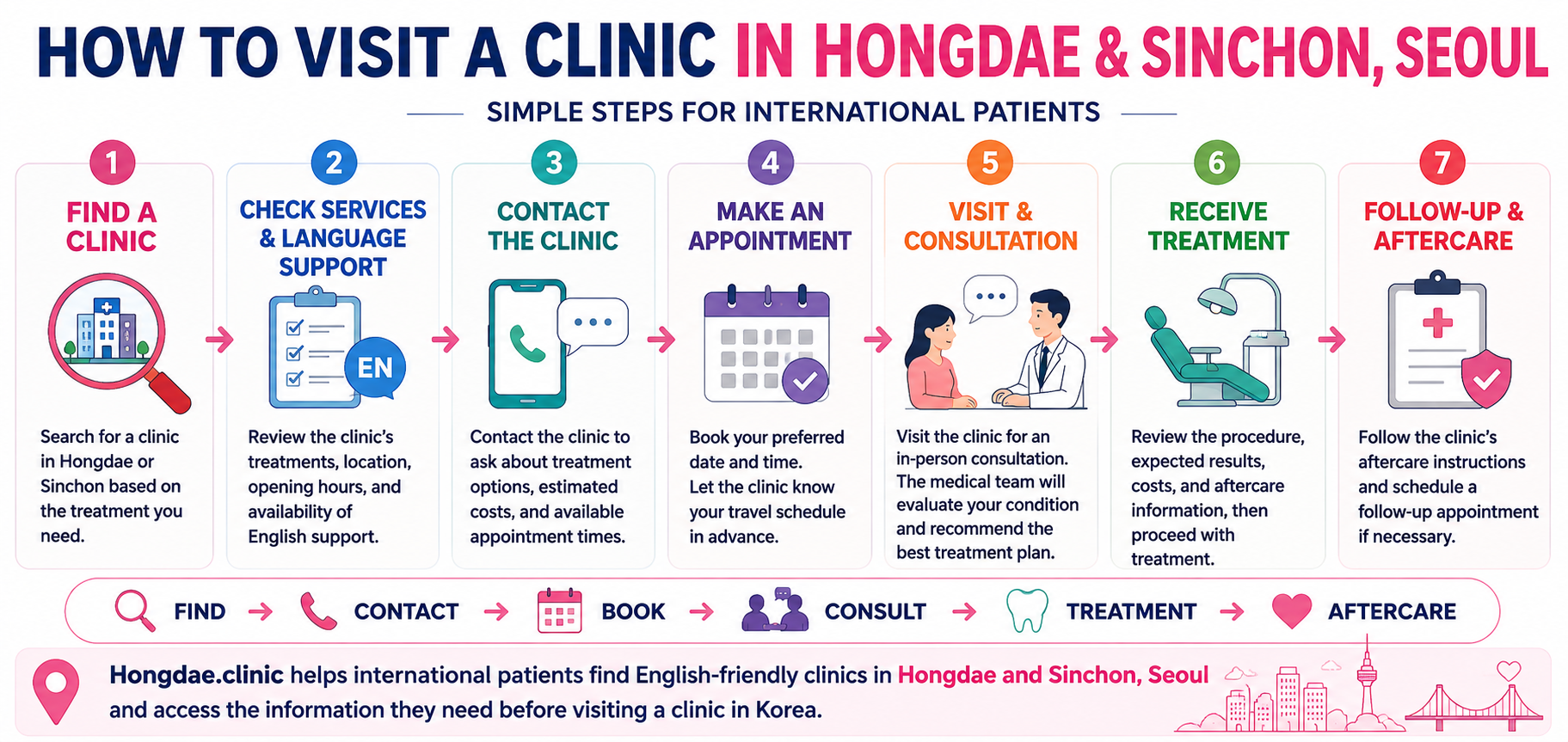
Consultation → nasal tip analysis → surgical planning → tip plasty → recovery → follow-up.
When Might You Consider Tip Plasty?
Tip plasty may be considered for:
- Bulbous nasal tip
- Poor tip definition
- Drooping nasal tip
- Short nose
- Low tip projection
- Wide nasal tip
- Tip asymmetry
- Desire for improved nasal proportions
The appropriate technique depends on skin thickness, cartilage strength, existing projection, tip rotation, and overall nasal anatomy.
Common Tip Plasty Goals
Tip Refinement
Cartilage reshaping and suturing techniques may help create a more defined and balanced nasal tip.
Tip Projection
Selected patients may need additional structural support to increase or control how far the nasal tip projects from the face.
Tip Rotation
Surgery can also modify the angle and position of the nasal tip when it appears excessively droopy or upward-turned.
Tip Plasty Treatment Process
A typical surgical process may include:
- Plastic surgery consultation
- Detailed facial and nasal assessment
- Photography and surgical planning
- Open or closed surgical approach
- Cartilage reshaping, suturing, or grafting
- Assessment of tip projection and symmetry
- Postoperative follow-up
Tip surgery requires individualized planning because small structural changes can have a significant effect on the overall appearance of the nose.
Tip Plasty Techniques
Cartilage Suturing
Sutures may be used to reshape or reposition the existing tip cartilage without removing excessive structural support.
Cartilage Grafting
Cartilage grafts may be added to improve tip projection, definition, or structural stability.
Septal Extension Graft
A septal extension graft may be considered when greater control of tip projection, rotation, or nasal length is required.
Tip Plasty vs Full Rhinoplasty
Tip plasty focuses mainly on the nasal tip, while full rhinoplasty may also modify the:
- Nasal bridge
- Nasal bones
- Septum
- Alar base
- Overall nasal width
- Functional breathing structures
Patients whose primary concern is limited to the tip may be candidates for more focused surgery, while broader structural concerns may require full rhinoplasty.
Open vs Closed Tip Plasty
Tip plasty may be performed through either an open or closed rhinoplasty approach.
Open tip plasty provides greater direct visualization of the cartilage and may be useful for more complex grafting or structural correction.
Closed tip plasty uses internal incisions and may be appropriate for selected, less complex modifications.
The approach should be chosen according to nasal anatomy and the amount of structural work required, rather than assuming one technique is always better.
Tip Plasty for Asian Noses
In East Asian rhinoplasty, nasal tip surgery often focuses on improving projection, definition, and structural support rather than simply reducing cartilage.
Published reviews describe cartilage grafting, suturing, and structural support techniques as important options for Asian nasal tip surgery, particularly when the tip has relatively weak cartilage support or thicker soft tissue.
Treatment should still be based on individual anatomy rather than ethnicity alone.
Which Cartilage Can Be Used?
Depending on the amount of support required, graft material may include:
- Septal cartilage
- Ear cartilage
- Rib cartilage
Septal or ear cartilage may be sufficient for selected primary procedures, while rib cartilage may be considered when stronger or greater structural support is needed, particularly in more complex or revision cases.
When Do Results Appear?
The change in tip shape is visible after surgery, but swelling can temporarily make the tip appear wider, higher, or less defined.
The nasal tip often takes longer than the bridge to settle because of the soft tissue and surgical manipulation involved.
Final tip definition should therefore be evaluated after adequate healing rather than during the early postoperative period.
What Is Recovery Like?
Temporary postoperative symptoms may include:
- Swelling
- Bruising
- Nasal congestion
- Tenderness
- Temporary numbness
- Tip stiffness
- Mild asymmetry during early healing
Recovery varies depending on whether tip plasty is performed alone or together with more extensive rhinoplasty.
Possible Risks and Complications
Potential complications may include:
- Infection
- Persistent swelling
- Tip asymmetry
- Under- or over-projection
- Visible or palpable graft edges
- Nostril shape changes
- Scarring
- Unsatisfactory cosmetic results
- Need for revision surgery
A Korean case series involving multilayer cartilage tip grafting reported complications including infection, visible graft contour, nostril deformity, over-projection, and revision surgery in some patients.
Can Tip Plasty Look Natural?
Yes. Natural-looking results depend on creating appropriate tip projection, rotation, definition, and proportion with the bridge and face.
Modern tip surgery emphasizes maintaining structural support while avoiding excessive narrowing or projection. Because nasal-tip anatomy varies significantly between patients, individualized planning is essential.
Tip Plasty for International Patients
When contacting a plastic surgery clinic, consider asking:
- Is English consultation available?
- Which tip concerns do I have?
- Is tip plasty alone sufficient?
- Will cartilage grafting be required?
- Where will the cartilage come from?
- Is an open or closed approach recommended?
- How long should I stay in Korea?
- Is postoperative follow-up included?
If you are visiting Korea temporarily, discuss the timing of suture removal, splint removal if used, and early postoperative checks before departure.
Choosing a Tip Plasty Clinic in Hongdae or Sinchon
Consider:
- Qualified plastic surgeon
- Detailed nasal tip analysis
- Experience with tip plasty
- Customized cartilage and suture techniques
- Experience with cartilage grafting
- Natural facial proportion planning
- Functional nasal assessment
- English communication
- Transparent surgery costs
Tip surgery is technically demanding because changes in cartilage shape and support can affect both appearance and nasal function.
Hongdae & Sinchon Medical Care
Hongdae is convenient for patients around:
Hongik University · Yeonnam-dong · Hapjeong · Sangsu · Mapo
Sinchon is convenient for patients around:
Yonsei University · Ewha Womans University · Seodaemun · Mapo
Common searches include:
- Tip Plasty Hongdae
- Nasal Tip Surgery Hongdae
- Tip Rhinoplasty Hongdae
- Tip Plasty Sinchon
- Nasal Tip Refinement Sinchon
- English speaking plastic surgery clinic Sinchon
Frequently Asked Questions
What is tip plasty?
Tip plasty is rhinoplasty focused primarily on reshaping or supporting the nasal tip, including its projection, rotation, definition, and symmetry.
Can foreigners get tip plasty in Seoul?
Yes. International patients can contact plastic surgery clinics in Seoul regarding consultation, surgical planning, recovery, and English-language support.
Is tip plasty the same as full rhinoplasty?
No. Tip plasty mainly addresses the nasal tip, while full rhinoplasty may also change the bridge, nasal bones, septum, or nasal base.
Is cartilage needed for tip plasty?
Sometimes. Septal, ear, or rib cartilage may be used when additional tip projection, definition, or structural support is required.
Can tip plasty correct a bulbous nasal tip?
Yes. Selected bulbous-tip concerns can be treated using
cartilage reshaping, suturing, grafting, or combined techniques, depending on skin thickness and underlying cartilage anatomy.