Hongdae & Sinchon Tummy Tuck
in Seoul, Korea
Tummy tuck is a surgical procedure designed to remove excess abdominal skin and improve the contour and firmness of the midsection. Treatment may also tighten weakened abdominal muscles depending on individual anatomy and body goals.
Patients seeking a
tummy tuck in Hongdae or Sinchon should consider surgical technique, scarring, and recovery needs.
If you are concerned about loose abdominal skin, lower-belly tissue excess, abdominal wall laxity, or separation of the rectus muscles after pregnancy or significant weight changes, a Tummy Tuck may be considered. Also called abdominoplasty, the procedure removes selected excess skin and fat and may include tightening of the abdominal fascia when rectus diastasis is present. Large clinical datasets show that abdominoplasty can provide substantial abdominal contour improvement, although it carries meaningful wound, seroma, hematoma, infection, and blood-clot risks.
Hongdae and Sinchon are convenient areas for Tummy Tuck consultations in Seoul, especially for international residents and travelers seeking abdominal body-contouring procedures.
What Is a Tummy Tuck?
A Tummy Tuck, or abdominoplasty, is a surgical procedure designed to remove redundant abdominal skin and reshape the abdominal wall.
Depending on the patient's anatomy, surgery may include lower-abdominal skin excision, repositioning of the belly button, rectus sheath plication, and Liposuction of surrounding areas. Different forms of abdominoplasty are used according to the amount and location of skin excess.
Consultation → abdominal assessment → surgical planning → skin and tissue removal → abdominal wall repair when indicated → umbilical positioning → closure → recovery → follow-up.
When Might You Consider a Tummy Tuck?
A Tummy Tuck may be considered for:
- Loose abdominal skin after pregnancy
- Excess skin after significant weight loss
- Lower-abdominal skin folds
- Rectus diastasis
- Abdominal wall laxity
- Persistent abdominal contour concerns not corrected by Liposuction alone
- Stretch-marked skin located within tissue planned for removal
- Desire for combined skin and abdominal-wall contouring
The appropriate procedure depends on skin excess, fat distribution, abdominal-wall anatomy, previous surgery, body weight, and the location of any rectus separation.
What Can a Tummy Tuck Treat?
Loose Abdominal Skin
Abdominoplasty directly removes selected redundant skin, making it different from Liposuction, which primarily removes subcutaneous fat.
This can be particularly useful after pregnancy or major weight changes when the skin no longer contracts adequately around the abdomen.
Rectus Diastasis
Rectus diastasis refers to widening of the midline connective tissue between the rectus abdominal muscles.
Abdominoplasty can include rectus sheath plication to narrow this separation and reinforce the abdominal wall. Prospective ultrasound follow-up has demonstrated durable correction after plication in appropriately selected patients.
Localized Fat
Selected abdominal and flank fat can also be treated with Liposuction during some abdominoplasty procedures.
Large outcome studies have shown that Liposuction can be combined with abdominoplasty when surgical technique preserves appropriate blood supply to the abdominal flap.
Tummy Tuck Surgery Process
A typical surgical process may include:
- Plastic surgery consultation
- Assessment of skin, fat, and abdominal-wall laxity
- Evaluation for rectus diastasis or hernia
- Customized incision and tissue-removal planning
- Rectus sheath plication when indicated
- Removal and redraping of abdominal skin
- Umbilical repositioning and postoperative follow-up
The actual operation varies according to whether the patient undergoes a full, mini, extended, fleur-de-lis, or combined lipoabdominoplasty technique. A recent analysis of more than 55,000 abdominoplasty procedures found significant differences in complication rates among different abdominoplasty types.
Full Tummy Tuck vs Mini Tummy Tuck
These procedures differ in the extent of correction.
Full Tummy Tuck
A full abdominoplasty generally treats more extensive abdominal skin laxity and commonly involves repositioning the umbilicus.
It can also provide broad access for abdominal-wall plication when rectus diastasis extends above and below the belly button.
Mini Tummy Tuck
A Mini Tummy Tuck is a more limited procedure, generally used when skin excess is concentrated below the navel.
Modified mini-abdominoplasty techniques can also address rectus diastasis in selected patients while preserving the umbilical stalk, although patient selection is important.
A Mini Tummy Tuck is not automatically better because the scar is shorter; it may provide insufficient correction when skin laxity or muscle separation extends across the entire abdomen.
Tummy Tuck vs Liposuction
These procedures treat different anatomical problems.
Tummy Tuck
- Removes excess skin
- Can repair rectus diastasis
- Can reshape the abdominal wall
- Requires a longer incision
Liposuction
- Removes subcutaneous fat
- Does not directly remove substantial loose skin
- Does not repair rectus diastasis
- Uses smaller cannula access incisions
When both skin excess and localized fat are present, a combined lipoabdominoplasty may be considered. In a large database study of 11,191 patients, combined truncal Liposuction and abdominoplasty was not associated with higher overall complication rates than abdominoplasty alone after adjustment for other factors.
What Is Lipoabdominoplasty?
Lipoabdominoplasty combines abdominal skin removal with Liposuction of selected abdominal, waist, or flank areas.
The goal is to improve both:
- Abdominal skin laxity
- Waist and torso contour
- Localized fat deposits
- Transition between the abdomen and flanks
Modern techniques often limit undermining or preserve important perforating vessels to maintain blood supply to the abdominal flap. A 300-patient series using a perforator-preserving approach reported a 17.3% overall complication rate, with major complications occurring in 1.3% of patients.
Does a Tummy Tuck Repair Abdominal Muscles?
The muscles themselves are not usually cut and shortened in a standard cosmetic Tummy Tuck.
Instead, when rectus diastasis is present, the fascia covering the rectus muscles is commonly tightened with sutures, bringing the abdominal wall toward the midline.
This can improve abdominal-wall contour and support, but not every patient requires plication.
Can a Tummy Tuck Make the Waist Smaller?
It may improve waist and abdominal proportions by combining:
- Skin removal
- Abdominal-wall tightening
- Selected Liposuction
- Redistribution of skin tension
The degree of waist change depends on skeletal proportions, abdominal fat, flank fullness, muscle structure, and the amount of safe tissue correction. Combined Liposuction and modified abdominoplasty techniques have produced favorable contour outcomes in clinical series.
Can a Tummy Tuck Remove Stretch Marks?
Only stretch marks located within skin that is actually removed can be eliminated directly.
Stretch marks remaining on retained upper-abdominal skin usually remain, although their position may change when the skin is redraped.
A Tummy Tuck should therefore not be considered a treatment that removes all abdominal stretch marks.
What Happens to the Belly Button?
In many full abdominoplasty procedures, the original umbilicus remains attached to the abdominal wall while surrounding skin is repositioned.
A new opening is then created in the redraped skin so the belly button can emerge at an appropriate location. Clinical techniques emphasize that umbilical shape and position are important components of a natural-looking abdominoplasty result.
Mini-abdominoplasty techniques may avoid standard umbilical transposition in selected patients.
Where Is the Tummy Tuck Scar?
A standard Tummy Tuck creates a horizontal lower-abdominal scar, generally positioned so that it can be concealed beneath underwear when anatomy allows.
Full abdominoplasty commonly also creates a scar around the belly button. More extensive procedures such as fleur-de-lis abdominoplasty add a vertical abdominal scar to remove excess skin in more than one direction.
Scar length depends on how much loose skin must be removed.
Can the Scar Be Very Long?
Yes.
The incision must generally extend far enough laterally to remove redundant skin without leaving large folds at the ends of the scar.
Patients with extensive weight-loss-related skin excess may therefore require longer incisions than patients with mild postpartum laxity.
Choosing an unrealistically short scar can sometimes compromise the amount or quality of skin correction.
When Do Results Appear?
Abdominal flattening is visible after surgery, but early appearance is affected by:
- Swelling
- Bruising
- Fluid retention
- Tissue tightness
- Scar redness
- Temporary abdominal numbness
The abdomen gradually becomes more natural as swelling resolves and the scar matures.
Final evaluation should therefore occur after adequate healing rather than during the first postoperative weeks.
What Is Recovery Like?
Temporary postoperative symptoms may include:
- Abdominal swelling
- Bruising
- Tightness
- Pain or tenderness
- Temporary numbness
- Difficulty standing completely upright initially
- Incision redness
- Temporary firmness
Recovery depends on the extent of skin removal, whether muscle plication is performed, whether Liposuction is added, and whether other procedures are performed simultaneously.
Large outcome data show that complication risk rises when abdominoplasty is combined with additional major cosmetic procedures.
Possible Risks and Complications
Potential complications include:
- Hematoma
- Seroma
- Infection
- Wound separation
- Delayed healing
- Skin or fat necrosis
- Unfavorable scarring
- Temporary or persistent numbness
- Umbilical healing problems
- Asymmetry
- Venous thromboembolism
- Need for revision surgery
A database analysis of 55,596 abdominoplasty patients reported a 2.1% major-complication rate, with risk differing by procedure type and patient factors.
Another large study of 25,478 patients found higher complication risks among patients with factors including BMI of 30 or greater, older age, male sex, and multiple simultaneous procedures.
Seroma After Tummy Tuck
A seroma is a collection of fluid beneath the abdominal skin flap and is one of the commonly discussed postoperative problems after abdominoplasty.
Surgical strategies such as progressive tension sutures are used by some surgeons to reduce dead space between the abdominal flap and underlying tissues. In a randomized clinical trial, patients treated without either drains or progressive tension sutures developed larger seromas and required more aspirations than the other treatment groups.
Another randomized study reported a 3.5% seroma rate in patients treated using progressive tension sutures.
Does a Tummy Tuck Require Drains?
Not always.
Some surgeons use temporary drains, while others use progressive tension sutures or other techniques designed to reduce dead space and manage postoperative fluid without drains.
Clinical trials have evaluated both strategies, and the appropriate approach depends on the surgeon's technique and the specific operation performed.
International patients should ask whether drains will be used and, if so, when they are expected to be removed.
Blood Clot Risk
Deep vein thrombosis and pulmonary embolism are uncommon but potentially serious complications of abdominoplasty.
In a large database study of 25,478 abdominoplasty patients, suspected or confirmed venous thromboembolism represented approximately one-fifth of the major complications recorded.
Individual preventive planning depends on factors such as body weight, age, medical history, mobility, procedure duration, and whether multiple operations are combined.
Smoking and Tummy Tuck Surgery
Smoking is particularly concerning because abdominal skin-flap healing depends on adequate blood supply.
In a study of 132 abdominoplasty patients, wound-healing problems occurred in 47.9% of smokers compared with 14.8% of nonsmokers.
Patients who smoke or use nicotine should disclose this clearly during consultation and follow the operating surgeon's pre- and postoperative nicotine restrictions.
Can a Tummy Tuck Look Natural?
Yes.
Natural-looking results generally depend on balancing:
- Abdominal skin tension
- Waist contour
- Umbilical shape
- Scar position
- Abdominal-wall correction
- Flank proportions
The goal should be a smooth, proportionate abdominal contour rather than removing the maximum possible amount of skin or fat.
Clinical comparisons suggest that techniques preserving blood supply while combining controlled Liposuction and limited undermining can achieve favorable aesthetic outcomes.
Are Tummy Tuck Results Permanent?
The skin removed during surgery does not grow back, and repaired abdominal fascia can remain stable for many patients.
Prospective ultrasound follow-up after rectus sheath plication has demonstrated durable correction of diastasis in the studied patients.
However, future appearance can change because of:
- Significant weight gain
- Major weight loss
- Pregnancy
- Aging
- Recurrent abdominal-wall laxity
Maintaining relatively stable weight can help preserve the result.
Pregnancy After a Tummy Tuck
Pregnancy can occur after abdominoplasty, but it may stretch the abdominal skin and repaired abdominal wall again.
In a study of women who became pregnant after abdominoplasty, reported aesthetic changes included new stretch marks, additional loose abdominal skin, scar widening, and recurrent abdominal bulging, although the severity varied considerably.
Patients expecting pregnancy relatively soon may therefore prefer to discuss timing carefully before undergoing surgery.
Revision Tummy Tuck
Revision surgery may be considered for:
- Residual skin excess
- Scar concerns
- Abdominal asymmetry
- Persistent fat deposits
- Recurrent laxity
- Umbilical shape concerns
- Contour irregularities after previous Liposuction
Revision planning may involve additional skin excision, Liposuction, fat grafting, scar revision, or renewed abdominal-wall treatment depending on the cause.
A recent case series of abdominal irregularities after previous Liposuction used combinations of fibrosis removal, Liposuction, and abdominoplasty or mini-abdominoplasty to address complex contour problems.
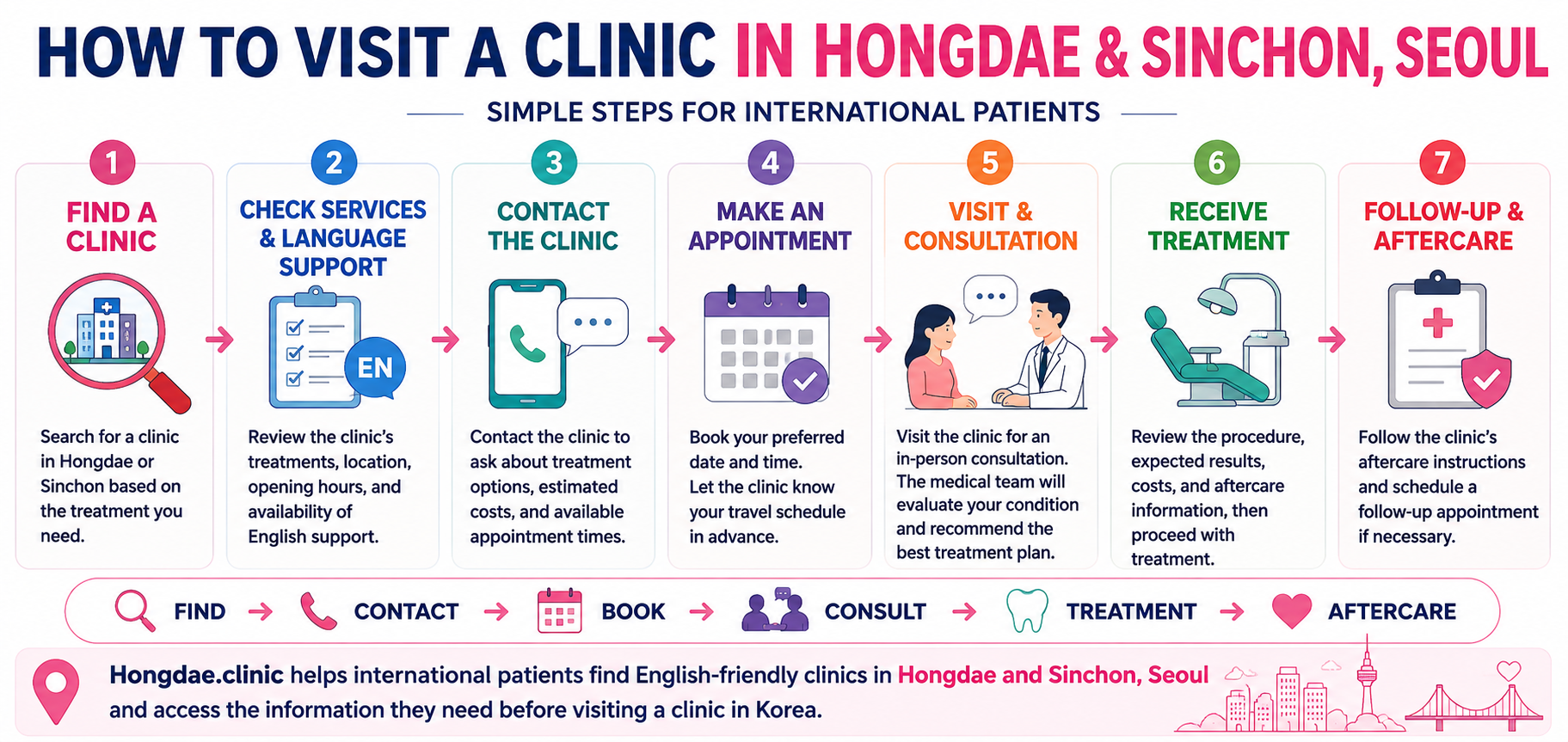
Tummy Tuck for International Patients
When contacting a plastic surgery clinic, consider asking:
- Is English consultation available?
- Do I need a full or Mini Tummy Tuck?
- Do I have rectus diastasis?
- Will muscle or fascial plication be performed?
- Will Liposuction be combined with surgery?
- Where will the final scar be located?
- Will drains be required?
- How will blood-clot risk be managed?
- How long should I stay in Korea?
- Is postoperative follow-up included?
If you have previously undergone abdominal Liposuction, cesarean section, hernia repair, bariatric surgery, or previous Tummy Tuck surgery, tell the surgeon because previous scars and abdominal-wall anatomy can influence surgical planning.
Choosing a Tummy Tuck Clinic in Hongdae or Sinchon
Consider:
- Qualified plastic surgeon
- Experience with abdominoplasty
- Detailed abdominal-wall assessment
- Evaluation for rectus diastasis
- Appropriate scar and umbilical planning
- Experience with lipoabdominoplasty when indicated
- Clear seroma and wound-management protocol
- Blood-clot risk assessment
- English communication
- Transparent surgery costs
Large outcome studies show that abdominoplasty complication risk varies according to patient characteristics, surgical technique, procedure type, and whether additional operations are combined, making individualized surgical planning particularly important.
Hongdae & Sinchon Medical Care
Hongdae is convenient for patients around:
Hongik University · Yeonnam-dong · Hapjeong · Sangsu · Mapo
Sinchon is convenient for patients around:
Yonsei University · Ewha Womans University · Seodaemun · Mapo
Common searches include:
- Tummy Tuck Hongdae
- Abdominoplasty Hongdae
- Lipoabdominoplasty Hongdae
- Tummy Tuck Sinchon
- Abdominal Skin Removal Sinchon
- English speaking plastic surgery clinic Sinchon
Frequently Asked Questions
What is a Tummy Tuck?
A Tummy Tuck, or abdominoplasty, removes selected excess abdominal skin and may include abdominal-wall plication and Liposuction depending on the patient's anatomy.
Is a Tummy Tuck the same as Liposuction?
No. Liposuction primarily removes subcutaneous fat, while a Tummy Tuck directly removes loose skin and can also repair rectus diastasis.
Can a Tummy Tuck repair separated abdominal muscles?
Yes. When rectus diastasis is present, surgeons may perform rectus sheath plication during abdominoplasty. Long-term ultrasound studies have demonstrated durable correction in appropriately selected patients.
Does a Tummy Tuck leave a scar?
Yes. A standard full Tummy Tuck leaves a lower-abdominal scar and commonly a scar around the belly button. Scar length depends on the amount and distribution of skin excess.
Can foreigners get a Tummy Tuck in Seoul?
Yes. International patients can contact plastic surgery clinics in Seoul regarding abdominal assessment, procedure selection, scar planning, recovery, postoperative monitoring, and English-language support.