Hongdae & Sinchon Upper Blepharoplasty
in Seoul, Korea
Upper blepharoplasty is a surgical procedure designed to remove or reposition excess upper eyelid skin and fat for a more refreshed appearance. Treatment may help improve eyelid heaviness, asymmetry, or visual obstruction depending on individual anatomy.
Patients seeking
upper blepharoplasty in Hongdae or Sinchon should consider surgical approach, expected results, and recovery needs.
If you are concerned about heavy upper eyelids, excess eyelid skin, reduced eyelid crease visibility, or a tired-looking eye area, upper blepharoplasty may be considered to improve the contour of the upper eyelids. The procedure may be performed for cosmetic reasons, functional vision concerns, or both.
Hongdae and Sinchon are convenient areas for plastic surgery consultations in Seoul, especially for international residents, students, and travelers.
What Is Upper Blepharoplasty?
Upper blepharoplasty is surgery designed to remove or reposition selected excess tissue from the upper eyelids.
Depending on the patient's anatomy, surgery may address loose skin, localized fat, eyelid-crease definition, or lateral hooding while preserving enough tissue for normal eyelid closure and function.
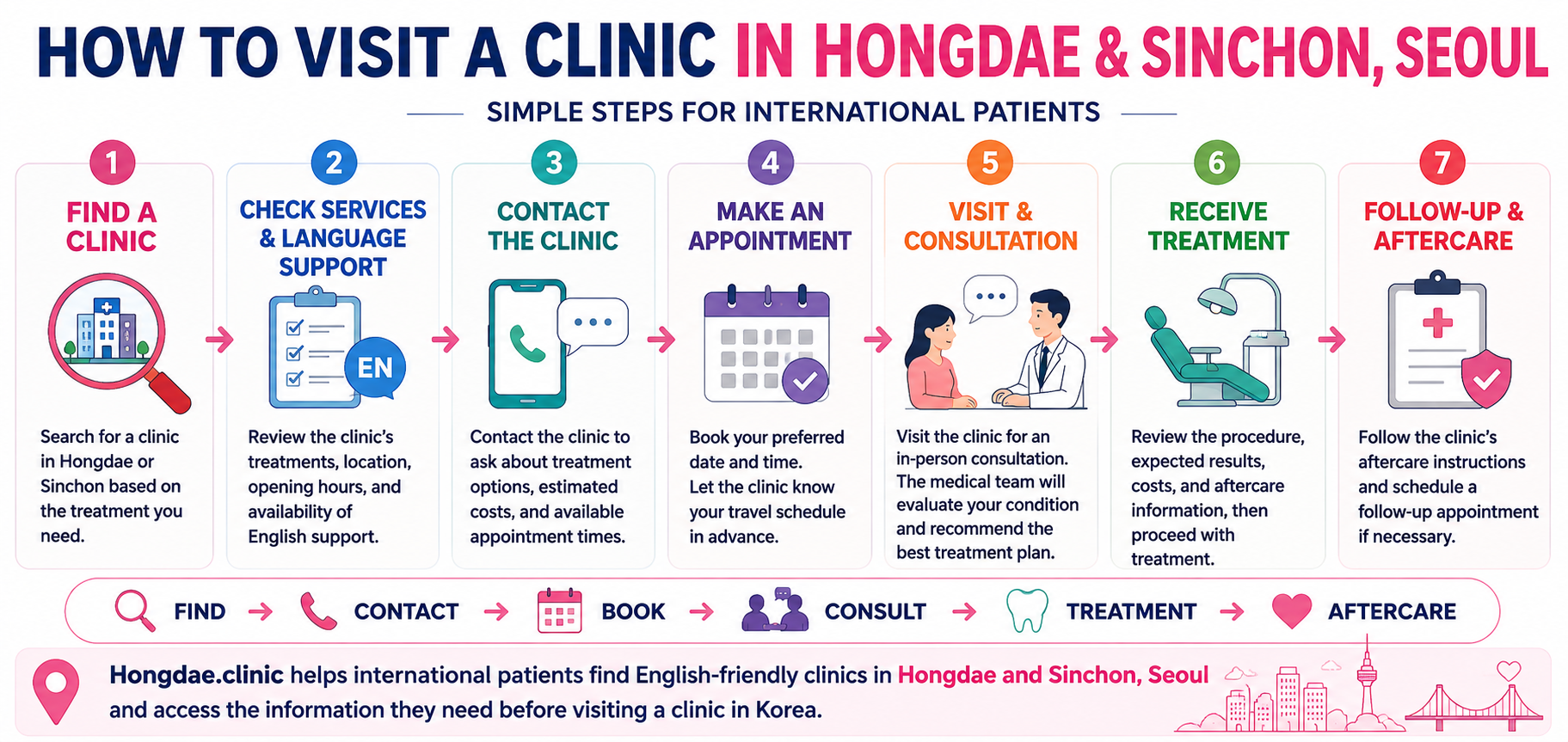
Consultation → eyelid assessment → surgical planning → upper blepharoplasty → recovery → follow-up.
When Might You Consider Upper Blepharoplasty?
Upper blepharoplasty may be considered for:
- Excess upper-eyelid skin
- Heavy-looking eyelids
- Hooded eyelids
- Reduced eyelid crease visibility
- Lateral eyelid hooding
- Eyelid asymmetry
- Aging-related upper-eyelid changes
- Excess skin affecting the upper visual field
Before surgery, the surgeon should also evaluate whether brow drooping or true eyelid ptosis is contributing to the heavy appearance.
Common Upper Blepharoplasty Goals
Removing Excess Eyelid Skin
Selected redundant skin can be removed to create a cleaner and less heavy upper-eyelid contour.
Improving Eyelid Definition
Surgery may improve visibility of the upper eyelid crease and tarsal platform. Systematic review evidence has found increased visible tarsal platform after upper blepharoplasty.
Improving Functional Vision
When excess skin hangs into the visual field, upper blepharoplasty may provide functional as well as cosmetic benefits. Recent American Academy of Ophthalmology evidence reviews found improvements in several visual-function and quality-of-life outcomes after upper eyelid surgery.
Upper Blepharoplasty Treatment Process
A typical surgical process may include:
- Plastic surgery consultation
- Detailed eyelid and brow assessment
- Evaluation for ptosis and asymmetry
- Customized incision and skin-removal design
- Removal or repositioning of selected tissue
- Careful wound closure
- Postoperative follow-up
Preoperative evaluation should include the brow position, eyelid-opening function, existing asymmetry, dry-eye symptoms, and overall eye health.
Upper Blepharoplasty vs Double Eyelid Surgery
The two procedures can overlap, but they are not always identical.
Upper blepharoplasty commonly focuses on excess or aging-related upper-eyelid tissue, while double eyelid surgery primarily creates or modifies an upper-eyelid crease.
In some Asian patients, both concerns may be addressed during the same operation depending on the existing crease and desired appearance.
Upper Blepharoplasty vs Ptosis Correction
Upper blepharoplasty removes or reshapes eyelid tissue, while ptosis correction addresses the structures responsible for lifting the eyelid itself.
If the upper eyelid margin sits abnormally low, simply removing skin may not fully correct the problem.
Studies of combined upper blepharoplasty and ptosis correction show that the procedures are frequently performed together when both conditions are present.
Upper Blepharoplasty vs Brow Lift
Sometimes the appearance of heavy eyelids is partly caused by a low eyebrow position rather than excess eyelid skin alone.
A brow lift addresses the eyebrow and forehead tissues, while upper blepharoplasty focuses primarily on the upper eyelid.
A meta-analysis found that brow position can decrease slightly after some upper-eyelid surgeries, making preoperative brow assessment particularly important.
Can Upper Blepharoplasty Improve Vision?
Yes, in selected patients.
When redundant upper-eyelid tissue obstructs the superior visual field, surgery may improve visual function and daily activities.
A 2025 American Academy of Ophthalmology evidence review found benefits in visual function, patient satisfaction, and health-related quality of life after upper blepharoplasty, ptosis correction, or combined procedures.
Upper Blepharoplasty for Asian Eyes
Asian upper-eyelid anatomy can vary in terms of:
- Existing eyelid crease
- Eyelid thickness
- Fat distribution
- Epicanthal fold
- Brow position
- Eyelid-opening strength
For this reason, upper blepharoplasty should be customized to the patient's existing anatomy and desired crease, rather than automatically creating a high or deeply defined eyelid fold.
Research involving East Asian patients also shows that upper-eyelid surgery can influence postoperative brow position, reinforcing the importance of evaluating the entire brow-eyelid relationship.
Does Upper Blepharoplasty Leave a Scar?
Yes. Incisional upper blepharoplasty generally places the surgical incision within or near the natural upper-eyelid crease.
The scar typically becomes less noticeable as it matures, but individual healing varies.
Scar appearance can depend on:
- Incision placement
- Skin characteristics
- Surgical technique
- Wound tension
- Individual healing
- Postoperative scar care
Systematic review evidence generally reports favorable patient satisfaction with scar appearance after upper blepharoplasty.
When Do Results Appear?
The eyelids usually appear more open soon after surgery, but swelling and bruising can temporarily affect the early result.
The eyelid crease and surrounding tissues gradually become more natural as swelling decreases.
Brow position may also adjust after surgery, so the final result should be evaluated after adequate healing rather than during the first postoperative weeks.
What Is Recovery Like?
Temporary postoperative symptoms may include:
- Swelling
- Bruising
- Tenderness
- Tightness
- Temporary numbness
- Dryness or irritation
- Mild asymmetry
- Temporary difficulty fully closing the eyelids
Most studies evaluating quality-of-life outcomes have not found persistent worsening of subjective dry-eye symptoms in most patients, although temporary symptoms can occur.
Possible Risks and Complications
Potential complications may include:
- Bleeding
- Infection
- Visible scarring
- Eyelid asymmetry
- Dry-eye symptoms
- Under- or over-correction
- Difficulty fully closing the eyes
- Brow-position changes
- Persistent eyelid heaviness
- Need for revision surgery
A recent randomized-trial meta-analysis found that techniques removing both skin and orbicularis muscle were associated with a greater risk of temporary incomplete eyelid closure than skin-only approaches, emphasizing the importance of conservative tissue removal.
Can Upper Blepharoplasty Correct Asymmetry?
Selected asymmetry can be improved, but perfect symmetry cannot always be guaranteed.
The surgeon should evaluate:
- Eyelid crease height
- Amount of excess skin
- Brow height
- Eyelid ptosis
- Fat distribution
- Previous eyelid surgery
Pre-existing asymmetry and ptosis should be identified before surgery because they can influence the final result.
Can Upper Blepharoplasty Look Natural?
Yes. Natural-looking results generally depend on conservative skin removal, appropriate crease design, preservation of eyelid volume, and consideration of brow position.
Over-removing skin or fat may create a hollow or excessively operated appearance.
Modern upper blepharoplasty therefore focuses on balancing rejuvenation, eyelid function, and natural facial proportions.
Upper Blepharoplasty for International Patients
When contacting a plastic surgery clinic, consider asking:
- Is English consultation available?
- Is my heaviness caused by excess skin, brow ptosis, or eyelid ptosis?
- How much skin will be removed?
- Will fat also be removed or repositioned?
- Will my existing eyelid crease be preserved?
- Do I need ptosis correction or a brow lift?
- How long should I stay in Korea?
- Is postoperative follow-up included?
If you have dry eyes, previous eye surgery, contact lens problems, or previous eyelid procedures, tell the surgeon before treatment because these factors may influence surgical planning.
Choosing an Upper Blepharoplasty Clinic in Hongdae or Sinchon
Consider:
- Qualified plastic surgeon
- Detailed upper-eyelid and brow assessment
- Evaluation for eyelid ptosis
- Conservative skin and tissue removal
- Natural eyelid-crease planning
- Assessment of dry-eye symptoms
- Clear discussion of scars and recovery
- English communication
- Transparent surgery costs
Successful upper blepharoplasty depends on evaluating the upper eyelid, eyebrow position, volume, symmetry, and eyelid-opening function together, rather than treating excess skin alone.
Hongdae & Sinchon Medical Care
Hongdae is convenient for patients around:
Hongik University · Yeonnam-dong · Hapjeong · Sangsu · Mapo
Sinchon is convenient for patients around:
Yonsei University · Ewha Womans University · Seodaemun · Mapo
Common searches include:
- Upper Blepharoplasty Hongdae
- Upper Eyelid Surgery Hongdae
- Hooded Eye Surgery Hongdae
- Upper Blepharoplasty Sinchon
- Upper Eyelid Lift Sinchon
- English speaking plastic surgery clinic Sinchon
Frequently Asked Questions
What is upper blepharoplasty?
Upper blepharoplasty is surgery that removes or repositions selected excess skin and other tissues of the upper eyelid to improve cosmetic appearance, functional vision, or both.
Can foreigners get upper blepharoplasty in Seoul?
Yes. International patients can contact plastic surgery clinics in Seoul regarding consultation, surgical planning, recovery, and English-language support.
Is upper blepharoplasty the same as ptosis surgery?
No. Blepharoplasty primarily treats excess eyelid tissue, while ptosis surgery corrects weakness or dysfunction in the structures responsible for lifting the upper eyelid.
Can upper blepharoplasty improve vision?
Yes, when excess upper-eyelid tissue obstructs the visual field. Evidence reviews have found improvement in visual and quality-of-life outcomes after functional upper-eyelid surgery.
Does upper blepharoplasty cause dry eyes?
Temporary dryness or irritation can occur. Most recent quality-of-life evidence did not show persistent subjective worsening in the majority of patients, but patients with
pre-existing dry-eye symptoms should be evaluated carefully before surgery.