Hongdae & Sinchon V-Line Surgery
in Seoul, Korea
V-Line surgery is a facial contouring procedure designed to create a slimmer, more defined lower face and jawline.
Treatment may involve reshaping the jawbone, chin, or both depending on individual facial structure and aesthetic goals.
Patients seeking
V-Line surgery in Hongdae or Sinchon should consider surgical technique, facial proportions, and recovery needs.
If you are concerned about a wide, square, or heavy-looking lower face, V-Line Surgery may be considered to create a narrower and more tapered facial contour. The procedure commonly combines mandibular contouring with chin reshaping, although the exact osteotomy design should be customized to the patient's jaw angles, mandibular width, chin dimensions, facial symmetry, and soft-tissue structure.
Hongdae and Sinchon are convenient areas for V-Line Surgery consultations in Seoul, especially for international residents, students, and travelers seeking facial contouring procedures.
What Is V-Line Surgery?
V-Line Surgery is a lower-face contouring procedure designed to create a smoother, narrower transition from the mandibular angles toward the chin.
Depending on the patient's anatomy, treatment may include:
- Mandibular angle reduction
- Mandibular body contouring
- Outer cortex reduction
- Narrowing genioplasty
- Chin shortening or lengthening
- Chin advancement or setback
- Asymmetry correction
Clinical literature describes V-line contouring as a combination of mandibular and chin procedures rather than one standardized operation.
Consultation → CT and facial assessment → customized osteotomy planning → jaw and/or chin contouring → fixation when required → recovery → follow-up.
When Might You Consider V-Line Surgery?
V-Line Surgery may be considered for:
- Wide or square lower face
- Prominent mandibular angles
- Broad chin
- Heavy-looking lower facial contour
- Lower-face asymmetry
- Desire for a more tapered jawline
- Combination of wide jaw and wide chin
- Residual facial width after previous contouring surgery
The appropriate operation depends on where the width originates. Some patients require treatment of both the jaw and chin, while others may achieve adequate improvement with isolated mandibular or chin surgery.
What Procedures Are Included in V-Line Surgery?
Mandibular Angle Reduction
Prominent posterior jaw angles can be reshaped using an osteotomy to create a smoother lower border.
Different techniques are available, including long curved, V-line, outer-cortex, and other customized osteotomies. Selection should depend on skeletal anatomy rather than using the same cutting pattern for every patient.
Narrowing Genioplasty
When the chin is wide or square, narrowing genioplasty can reshape the front portion of the mandible.
Clinical studies describe several techniques, including T-shaped, M-shaped, inverted V-shaped, and sliding osteotomies, allowing changes in chin width, height, projection, and asymmetry.
Outer Cortex Reduction
Selected removal of the lateral cortical layer may reduce transverse mandibular width without requiring excessive removal of the entire mandibular angle.
This may be combined with other osteotomies when frontal facial width remains prominent.
V-Line Surgery Process
A typical surgical process may include:
- Plastic or maxillofacial surgery consultation
- Facial photographs and CT imaging
- Assessment of jaw width, chin shape, and asymmetry
- Mapping of the inferior alveolar and mental nerves
- Customized mandibular and chin osteotomy planning
- Bone reduction, repositioning, and smoothing
- Postoperative monitoring and follow-up
Three-dimensional planning can help define osteotomy boundaries and the relationship between the planned bone reduction and important structures such as the inferior alveolar nerve canal.
V-Line Surgery vs Jaw Reduction Surgery
These terms overlap but are not always identical.
Jaw Reduction Surgery often focuses primarily on:
- Mandibular angles
- Mandibular body width
- Lower-border contour
V-Line Surgery more commonly incorporates the chin as part of the overall lower-face design.
Clinical studies have emphasized that treating the mandibular angles alone may not create an optimal frontal result when a disproportionately broad chin remains untreated.
V-Line Surgery vs Chin Reduction
Chin Reduction Surgery specifically modifies the chin.
V-Line Surgery may combine chin reshaping with contouring extending farther backward along the mandible.
A patient with a broad chin but normal mandibular angles may be suitable for a mini V-line or isolated narrowing genioplasty, avoiding unnecessary posterior jaw reduction. In one clinical series of 248 patients undergoing mini V-line surgery, chin narrowing alone improved lower-face contour in selected patients without prominent mandibular angles.
V-Line Surgery vs Orthognathic Jaw Surgery
These procedures have different goals.
V-Line Surgery
- Primarily changes facial contour
- Narrows or reshapes the mandible and chin
- Usually does not intentionally change dental occlusion
Orthognathic Jaw Surgery
- Repositions the upper jaw, lower jaw, or both
- Corrects skeletal bite problems
- May treat underbite, overbite, open bite, or significant skeletal asymmetry
Mandibular contouring procedures have historically been performed without orthodontic treatment when the primary concern is external jaw shape rather than dental alignment.
Can V-Line Surgery Make the Face Look Smaller?
Yes, particularly when lower-face width comes from the mandibular angles, mandibular body, or broad chin.
Clinical studies of V-line osteotomy and combined lower-face contouring have documented reductions in lower facial width and improvements in jawline shape.
However, overall facial width is also influenced by:
- Cheekbone width
- Masseter muscle size
- Facial fat
- Chin shape
- Skin and soft-tissue thickness
V-Line Surgery does not directly reduce prominent cheekbones.
Can V-Line Surgery Create a More Defined Chin?
Yes.
Genioplasty allows the chin to be modified in several dimensions, including:
- Width
- Height
- Projection
- Position
- Symmetry
Three-dimensional sliding genioplasty can therefore be used to create a narrower or better-proportioned chin as part of a V-line contour.
The goal should be to balance the chin with the jawline rather than simply making it as narrow as possible.
Is Full V-Line Surgery Always Necessary?
No.
Some patients may need only:
- Mandibular angle reduction
- Outer cortex reduction
- Narrowing genioplasty
- Chin reshaping
For example, patients whose lower-face width is primarily caused by a broad chin may achieve satisfactory contouring with mini V-line surgery alone, without posterior mandibular angle reduction.
A complete facial and skeletal evaluation helps avoid unnecessary bone removal.
Can V-Line Surgery Correct Asymmetry?
Selected skeletal asymmetry can be improved by using different osteotomy designs or reduction amounts on the two sides.
Planning should consider:
- Mandibular angle position
- Lower-border height
- Chin midline
- Chin width
- Dental midline
- Soft-tissue asymmetry
Computer-assisted planning and three-dimensional surgical guides may improve the accuracy of planned mandibular contouring, particularly in patients with asymmetry.
Perfect facial symmetry cannot be guaranteed.
Inferior Alveolar Nerve and V-Line Surgery
The inferior alveolar nerve runs through a canal inside the mandible and ultimately contributes sensation to the lower lip and chin.
Its location varies between individuals, making preoperative CT evaluation important. Anatomical research specifically examining mandibular angle reduction has demonstrated clinically relevant variation in the relationship between the nerve canal and mandibular border.
An osteotomy performed too close to the nerve may result in temporary or persistent sensory disturbance.
Numbness After V-Line Surgery
Temporary numbness of the lower lip, chin, or intraoral tissues is one of the better-recognized complications of mandibular contouring surgery.
In a Korean study of 588 mandibuloplasty patients, sensory deficits were the most common complication. Thirty-eight patients experienced sensory changes, with most improving over time, although a smaller number still reported symptoms at one year.
Persistent sensory changes are possible, so nerve-related risks should be discussed before surgery.
Can V-Line Surgery Cause Facial Sagging?
Soft-tissue changes can occur after substantial mandibular reduction.
The lower jaw provides structural support for the surrounding muscles and soft tissues, so aggressive bone removal can potentially contribute to:
- Jowling
- Lower-face laxity
- Reduced mandibular-angle support
- Skeletonized contour
A comparative study of 106 patients found greater soft-tissue sagging and gonial deficiency after long curved ostectomy than with a V-line technique designed to preserve a more physiological mandibular angle.
Soft-tissue behavior also depends on age, skin elasticity, amount of reduction, and surgical technique.
Can Too Much Jawbone Be Removed?
Yes.
Over-resection can create:
- Excessively narrow lower face
- Loss of a natural mandibular angle
- Irregular lower border
- Facial asymmetry
- Soft-tissue sagging
- Skeletonized appearance
- Difficult revision surgery
Cases requiring reconstructive restoration after excessive mandibular reduction have been reported, including reconstruction of lost mandibular-angle and lower-border volume.
For this reason, V-Line Surgery should emphasize proportion and preservation of natural anatomy, not maximum bone removal.
Masseter Muscle and V-Line Surgery
The masseter muscle attaches around the mandibular angle and contributes to lower-face width.
Surgical exposure around the mandibular border can affect this muscular attachment. Disruption of the pterygomasseteric sling may allow the masseter to retract upward, potentially producing reduced soft-tissue volume over the jaw angle and a more skeletonized appearance.
Careful tissue handling is therefore important in addition to bone contouring.
Does V-Line Surgery Leave a Visible Scar?
Many V-Line procedures are performed through intraoral incisions, allowing access to the mandible and chin without a routine long external facial scar.
Published clinical series of square-jaw contouring have used entirely intraoral approaches for V-line osteotomy, outer-cortex reduction, and genioplasty.
However, internal incisions still require healing and may cause temporary swelling, discomfort, and limitation of mouth opening.
When Do Results Appear?
The skeletal contour changes during surgery, but early appearance is affected by significant swelling.
Patients may temporarily experience:
- Broad-looking lower face from swelling
- Facial asymmetry
- Tightness
- Firmness
- Reduced mouth opening
The lower facial contour gradually becomes clearer as swelling decreases and the soft tissues adapt to the new skeleton.
Postoperative studies have documented ongoing soft-tissue adaptation after mandibular contouring, meaning the early appearance should not be treated as the final result.
What Is Recovery Like?
Temporary postoperative symptoms may include:
- Facial swelling
- Bruising
- Lower-lip or chin numbness
- Jaw tightness
- Intraoral discomfort
- Difficulty chewing
- Limited mouth opening
- Temporary asymmetry
Clinical studies of mandibular-angle contouring have documented temporary trismus or limited mouth opening, which typically improves during recovery.
Recovery may be more extensive when mandibular and chin procedures are performed together.
Possible Risks and Complications
Potential complications may include:
- Bleeding
- Hematoma
- Infection
- Temporary or persistent numbness
- Facial asymmetry
- Under-correction
- Overcorrection
- Irregular mandibular contour
- Secondary angle formation
- Unfavorable bone fracture
- Facial nerve injury
- Soft-tissue sagging
- Need for revision surgery
A Korean survey covering 1,251 mandibular angle ostectomy procedures reported complications in 9.9% of operations, including subcondylar fracture, severe bleeding, transient facial nerve injury, infection, trismus, asymmetry, undercorrection, and overcorrection.
A separate 588-patient Korean mandibuloplasty series found sensory disturbance and infection among the more common postoperative problems.
Can the Jaw Fracture During V-Line Surgery?
Yes, although it is uncommon.
Unfavorable fractures can occur when:
- Osteotomy design is inappropriate
- Excessive bone is removed
- Bone thickness is insufficient
- The cut extends into an unfavorable region
Subcondylar fractures were among the serious complications reported in the Korean multicenter survey of mandibular angle ostectomy.
Preoperative CT assessment and conservative cutting boundaries are important for reducing this risk.
Are V-Line Surgery Results Permanent?
Once the bone has healed, the skeletal change is generally long-lasting.
However, the facial appearance continues to evolve because of:
- Aging
- Weight changes
- Skin laxity
- Soft-tissue remodeling
- Muscle changes
The surgery therefore permanently changes the bony framework but does not stop future facial aging.
Revision V-Line Surgery
Revision may be considered for:
- Residual lower-face width
- Asymmetry
- Secondary angles
- Over-reduction
- Under-reduction
- Broad residual chin
- Irregular jawline
- Concerns after previous mandibuloplasty
Revision can be substantially more complicated because previous surgery may alter the bone thickness, nerve position relative to remaining bone, soft-tissue attachments, and osteotomy anatomy.
Over-resected mandibular contours may sometimes require reconstructive augmentation rather than further bone removal.
Can V-Line Surgery Look Natural?
Yes.
Natural-looking results depend on balancing:
- Mandibular angle
- Lower-border curve
- Chin width
- Chin height
- Chin projection
- Facial symmetry
- Soft-tissue support
Recent comparative research emphasizes preservation or reconstruction of a physiological mandibular angle rather than simply eliminating the angle completely.
The goal should be a smooth and proportionate lower face rather than an extremely narrow or artificially pointed chin.
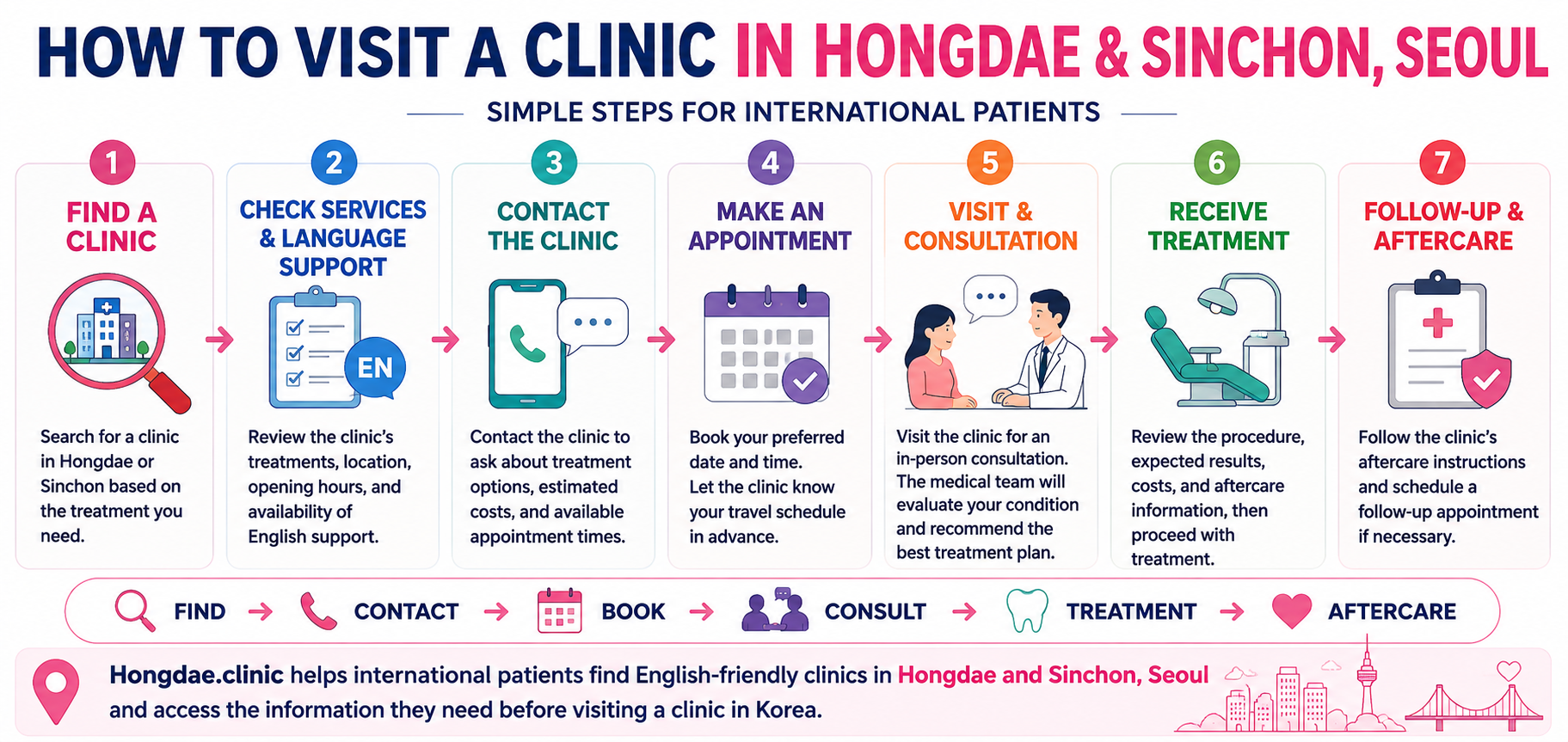
V-Line Surgery for International Patients
When contacting a plastic surgery clinic, consider asking:
- Is English consultation available?
- Do I need full V-Line Surgery or only chin/jaw contouring?
- Is my lower-face width caused by bone, muscle, or soft tissue?
- Which osteotomy technique is recommended?
- How much mandibular bone will be removed?
- How will my inferior alveolar and mental nerves be protected?
- Will my chin also be narrowed or repositioned?
- What is the risk of facial sagging?
- How long should I stay in Korea?
- Is postoperative follow-up included?
If you have previously undergone Jaw Reduction, Chin Reduction, Jaw Surgery, Zygoma Reduction, or previous V-Line Surgery, tell the surgeon because prior skeletal surgery can significantly affect planning.
Choosing a V-Line Surgery Clinic in Hongdae or Sinchon
Consider:
- Qualified plastic or maxillofacial surgeon
- Experience with mandibular and chin contouring
- Detailed CT and 3D skeletal assessment
- Inferior alveolar nerve mapping
- Customized jaw and chin osteotomy planning
- Conservative bone-removal strategy
- Attention to soft-tissue support
- Experience with revision facial contouring
- English communication
- Transparent surgery costs
V-Line Surgery should be treated as an individualized three-dimensional lower-face contouring operation, not a standardized procedure performed with the same amount of jaw and chin reduction in every patient.
Hongdae & Sinchon Medical Care
Hongdae is convenient for patients around:
Hongik University · Yeonnam-dong · Hapjeong · Sangsu · Mapo
Sinchon is convenient for patients around:
Yonsei University · Ewha Womans University · Seodaemun · Mapo
Common searches include:
- V-Line Surgery Hongdae
- V-Line Jaw Surgery Hongdae
- Mandibular Contouring Hongdae
- V-Line Surgery Sinchon
- Jaw and Chin Reduction Sinchon
- English speaking facial contouring clinic Sinchon
Frequently Asked Questions
What is V-Line Surgery?
V-Line Surgery is a lower-face contouring operation that may combine mandibular angle reduction, jawline contouring, and narrowing genioplasty to create a smoother and more tapered lower face.
Is V-Line Surgery the same as Jaw Reduction?
Not exactly. Jaw Reduction may focus mainly on the mandible, while V-Line Surgery commonly includes chin reshaping as part of the overall lower-face contour.
Do I always need both jaw and chin surgery?
No. Patients whose main concern is a broad chin may be suitable for mini V-line or isolated narrowing genioplasty, while others need treatment of both the chin and mandibular angles.
Can V-Line Surgery cause permanent numbness?
Yes. Temporary sensory disturbance is more common, but persistent numbness can occur if the inferior alveolar or mental nerve is injured.
Can foreigners get V-Line Surgery in Seoul?
Yes. International patients can contact plastic surgery or maxillofacial clinics in Seoul regarding CT assessment, customized surgical planning, recovery, postoperative monitoring, and English-language support.