Hongdae & Sinchon BPH Treatment
in Seoul, Korea
BPH treatment helps manage urinary symptoms caused by an enlarged prostate, such as frequent urination, weak flow, or difficulty emptying the bladder. Treatment may include medication, lifestyle management, or minimally invasive procedures depending on symptom severity. Patients seeking BPH treatment in Hongdae or Sinchon should consider prostate evaluation, treatment options, and personalized follow-up care.
If you experience weak urine flow, frequent urination, difficulty starting urination, or waking frequently at night to urinate, you may have benign prostatic hyperplasia (BPH). BPH is a non-cancerous enlargement of the prostate that becomes more common with age.
Hongdae and Sinchon are convenient areas for urology and prostate consultations in Seoul, especially for international residents, students, and long-term visitors.
What Is BPH?
Benign prostatic hyperplasia (BPH) occurs when the prostate becomes enlarged without being caused by cancer.
Because the prostate surrounds part of the urethra, enlargement can narrow the urinary passage and interfere with normal bladder emptying.
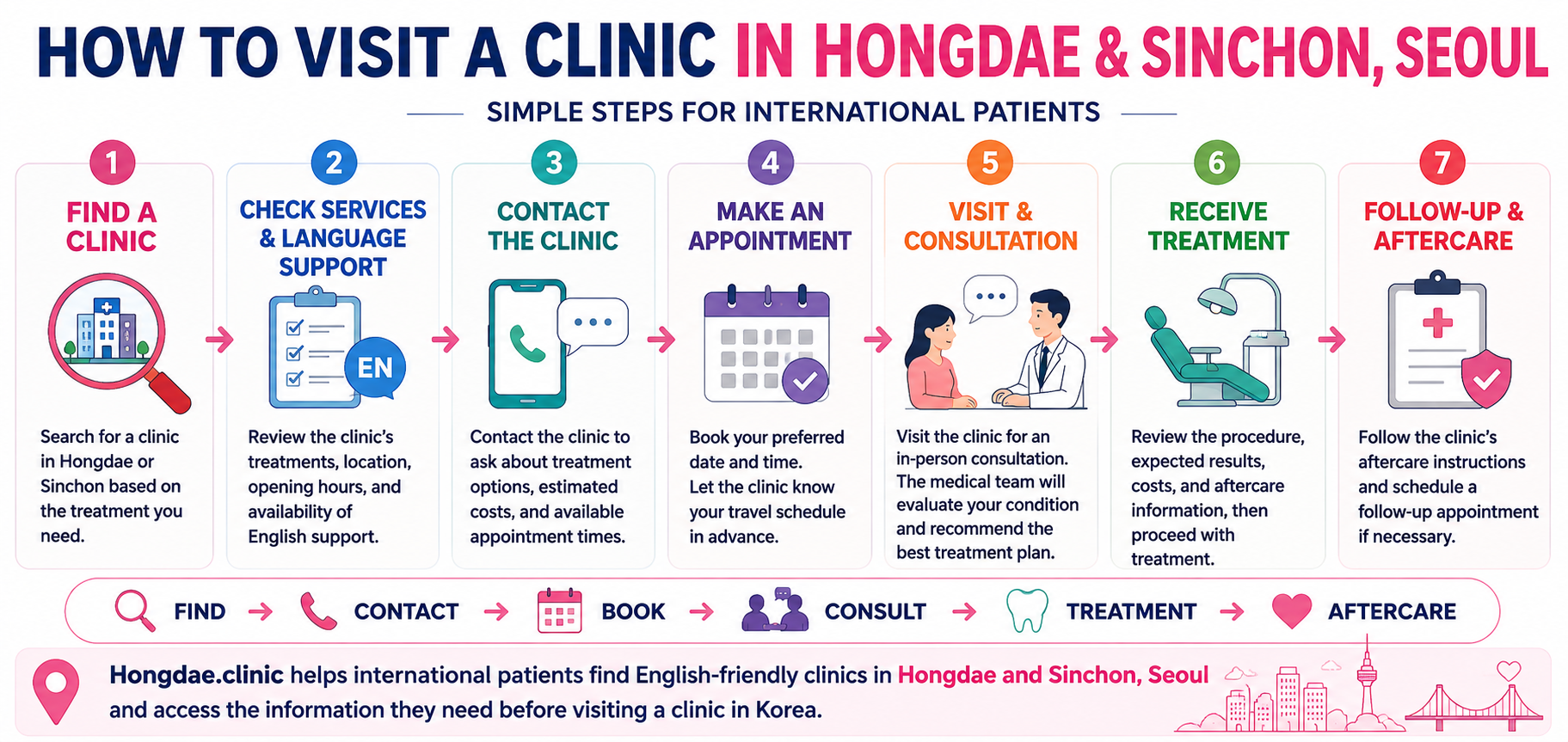
Consultation → urinary assessment → prostate evaluation → treatment selection → symptom monitoring → follow-up.
When Might You Need BPH Treatment?
A urology consultation may be appropriate if you experience:
- Weak or interrupted urine flow
- Difficulty starting urination
- Frequent urination
- Sudden urinary urgency
- Waking several times at night to urinate
- Dribbling after urination
- Feeling that the bladder does not empty completely
- Increasing difficulty urinating
BPH symptoms do not always correspond directly to prostate size, and similar symptoms can also occur with UTIs, prostatitis, bladder conditions, or prostate cancer.
How Is BPH Diagnosed?
A typical evaluation may include:
- Urology consultation
- Medical and urinary symptom history
- Medication review
- Physical examination
- Urinalysis
- PSA blood testing when appropriate
- Urinary flow or residual urine testing
- Ultrasound or additional testing when needed
More specialized tests such as cystoscopy or urodynamic testing may be considered depending on the patient's symptoms and treatment plan.
Common BPH Treatment Options
Lifestyle Changes & Monitoring
Patients with mild symptoms that do not significantly affect daily life may initially choose watchful waiting.
Reducing evening fluids, limiting caffeine and alcohol, remaining physically active, and reviewing medications that worsen urinary symptoms may help.
BPH Medication
Common medications include alpha blockers, which relax muscles around the prostate and bladder neck, and 5-alpha-reductase inhibitors, which can slow prostate growth or reduce prostate size.
PDE5 inhibitors may also improve urinary symptoms in selected patients.
Minimally Invasive Procedures
Selected patients may consider minimally invasive treatments designed to improve urine flow while avoiding more extensive surgery.
Options discussed in contemporary BPH guidance include prostatic urethral lift, water-vapor thermal therapy, temporary implanted prostatic devices, and prostate artery embolization in appropriately selected patients.
BPH Surgery
Surgery may be recommended when:
- Medication does not provide enough improvement
- Symptoms significantly affect quality of life
- Urinary retention develops
- Recurrent infections occur
- Bladder stones develop
- Kidney or bladder complications occur
Surgical options include transurethral resection of the prostate (TURP), laser procedures, prostate enucleation, and other prostate tissue-removing techniques.
TURP vs Laser BPH Treatment
TURP removes obstructing prostate tissue through the urethra using an endoscopic instrument.
Laser procedures may vaporize or enucleate enlarged prostate tissue. Modern BPH guidelines include laser techniques such as photoselective vaporization and laser enucleation among established procedural options.
The best approach depends on prostate size, anatomy, medication use, overall health, and treatment priorities.
Does BPH Affect Sexual Function?
BPH itself and some BPH treatments may affect sexual function.
Depending on the medication or procedure, possible effects can include:
- Ejaculatory changes
- Reduced semen volume
- Retrograde ejaculation
- Erectile changes
- Reduced libido with some medications
Patients concerned about preserving ejaculatory or erectile function should discuss this before choosing medication or surgery.
When Should You Seek Urgent Medical Care?
Seek prompt medical attention if you:
- Cannot urinate at all
- Have fever and chills with urinary symptoms
- Have significant blood in the urine
- Develop severe lower abdominal pain
- Have worsening urinary retention
Complete inability to urinate can represent acute urinary retention and requires urgent evaluation.
How Quickly Does BPH Treatment Work?
Results depend on the treatment selected.
Alpha blockers primarily improve urinary flow by relaxing prostate and bladder-neck muscles, while 5-alpha-reductase inhibitors work by reducing prostate growth and generally act more gradually.
Procedural treatments may provide more substantial improvement in urinary obstruction but involve different recovery periods and potential side effects.
BPH Treatment for International Patients
When contacting a urology clinic, consider asking:
- Is English consultation available?
- Do I need urine or PSA testing?
- How enlarged is my prostate?
- Which medication is recommended?
- Am I suitable for a minimally invasive procedure?
- Which surgical options are available?
- Could treatment affect ejaculation or erections?
- Is follow-up included?
Bring information about current medications, previous prostate tests, urinary symptoms, and previous PSA results if available.
Choosing a BPH Clinic in Hongdae or Sinchon
Consider:
- Qualified urologist
- Detailed urinary symptom assessment
- PSA and urine testing when appropriate
- Prostate size evaluation
- Medical and minimally invasive treatment options
- Discussion of sexual side effects
- English communication
- Transparent treatment costs
BPH treatment should be individualized according to symptom severity, prostate anatomy, risk of progression, overall health, and personal treatment priorities.
Hongdae & Sinchon Medical Care
Hongdae is convenient for patients around:
Hongik University · Yeonnam-dong · Hapjeong · Sangsu · Mapo
Sinchon is convenient for patients around:
Yonsei University · Ewha Womans University · Seodaemun · Mapo
Common searches include:
- BPH Treatment Hongdae
- Enlarged Prostate Treatment Hongdae
- Urology Clinic Hongdae
- BPH Treatment Sinchon
- Prostate Clinic Sinchon
- English speaking urology clinic Sinchon
Frequently Asked Questions
What is BPH?
BPH is a non-cancerous enlargement of the prostate that can narrow the urethra and cause urinary symptoms such as weak flow, frequency, urgency, and nighttime urination.
Can foreigners get BPH treatment in Seoul?
Yes. International patients can contact urology clinics in Seoul about prostate evaluation, medication, procedures, and English-language support.
Does BPH mean prostate cancer?
No. BPH is not prostate cancer, although some urinary symptoms can overlap with other prostate or urinary conditions, so proper evaluation is important.
Can BPH be treated without surgery?
Yes. Depending on symptom severity, treatment may include lifestyle changes, observation, alpha blockers, 5-alpha-reductase inhibitors, PDE5 inhibitors, or minimally invasive procedures.
When is surgery needed for BPH?
Surgery may be considered when symptoms remain severe despite medication or when complications such as
urinary retention, recurrent infections, bladder stones, or kidney problems occur.