Hongdae & Sinchon Eye Shape Correction
in Seoul, Korea
Eye shape correction includes procedures designed to improve eye symmetry, contour, and overall balance with surrounding facial features. Treatment may involve eyelid surgery, canthoplasty, ptosis correction, or other techniques based on individual anatomy and goals. Patients seeking eye shape correction in Hongdae or Sinchon should consider surgical approach, expected results, and recovery needs.
If you are concerned about narrow-looking eyes, prominent inner-eye folds, drooping outer corners, eyelid asymmetry, or the overall shape of your eyes, eye shape correction may be considered. The treatment should be customized according to eyelid anatomy, canthal position, eye spacing, eyelid function, and personal aesthetic goals.
Hongdae and Sinchon are convenient areas for plastic surgery consultations in Seoul, especially for international residents, students, and travelers.
What Is Eye Shape Correction?
Eye shape correction is a broad term rather than one standardized surgical procedure.
Depending on the patient's anatomy, it may involve epicanthoplasty, lateral canthoplasty, double eyelid surgery, ptosis correction, or other eyelid procedures designed to modify the visible proportions and contour around the eyes.
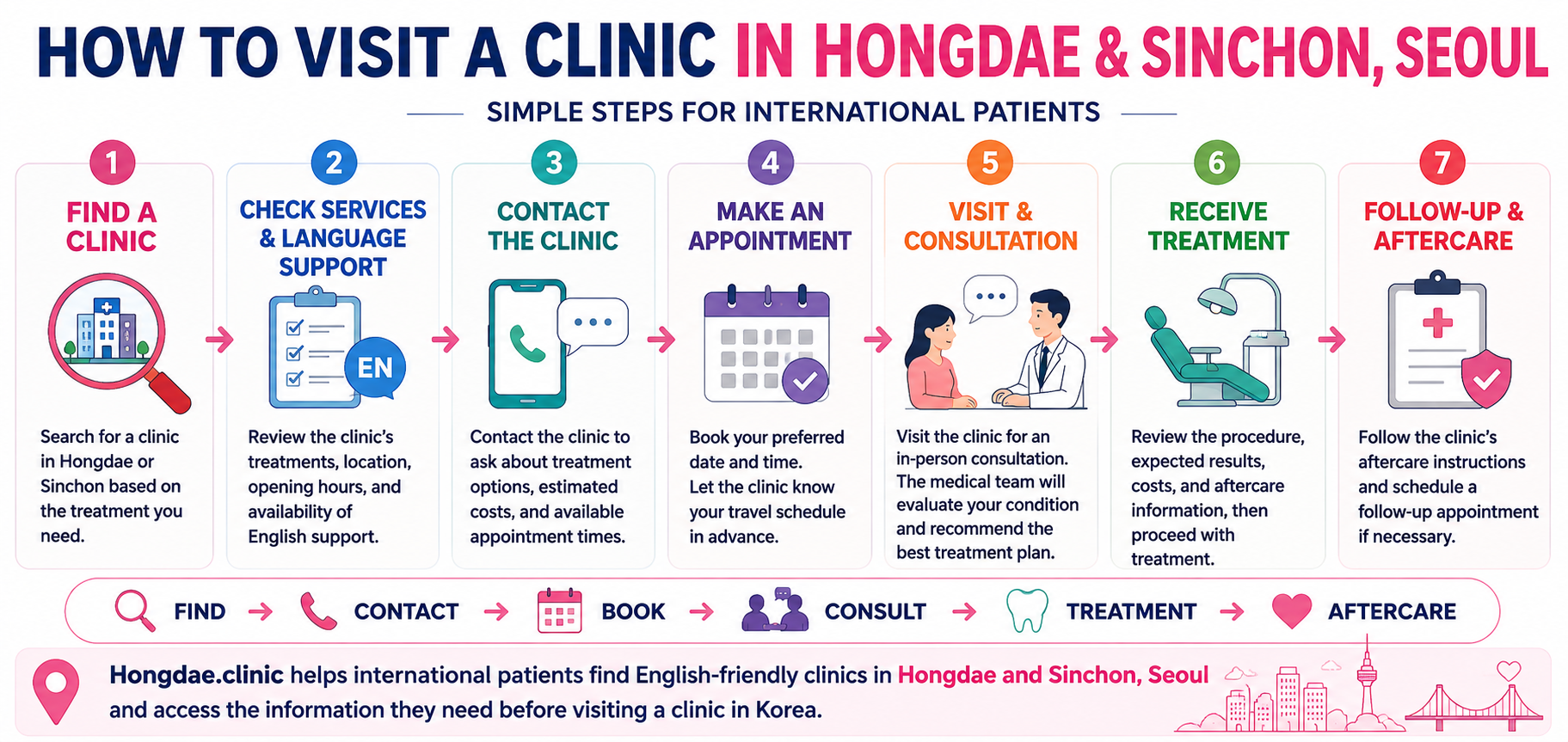
Consultation → eyelid assessment → surgical planning → customized correction → recovery → follow-up.
When Might You Consider Eye Shape Correction?
Treatment may be considered for:
- Prominent inner-eye folds
- Short-looking horizontal eye shape
- Drooping outer eye corners
- Eyelid asymmetry
- Poorly defined eyelid crease
- Heavy-looking upper eyelids
- Desire for a more open eye appearance
- Previous eyelid surgery concerns
The appropriate procedure depends on the specific anatomical reason for the eye shape concern, rather than using the same technique for every patient.
Common Eye Shape Correction Procedures
Epicanthoplasty
Medial epicanthoplasty reshapes the epicanthal fold around the inner corner of the eye and may increase the visible horizontal eye opening.
Lateral Canthoplasty
Lateral canthoplasty modifies the outer corner of the eye and may be used to adjust lateral eye shape or increase horizontal eyelid length in selected patients.
Double Eyelid Surgery
Upper eyelid surgery can create or modify an eyelid crease and may be combined with canthal procedures when broader eye-shape changes are desired.
Eye Shape Correction Treatment Process
A typical surgical process may include:
- Plastic surgery consultation
- Detailed eyelid and eye-shape assessment
- Evaluation of eyelid function
- Customized surgical design
- Selected eyelid or canthal procedure
- Careful wound closure
- Postoperative follow-up
Preoperative assessment is important because eyelid position, skin, muscle function, dry-eye symptoms, and lower-eyelid support can influence surgical planning.
Inner vs Outer Corner Eye Surgery
Inner corner surgery, or medial epicanthoplasty, primarily modifies the epicanthal fold near the nose.
Outer corner surgery, or lateral canthoplasty, modifies the lateral canthus at the outer side of the eye.
Some patients may benefit from one procedure, while others may consider a combination depending on existing eye shape and desired changes.
Can Eye Shape Correction Make the Eyes Look Bigger?
Selected procedures may make the eyes appear longer, more open, or differently proportioned, but they do not physically enlarge the eyeball.
For example, medial epicanthoplasty can expose more of the inner eye corner, while lateral canthoplasty can modify the outer canthal region and visible horizontal eyelid opening.
The achievable change depends on anatomy and should remain within safe functional limits.
Eye Shape Correction vs Double Eyelid Surgery
Double eyelid surgery primarily changes the upper eyelid crease, while eye shape correction can include procedures affecting the inner corner, outer corner, eyelid position, or overall visible eye contour.
The procedures are often combined in Asian eyelid surgery when both crease formation and epicanthal-fold correction are desired.
Canthoplasty vs Canthopexy
Both procedures involve the outer eye region, but they are not identical.
Canthoplasty generally involves surgical modification of the lateral canthal structures, while canthopexy primarily supports or repositions the existing lateral canthus without the same degree of reconstruction.
The appropriate procedure depends on eyelid anatomy, support, laxity, and aesthetic goals.
Eye Shape Correction for Asian Eyes
Asian eyelid anatomy varies significantly between individuals, particularly in the epicanthal fold, eyelid crease, soft-tissue thickness, and canthal shape.
For this reason, treatment may involve different combinations of:
- Epicanthoplasty
- Double eyelid surgery
- Lateral canthoplasty
- Ptosis correction
- Other customized eyelid procedures
The goal should be to improve proportion while preserving natural eyelid function and individual facial characteristics.
Does Eye Shape Correction Leave Scars?
Scarring depends on the procedure performed.
Epicanthoplasty can create scars around the inner eye corner, while some lateral canthoplasty techniques involve incisions around the outer canthus. Surgical techniques are designed to reduce visible scarring, but scars cannot always be completely avoided.
Scar appearance varies according to:
- Surgical technique
- Skin characteristics
- Wound tension
- Individual healing
- Postoperative scar care
When Do Results Appear?
Eye-shape changes are visible after surgery, but swelling, bruising, and temporary asymmetry can affect the early appearance.
The result gradually becomes more natural as swelling decreases and incision lines mature.
Because delicate eyelid tissues heal over time, the final appearance should not be judged immediately after surgery.
What Is Recovery Like?
Temporary postoperative symptoms may include:
- Swelling
- Bruising
- Redness
- Tenderness
- Temporary tightness
- Watery or irritated eyes
- Mild asymmetry during healing
Patients should follow their surgeon's instructions regarding wound care, contact lenses, eye makeup, exercise, and sun exposure. Eyelid surgery can also aggravate dry-eye symptoms in susceptible patients, making preoperative evaluation important.
Possible Risks and Complications
Potential complications depend on the procedure and may include:
- Visible scarring
- Asymmetry
- Under- or over-correction
- Dry-eye symptoms
- Difficulty closing the eyelids
- Lower-eyelid malposition
- Unnatural canthal shape
- Recurrence
- Need for revision surgery
Failed lateral canthoplasty can result in lateral canthal deformity or lower-eyelid instability, which may require reconstructive treatment.
Can Eye Shape Correction Look Natural?
Yes. Natural-looking results generally depend on conservative correction, appropriate eyelid support, and maintaining harmony between the inner corner, outer corner, eyelid crease, and surrounding facial features.
Research on Asian eyelid surgery emphasizes individualized evaluation of the epicanthal fold and surrounding eyelid anatomy rather than applying one standardized design.
Eye Shape Correction for International Patients
When contacting a plastic surgery clinic, consider asking:
- Is English consultation available?
- Which part of my eye shape should be corrected?
- Is epicanthoplasty recommended?
- Do I need lateral canthoplasty?
- Should double eyelid or ptosis surgery be combined?
- Where will the incisions be located?
- How long should I stay in Korea?
- Is postoperative follow-up included?
If you are visiting Korea temporarily, discuss the timing of suture removal, wound checks, and early postoperative follow-up before departure.
Choosing an Eye Shape Correction Clinic in Hongdae or Sinchon
Consider:
- Qualified plastic surgeon
- Detailed eyelid and canthal assessment
- Experience with Asian eyelid surgery
- Customized surgical design
- Evaluation of eyelid function and support
- Conservative correction
- Clear discussion of scarring and complications
- English communication
- Transparent surgery costs
Because “eye shape correction” may refer to several different operations, confirm the exact procedure and surgical goal rather than comparing clinics based only on the treatment name.
Hongdae & Sinchon Medical Care
Hongdae is convenient for patients around:
Hongik University · Yeonnam-dong · Hapjeong · Sangsu · Mapo
Sinchon is convenient for patients around:
Yonsei University · Ewha Womans University · Seodaemun · Mapo
Common searches include:
- Eye Shape Correction Hongdae
- Eye Corner Surgery Hongdae
- Canthoplasty Hongdae
- Eye Shape Correction Sinchon
- Epicanthoplasty Sinchon
- English speaking plastic surgery clinic Sinchon
Frequently Asked Questions
What is eye shape correction?
Eye shape correction is a broad term for procedures that modify the inner corner, outer corner, eyelid crease, or overall visible contour of the eyes.
Can foreigners get eye shape correction in Seoul?
Yes. International patients can contact plastic surgery clinics in Seoul regarding consultation, surgical planning, recovery, and English-language support.
Is eye shape correction the same as double eyelid surgery?
No. Double eyelid surgery primarily modifies the upper eyelid crease, while eye shape correction may also include epicanthoplasty, lateral canthoplasty, or other procedures.
Can eye shape correction make my eyes look longer?
In selected patients, medial or lateral canthal procedures can increase the visible horizontal eye opening, although the degree of change depends on anatomy.
Does eye shape correction leave scars?
Scarring is possible, particularly around the inner or outer corners. Modern techniques aim to make scars less visible while preserving a natural canthal shape, but individual healing varies.