Hongdae & Sinchon Under Eye Fat Repositioning
in Seoul, Korea
Under eye fat repositioning is a procedure designed to improve under-eye bags and hollow areas for a smoother, more refreshed appearance. Treatment redistributes existing fat to create a more even transition between the lower eyelid and cheek.
Patients seeking
under eye fat repositioning in Hongdae or Sinchon should consider eye anatomy, surgical approach, and recovery needs.
If you are concerned about under-eye bags, tear troughs, or a tired-looking transition between the lower eyelid and cheek, under-eye fat repositioning may be considered. Instead of simply removing protruding orbital fat, the procedure redistributes existing fat to create a smoother lower eyelid–cheek contour.
Hongdae and Sinchon are convenient areas for plastic surgery consultations in Seoul, especially for international residents, students, and travelers.
What Is Under Eye Fat Repositioning?
Under Eye Fat Repositioning, also called lower eyelid fat repositioning, is a surgical procedure that moves existing orbital fat from prominent under-eye bags into areas such as the tear trough or lid-cheek junction.
A common approach is transconjunctival lower blepharoplasty, where the incision is placed inside the lower eyelid rather than through the external skin.
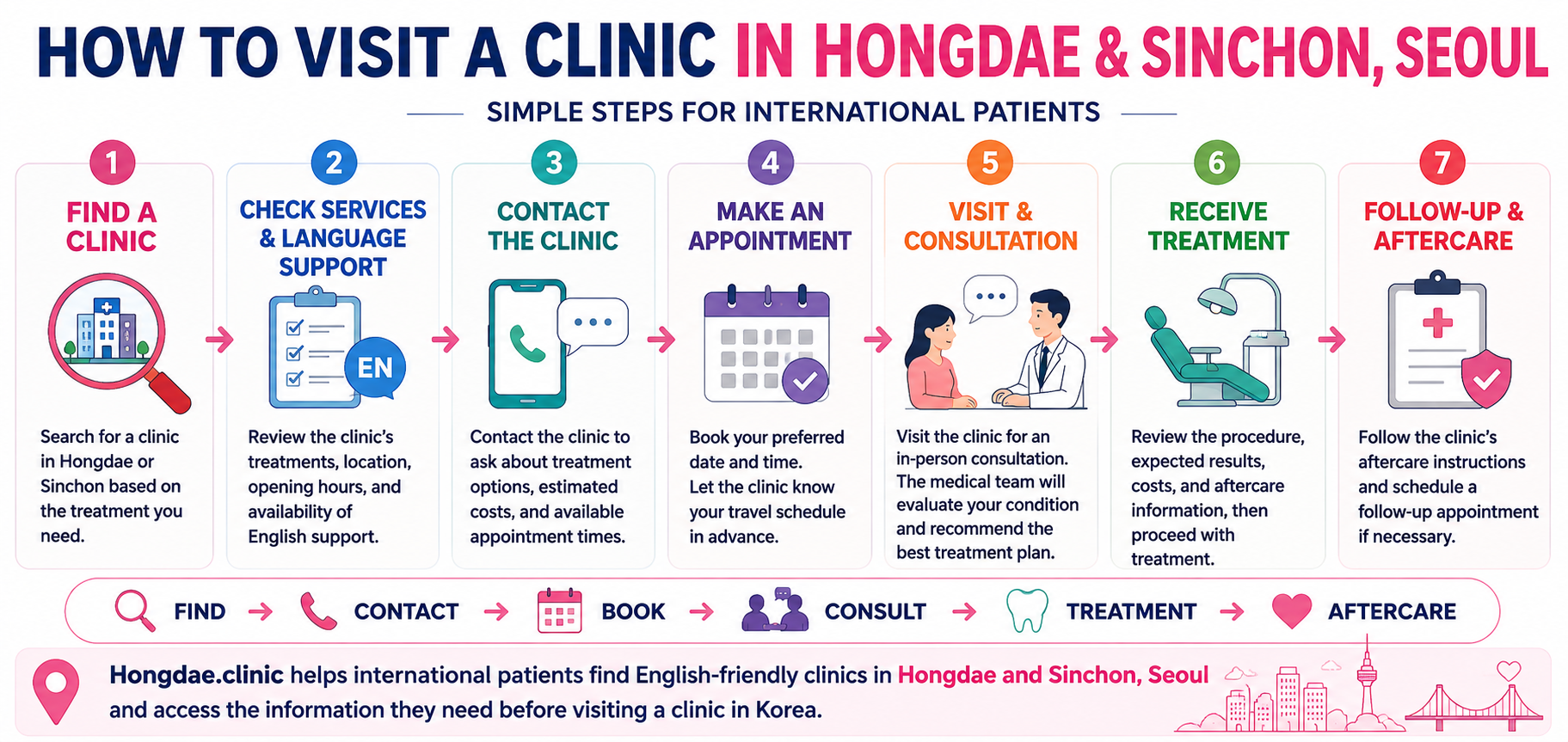
Consultation → under-eye assessment → surgical planning → fat repositioning → recovery → follow-up.
When Might You Consider Under Eye Fat Repositioning?
The procedure may be considered for:
- Under-eye bags
- Tear trough hollows
- Bulging lower-eyelid fat
- Uneven lower eyelid–cheek transition
- Tired-looking under-eye appearance
- Mild under-eye asymmetry
- Patients who want to preserve rather than simply remove orbital fat
Fat repositioning has been studied specifically for patients with lower-eyelid fat prolapse and tear trough deformity.
Common Under Eye Concerns
Under-Eye Bags
Protruding orbital fat can create visible fullness beneath the eyes.
Rather than removing all of this fat, repositioning can redistribute selected fat to improve the contour below the eyelid.
Tear Troughs
The tear trough is the groove extending from the inner lower eyelid toward the cheek.
Fat repositioning can help fill this depression using the patient's existing orbital fat.
Lid-Cheek Junction
A pronounced transition between the lower eyelid and cheek can contribute to an aged or tired appearance. Fat repositioning aims to create a smoother transition across this area.
Under Eye Fat Repositioning Process
A typical surgical process may include:
- Plastic surgery consultation
- Detailed lower-eyelid assessment
- Evaluation of fat prolapse and tear trough depth
- Transconjunctival or other surgical approach
- Release and repositioning of orbital fat
- Fixation of repositioned tissue when required
- Postoperative follow-up
Different techniques place the repositioned fat in subperiosteal or supraperiosteal tissue planes, depending on the surgeon's approach and the patient's anatomy.
Fat Repositioning vs Fat Removal
Traditional lower blepharoplasty may remove protruding orbital fat.
Fat repositioning preserves and redistributes existing fat, helping address both the under-eye bag and nearby tear trough rather than simply reducing fullness. Excessive fat removal can contribute to a hollow lower-eyelid appearance in some patients.
The most appropriate technique depends on the amount and position of orbital fat and the surrounding facial anatomy.
Fat Repositioning vs Fat Grafting
Fat repositioning uses existing orbital fat, while fat grafting transfers fat harvested from another part of the body.
A recent randomized comparative study evaluated both approaches for tear trough correction and found both techniques useful, although they differ in surgical method and tissue source.
Some patients may require one technique or a combination depending on their under-eye anatomy.
Is a Skin Incision Required?
Not always.
A commonly used technique is transconjunctival fat repositioning, where the surgical incision is made through the inside of the lower eyelid. This avoids a routine external lower-eyelid skin incision.
However, patients with significant excess or loose lower-eyelid skin may require additional skin treatment or a different surgical approach.
Can Younger Patients Have Fat Repositioning?
Yes, under-eye bags and tear trough deformities can occur even in younger adults.
A 2025 prospective randomized study specifically noted that lower-eyelid fat prolapse and tear trough deformity are increasingly treated in younger patients using transconjunctival techniques.
Age alone does not determine suitability; fat distribution, skin laxity, tear trough anatomy, and eyelid support are more important factors.
When Do Results Appear?
Initial changes are visible after surgery, but swelling can temporarily affect the contour of the under-eye area.
A 2026 study of transconjunctival fat repositioning found that postoperative soft-tissue swelling was greatest early in recovery and gradually decreased over time, with outcomes assessed at six months.
The final result should therefore be evaluated after adequate healing rather than immediately after surgery.
What Is Recovery Like?
Temporary postoperative symptoms may include:
- Swelling
- Bruising
- Tenderness
- Temporary tightness
- Conjunctival redness
- Dry-eye symptoms
- Mild asymmetry during healing
Published studies of fat repositioning have reported temporary complications including conjunctival bleeding, dry eye, numbness, localized depression, and localized bulging in some patients.
Possible Risks and Complications
Potential complications may include:
- Bleeding
- Infection
- Persistent swelling
- Under-correction
- Over-correction
- Irregular under-eye contour
- Fat bulging or depression
- Dry-eye symptoms
- Lower-eyelid asymmetry
- Need for revision surgery
A systematic review including 4,671 patients across 33 studies evaluated complications associated with lower-eyelid fat grafting and fat repositioning, confirming that these procedures can have postoperative complications despite generally favorable aesthetic outcomes.
Can Fat Repositioning Treat Tear Troughs Without Large Eye Bags?
In selected patients, yes.
A study involving 232 patients found that transconjunctival fat repositioning could improve tear trough deformities even in patients with minimal or no obvious excess orbital fat, provided that adequate fat was available for repositioning.
Proper examination is therefore more important than simply judging the amount of visible under-eye bulging.
Can Under Eye Fat Repositioning Look Natural?
Yes. The procedure is designed to create a smoother transition between the lower eyelid and cheek while preserving useful orbital fat.
Clinical studies have reported high levels of improvement and patient satisfaction after appropriately selected fat-repositioning procedures.
Natural results depend on conservative fat redistribution and accurate assessment of the tear trough and surrounding anatomy.
Under Eye Fat Repositioning for International Patients
When contacting a plastic surgery clinic, consider asking:
- Is English consultation available?
- Do I have fat prolapse, tear troughs, or both?
- Is transconjunctival surgery suitable for me?
- Will fat be repositioned or removed?
- Do I also need skin removal or tightening?
- What downtime should I expect?
- How long should I stay in Korea?
- Is postoperative follow-up included?
If you have previously received under-eye filler, fat grafting, lower blepharoplasty, or other eyelid surgery, tell the surgeon before treatment because previous procedures can affect surgical planning.
Choosing an Under Eye Fat Repositioning Clinic in Hongdae or Sinchon
Consider:
- Qualified plastic surgeon
- Detailed lower-eyelid assessment
- Experience with transconjunctival fat repositioning
- Evaluation of tear trough anatomy
- Conservative fat preservation
- Assessment of lower-eyelid skin and support
- Clear discussion of possible complications
- English communication
- Transparent surgery costs
Research supports tailoring the procedure according to fat prolapse, tear trough depth, skin laxity, and individual lower-eyelid anatomy rather than applying the same surgical technique to every patient.
Hongdae & Sinchon Medical Care
Hongdae is convenient for patients around:
Hongik University · Yeonnam-dong · Hapjeong · Sangsu · Mapo
Sinchon is convenient for patients around:
Yonsei University · Ewha Womans University · Seodaemun · Mapo
Common searches include:
- Under Eye Fat Repositioning Hongdae
- Under Eye Bag Surgery Hongdae
- Tear Trough Surgery Hongdae
- Under Eye Fat Repositioning Sinchon
- Lower Blepharoplasty Sinchon
- English speaking plastic surgery clinic Sinchon
Frequently Asked Questions
What is under eye fat repositioning?
It is a lower-eyelid procedure that moves existing orbital fat into nearby hollow areas such as the tear trough, helping smooth the transition between the lower eyelid and cheek.
Can foreigners get under eye fat repositioning in Seoul?
Yes. International patients can contact plastic surgery clinics in Seoul regarding consultation, surgical planning, recovery, and English-language support.
Is fat repositioning the same as removing eye bags?
Not exactly. Traditional surgery may remove excess orbital fat, while fat repositioning preserves and redistributes fat to address both bulging and nearby hollowness.
Does under eye fat repositioning leave a visible scar?
A transconjunctival approach uses an incision inside the lower eyelid, so it avoids a routine external skin incision.
Can fat repositioning improve tear troughs?
Yes. Multiple clinical studies have reported improvement in
tear trough deformity and lower-eyelid contour following orbital fat repositioning.